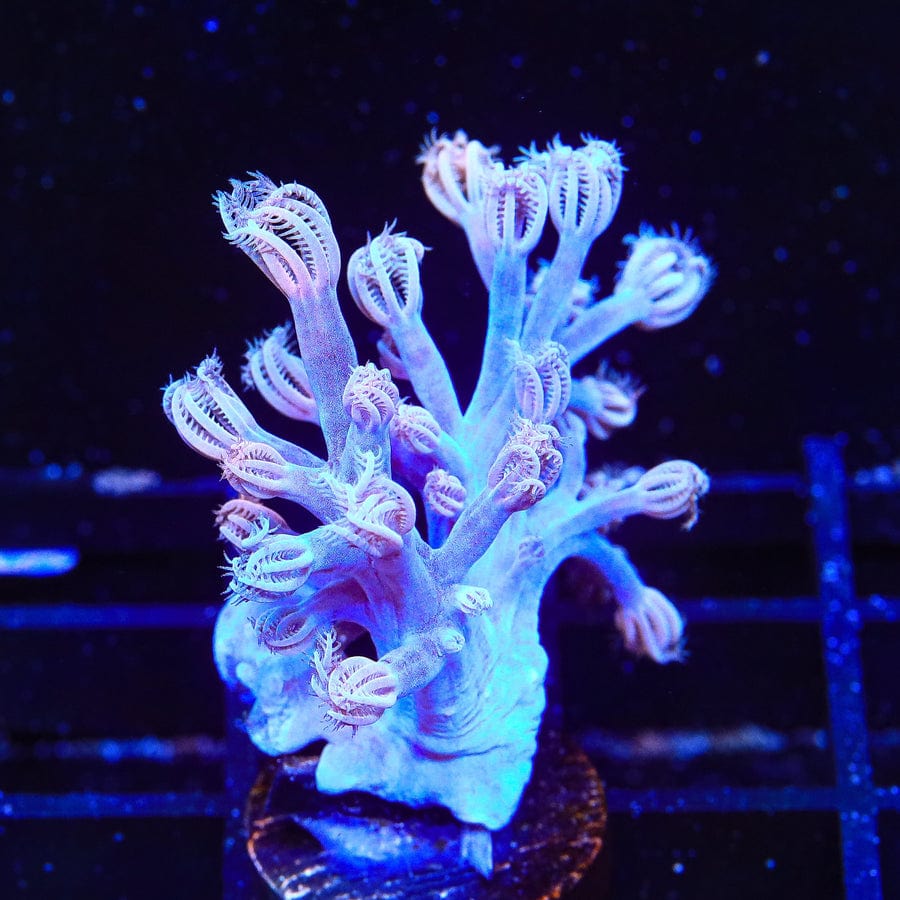
Xenia Corals

5 Xenia corals for sale, including Pulsing Xenia, Anthelia and Cespitularia
Shop aquacultured Xenia corals for sale, including rhythmic pulsing Xenia, waving Anthelia, and shimmering blue-green Cespitularia. These fast-growing soft corals are among the easiest and most hypnotic animals you can add to a reef tank, settling in under ... Read more Show less

Shop aquacultured Xenia corals for sale, including rhythmic pulsing Xenia, waving Anthelia, and shimmering blue-green Cespitularia. These fast-growing soft corals are among the easiest and most hypnotic animals you can add to a reef tank, settling in under moderate light and moderate flow. Xeniidae corals also spread quickly, so give them an isolated rock and plan for the colony rather than the frag. Every frag here is grown in our own systems and ships with a live arrival guarantee.

Skip to results list

Filters

5 items
Column grid

Active filters:

Column grid
Filter

Active filters:

  • Waving Hand Anthelia Coral

    Waving Hand Anthelia Coral

    Sale price  $29.99 Regular price $39.99

    Almost WYSIWYG

    Care Level Easy
    Lighting Moderate
    Flow Moderate
    Placement Low–Mid
  • Vargas Cespitularia Coral

    Vargas Cespitularia Coral

    Sale price  $49.99 Regular price $79.99

    Almost WYSIWYG

    Care Level Moderate
    Lighting Moderate–High
    Flow Moderate, indirect
    Placement Mid–High
  • Giant Bali Xenia Coral

    Giant Bali Xenia Coral

    Sale price  $99.99 Regular price $129.99

    Almost WYSIWYG

    Care Level Easy
    Lighting Moderate
    Flow Moderate
    Placement Low–Mid
  • Vargas Cespitularia Coral

    Vargas Cespitularia Coral

    Sale price  $54.99 Regular price $89.99

    Signature Coral

    Care Level Moderate
    Lighting Moderate–High
    Flow Moderate, indirect
    Placement Mid–High
  • Waving Hand Anthelia Coral

    Waving Hand Anthelia Coral

    Sale price  $34.99 Regular price $44.99

    Signature Coral

    Care Level Easy
    Lighting Moderate
    Flow Moderate
    Placement Low–Mid

Popular live coral picks

Compare Xenia, Anthelia & Cespitularia

Compare our most popular live corals by care level, lighting, flow, growth, placement, and temperament — from beginner-friendly softies to advanced SPS.

Answers

Xenia Coral Care FAQ

Why do Xenia corals pulse?

Pulsing Xenia open and close their polyps in a steady rhythm, and unlike most coral movement this is driven by the coral itself rather than the current. Research points to the motion improving photosynthesis: contracting the polyps sweeps oxygen away from the tissue and thins the boundary layer of still water around it, letting the symbiotic algae work more efficiently. Pulsing usually slows or stops when the coral is newly shipped, unsettled, or unhappy with flow, light, or water chemistry, so a colony that stops pulsing for more than a few days is worth investigating.

Are Xenia corals easy to keep?

Xenia are widely considered beginner corals because they tolerate a broad range of light, flow, and nutrient levels and never need target feeding. They are photosynthetic and pull dissolved organics straight from the water. The catch is that they dislike very clean water: colonies often struggle in ultra-low-nutrient systems where nitrate and phosphate are stripped to near zero. Xenia also has a reputation for melting without warning after a sharp parameter swing, so stability matters more than any single target number.

How fast do Xenia corals spread?

Very fast. In a stable tank a single frag can cover a rock in a few months, spreading by walking its base outward and dropping small daughter colonies that settle nearby. That growth rate is exactly why Xenia is popular for filling space quickly and exactly why experienced reefers are cautious with it. Plan placement with the mature colony in mind, and remove runners early rather than after they reach corals you care about.

Where should I place Xenia in a reef tank?

Most keepers put Xenia on an isolated rock, an island, or a raised ledge separated from the main aquascape by open sand, which limits how far it can walk. Moderate light and moderate, indirect flow suit it well; too much direct flow keeps the polyps folded shut and too little leaves detritus sitting on the colony. Mid to upper placement generally produces the strongest pulsing. Give surrounding stony corals a few inches of clearance, since Xenia competes chemically as it advances.

What is the difference between Xenia, Anthelia, and Cespitularia?

All three belong to the family Xeniidae and share the same easy, fast-growing character. Xenia grows a distinct stalk topped with a crown of polyps and is the genus famous for pulsing. Anthelia sends its polyps straight up from an encrusting mat with no real stalk, and it waves rather than pulses; it also cannot retract its polyps the way Xenia can. Cespitularia forms bushy, tree-like branches in striking blue and green iridescence and is the most demanding of the three, wanting cleaner water and more stable conditions.

Live coral buying guide

How to Choose Live Corals for Your Reef Aquarium

What are Xenia corals?

Xenia corals are soft corals in the family Xeniidae, a group of octocorals defined by eight feathery tentacles on every polyp and a soft, fleshy body with no stony skeleton. The family covers several genera kept in the hobby, including Xenia, Anthelia, and Cespitularia. All of them are photosynthetic, all grow quickly, and all are counted among the most forgiving soft corals you can put in a reef tank.

Xenia, Anthelia, and Cespitularia compared

The three genera in this collection look similar at a glance but grow in distinctly different ways:

  • Xenia — a clear stalk topped by a crown of polyps, and the genus known for rhythmic pulsing. Pulsing Xenia is the classic; Giant Bali Xenia grows larger polyps on a heavier trunk.
  • Anthelia — polyps rise directly from an encrusting mat with no stalk, waving in the current instead of pulsing. Unlike Xenia it cannot pull its polyps back into a stalk, so it always looks open.
  • Cespitularia — bushy, branching growth with blue and green iridescence that stands out under actinic light. The most delicate of the three, and the one that rewards clean, stable water.

Xenia coral care: light, flow, and nutrients

Xeniidae corals settle in under moderate light and moderate, indirect flow. Too much direct current holds the polyps closed and too little lets detritus collect on the colony. Compare your reef lighting and keep salinity, alkalinity, calcium, and magnesium steady with dependable water testing equipment. Unusually for corals, Xenia often does worse in pristine water than in a tank carrying some nitrate and phosphate, so resist stripping nutrients to zero. They are fully photosynthetic and absorb dissolved organics directly, which means no target feeding is required.

Keeping Xenia contained in a mixed reef

The single most common regret with Xenia is underestimating how far it travels. A colony spreads by walking its base across rock and seeding small daughter colonies downstream, and once it reaches the main aquascape it is tedious to remove. Start it on an isolated island rock surrounded by open sand, prune runners as soon as they appear, and keep a few inches of clearance from stony corals, which lose ground to Xeniidae in a chemical standoff. Scraping the base off rock and siphoning the fragments out during a water change is the simplest control method.

Building a soft coral reef

Xenia pairs naturally with other fast, forgiving softies. Browse the full range of live corals for sale, add hardy companions from our beginner corals selection, or assemble a coordinated mix with a soft coral pack. If you are still deciding which coral group suits your tank, start with our beginner’s guide to soft, LPS, and SPS corals.