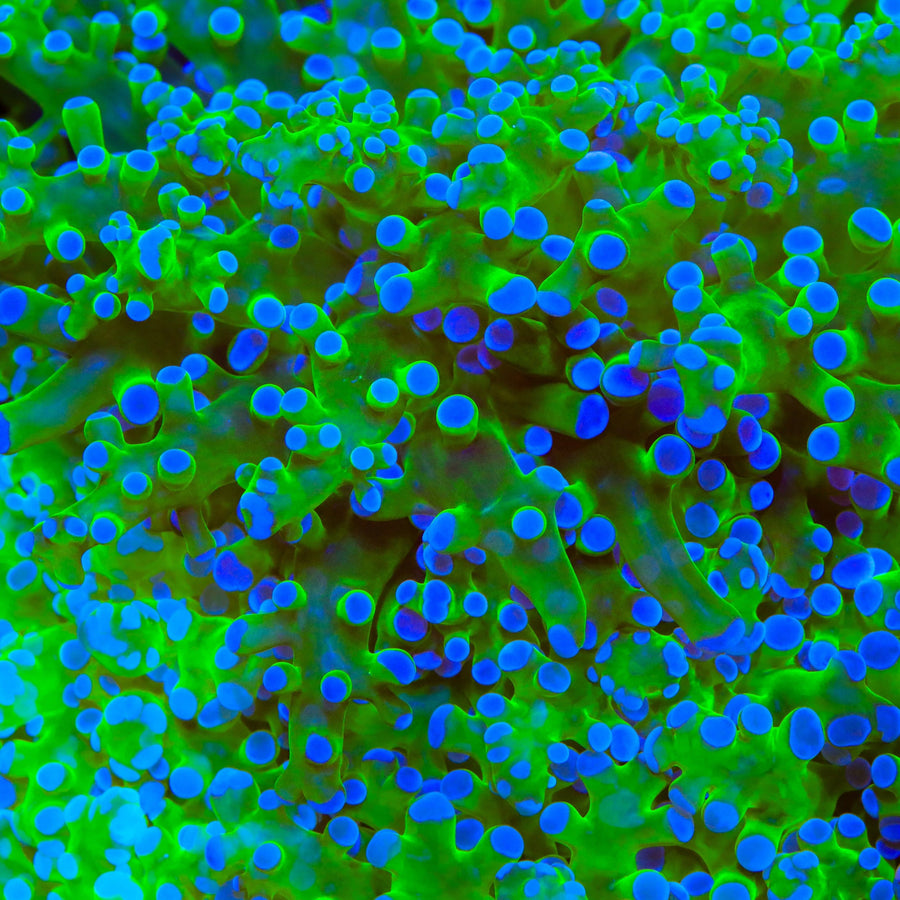
Frogspawn Corals

9 frogspawn corals for sale, including bicolor, pink, blue tip and octospawn
Shop aquacultured frogspawn coral for sale, from classic green and pink colonies to bicolor, blue tip, and octospawn morphs. Frogspawn (Euphyllia divisa and Euphyllia paradivisa) carries long tentacles tipped with rounded, branched knobs that cluster like c... Read more Show less

Shop aquacultured frogspawn coral for sale, from classic green and pink colonies to bicolor, blue tip, and octospawn morphs. Frogspawn (Euphyllia divisa and Euphyllia paradivisa) carries long tentacles tipped with rounded, branched knobs that cluster like clumps of frog eggs, and the whole colony sways constantly in gentle flow. It is one of the hardiest Euphyllia corals and a reliable step up from soft corals. Every frogspawn frag here is grown in our own systems and ships with a live arrival guarantee.

Skip to results list
Filters
9 items
Column grid
Column grid
Filter

Active filters:

  • Bicolor Frogspawn Coral

    Bicolor Frogspawn Coral

    Sale price  $99.99 Regular price $174.99

    Signature Coral

    Care Level Moderate
    Lighting Moderate
    Flow Moderate, indirect
    Placement Mid–Low
  • Yellow Octospawn Coral

    Yellow Octospawn Coral

    Sale price  $89.99 Regular price $199.99

    Almost WYSIWYG

    Care Level Moderate
    Lighting Moderate
    Flow Moderate
    Placement Low–Mid
  • Green Octospawn Coral

    Green Octospawn Coral

    Sale price  $89.99 Regular price $179.99

    Almost WYSIWYG

  • Pink Frogspawn Coral

    Pink Frogspawn Coral

    Sale price  $79.99 Regular price $179.99

    Signature Coral

    Care Level Moderate
    Lighting Moderate
    Flow Moderate indirect
    Placement Mid–Low
  • Gold Center Frogspawn Coral

    Gold Center Frogspawn Coral

    Sale price  $89.99 Regular price $199.99

    Almost WYSIWYG

    Care Level Moderate
    Lighting Moderate
    Flow Moderate, indirect
    Placement Mid–Low
  • Pink Frogspawn Coral

    Pink Frogspawn Coral

    Sale price  $79.99 Regular price $179.99

    Almost WYSIWYG

    Care Level Moderate
    Lighting Moderate
    Flow Moderate indirect
    Placement Mid–Low
  • Bicolor Frogspawn Coral

    Bicolor Frogspawn Coral

    Sale price  $89.99 Regular price $149.99

    Almost WYSIWYG

    Care Level Moderate
    Lighting Moderate
    Flow Moderate, indirect
    Placement Mid–Low
  • Bicolor Frogspawn Wall Coral

    Bicolor Frogspawn Wall Coral

    Sale price  $199.99 Regular price $274.99

    WYSIWYG

  • Pink Frogspawn Wall Coral

    Pink Frogspawn Wall Coral

    Sale price  $199.99 Regular price $274.99

    WYSIWYG

Popular live coral picks

Compare Frogspawn Corals

Compare our most popular live corals by care level, lighting, flow, growth, placement, and temperament — from beginner-friendly softies to advanced SPS.

Answers

Frogspawn Coral Care FAQ

Is frogspawn coral easy to keep?

Frogspawn is one of the easier large polyp stony corals and a common first Euphyllia. It wants moderate light, gentle to moderate flow, and stable alkalinity, calcium, and salinity. The main requirements are a matured tank rather than a freshly cycled one, and enough space that nothing stings it. Frogspawn is generally considered hardier than torch coral and roughly on par with hammer, so it is a sensible entry point into the genus.

Where should I place frogspawn coral?

Middle to lower rockwork with moderate light and gentle, indirect flow suits frogspawn well. You want enough current to keep the tentacles drifting and swaying without pinning them back against the skeleton, which stresses the tissue and can cause recession. Mount it so the heads have room to hang and expand, and remember the colony will roughly double its footprint as new heads branch outward.

What is the difference between frogspawn and hammer coral?

Look at the tentacle tips. Frogspawn tips are rounded and often branched into small clusters that resemble clumps of frog eggs, while hammer coral tips are flattened and T-shaped or kidney-shaped like the head of a hammer or anchor. Both are Euphyllia, both come in wall and branching skeletal forms, and their care is effectively identical. Torch coral, the third common Euphyllia, has long straight tentacles with a single rounded tip and no branching.

Will frogspawn sting other corals?

Yes. Frogspawn extends sweeper tentacles that reach several inches, particularly at night, and it will damage most neighbors it can touch. Allow at least six inches of clearance from non-Euphyllia corals. Different Euphyllia species can also sting one another, so while many reefers do grow hammer, torch, and frogspawn together in a Euphyllia garden, it is safest to keep a few inches between species and let them grow into contact slowly rather than placing them touching.

Should I feed frogspawn coral?

Feeding is optional but beneficial. Frogspawn is photosynthetic and will grow on light alone, but small meaty foods such as mysis or prepared LPS blends once or twice a week noticeably speed up head production. Feed when the tentacles are fully extended, keep portions small, and target the food onto individual heads rather than broadcasting it across the tank.

Live coral buying guide

What is frogspawn coral?

Frogspawn is a large polyp stony coral in the genus Euphyllia, covering Euphyllia divisa in its wall form and Euphyllia paradivisa in its branching form. The name comes from the tentacle tips, which swell into rounded, often forked knobs that cluster together like a mass of frog eggs. A healthy colony is in constant motion, and it is that movement, rather than raw color, that makes frogspawn a mainstay of the Euphyllia group.

Frogspawn, octospawn, and color morphs

Frogspawn is sorted by skeletal form and by tip color:

  • Branching frogspawn — individual heads on separate stalks, which makes the colony easy to frag and lets it spread into an open, airy shape. The most common form in the hobby.
  • Wall frogspawn — a continuous fused skeleton with a meandering ridge of tentacles. Slower to propagate but dense and dramatic at size.
  • Octospawn — fewer, larger, more heavily branched tips than standard frogspawn, giving a chunkier look. Often sold in gold, yellow, and green.
  • Color morphs — green remains the classic, with pink, gold, orange, purple, and blue-tip lineages carrying a premium for tip contrast.

Frogspawn coral care: light, flow, and stability

Moderate light and gentle, indirect flow are the targets. Too much current holds the tentacles closed and can abrade the tissue at the skeletal edge, while too little allows detritus to settle between the heads. Because frogspawn is continuously laying down skeleton, alkalinity and calcium stability matter more than peak numbers: track them with dependable water testing equipment and review your reef lighting before moving a colony higher in the tank. Feed small meaty foods once or twice a week to accelerate branching.

Brown jelly and what to watch for

The failure mode Euphyllia keepers worry about is brown jelly, a fast-moving infection that appears as a brown, mucus-like mass consuming tissue and can strip a colony within days. It usually follows physical damage, a sting from a neighbor, or a sharp parameter swing. Catching it early matters: siphon the affected material out immediately, cut away the infected head if the colony is branching, and improve flow around the remaining heads. Stable parameters and generous spacing prevent most cases.

Building a Euphyllia garden

Frogspawn, hammer, and torch grown together on the same shelf create the classic Euphyllia garden, a wall of constant motion that no other coral group matches. Compare hammer corals and torch corals for the other two, see the whole genus in Euphyllia corals, or browse the full range of live corals for sale.