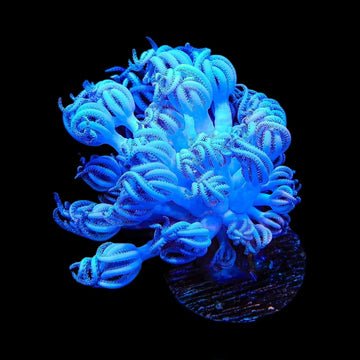
Blue Eye Green Star Polyps Coral
Overview
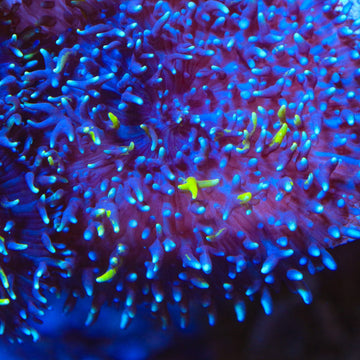
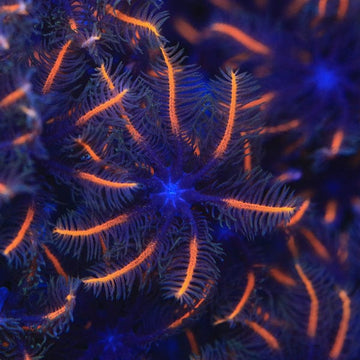
Blue Eye Green Star Polyps Coral forms bright green mats with small polyps displaying blue oral discs. Pachyclavularia violacea is a soft, encrusting colonial coral that thrives under moderate light and moderate to strong water flow. It is primarily photosynthetic via symbiotic algae but accepts fine particulate foods, which can support faster growth and maintain color. Place on an isolated rock or separate area, as it can spread quickly and overgrow nearby corals.
Quick Facts
Care
Easy
Lighting
Low–Moderate
Flow
Moderate-High
Placement
Low–Mid
Temperament
Semi-aggressive (fast-growing mat; can overrun neighbors—isolate or leave spacing)
Recommended Parameters
Temp
76–80°F
pH
8.1–8.4
Salinity
1.025–1.026
Calcium
400–450 ppm
AlkAlkalinity
8–10 dKH
Magnesium
1250–1350 ppm
Feeding
photosynthetic, phytoplankton, microplankton, rotifers, copepod nauplii, cyclops, marine snow, coral-specific powdered foods
Care & Placement
FAQ
Frequently Asked Questions
About the Blue Eye Green Star Polyps Coral
-
My Blue Eye Green Star Polyps suddenly stayed closed for days. What’s the likely cause beyond “normal adjustment”?
Extended closure often points to irritation or chemistry swings. Check for film algae/cyano on the mat, stinging from nearby corals, or pests (nudi/flatworms). Increase random flow to keep the mat clean, blow off debris with a baster, run fresh carbon for allelopathy, and verify stable alk 8–9 dKH. If pests are suspected, perform an iodine or broad-spectrum coral dip and inspect at night. -
How do I keep the “blue eye” centers vivid instead of washing out to green or brown?
Maintain PAR around 80–150 with a strong 420–470 nm spectrum and moderate white. Avoid ultra-low nutrients; target nitrate 5–15 ppm and phosphate 0.03–0.1 ppm to support pigments. Keep alkalinity stable, and ensure medium–strong, non-laminar flow. If color still fades, check for old bulbs, heavy metal contamination, or skimmer overstripping; consider small, careful iron/iodine supplementation only if tested. -
What’s the best strategy to enjoy fast growth without it taking over my rockwork?
Mount the colony on an isolated “island” or on the back wall, with a sand moat or bare glass edges as natural barriers. Trim the advancing mat monthly: score the edge with a scalpel, peel, and siphon the removed strip to prevent reattachment. Avoid placing next to slow growers. If it creeps onto rock you want to free, lift the mat with a thin card and scrape under it cleanly. -
Any advanced tips for clean, low-stress propagation of Pachyclavularia violacea?
Use a sharp blade to cut a 1–2 cm margin of mat between polyp rows, then gently peel. Secure to rubble with a tiny bit of gel cyanoacrylate or sandwich under mesh/rubber band to avoid smothering glue. Provide brisk flow for healing and keep detritus off the cut edges. Frags usually re-open within 2–5 days; delay shipping or trading until full extension returns.