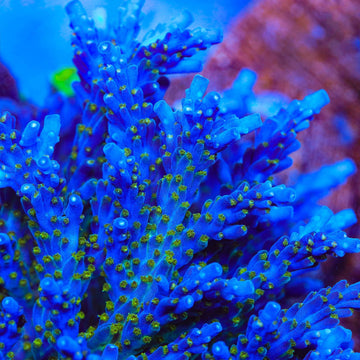
TSA Fruity Pebbles Acropora Coral
Overview
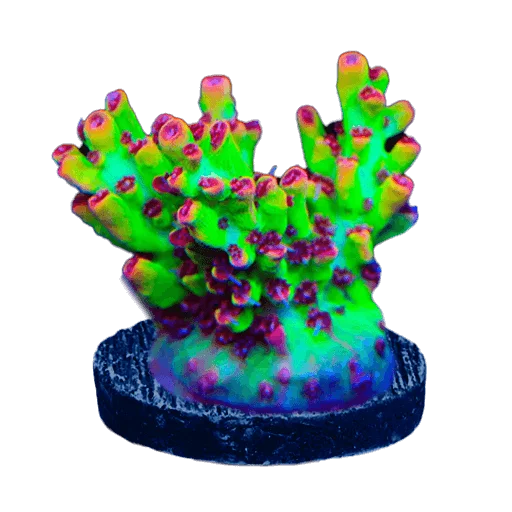
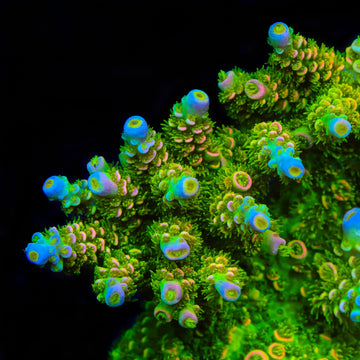
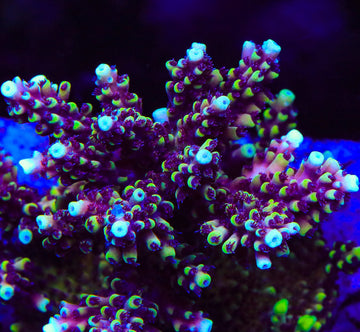
Blueberry Shortcake Acropora Coral shows tight branching clusters with blue tips and pink to cream bases. Acropora microclados is a small-polyp stony (SPS) branching coral that prefers strong light and strong, turbulent flow. It is primarily photosynthetic through symbiotic algae but can take very fine planktonic foods, which may support growth and maintain coloration. Place high on stable rockwork with space from stinging corals, and acclimate to higher light gradually to avoid bleaching.
Quick Facts
Care
Difficult
Lighting
High
Flow
High, turbulent
Placement
High
Temperament
Semi-aggressive (3–6 inches spacing)
Recommended Parameters
Temp
76–80°F
pH
8.1–8.4
Salinity
1.025–1.026
Calcium
420–450 ppm
AlkAlkalinity
7.5–8.5 dKH
Magnesium
1280–1350 ppm
Feeding
photosynthetic, microplankton, rotifers, copepod nauplii, phytoplankton, oyster eggs, coral-specific powdered foods, amino acids
Care & Placement
FAQ
Frequently Asked Questions
About the TSA Fruity Pebbles Acropora Coral
-
How can I keep the “blueberry” polyps and pink base colors from fading on Blueberry Shortcake Acropora?
Aim for high PAR (300–450) with strong blue/UV, stable alkalinity 7.5–8.3 dKH, and balanced nutrients: nitrate 2–10 ppm, phosphate 0.02–0.08 ppm. Too-clean water or phosphate spikes wash out pinks; excess iron can push green hues. Increase flow and light slowly over 2–3 weeks. Occasional amino dosing at night supports polyp vigor without overfeeding. -
Why do the branch tips burn or “melt” after I increase kalkwasser or adjust my reactor?
Rapid alkalinity or pH jumps cause tip necrosis in A. microclados. Keep daily alk swing under 0.3 dKH, and spread dosing across 24 hours with strong, random flow across tips. If damage occurs, stabilize parameters, trim necrotic ends to healthy flesh, and reduce light 10–15% for a week to ease stress while tissue recovers. -
What flow pattern best prevents shadowing and dead spots inside its dense branches?
Use intersecting, pulsed gyres or alternating crossflow to create chaotic turbulence around 30–50× turnover. Periodically vary intensity to flush detritus from between short radial corallites. Position one pump slightly downward to sweep the base, and another higher to ruffle tips. Avoid a constant, direct jet that can erode growth tips and cause asymmetry. -
How do I detect and manage subtle pest issues that target A. microclados?
Watch for tiny bite marks between corallites, reduced daytime polyp extension, and sand-like eggs on undersides—signs of AEFW. Inspect at night with a flashlight. Implement weekly dips (e.g., iodine or specialized treatments), turkey-baste to dislodge juveniles, and use a white container to check rinse water. Consider an interceptor course for red bugs if polyp behavior stays muted.