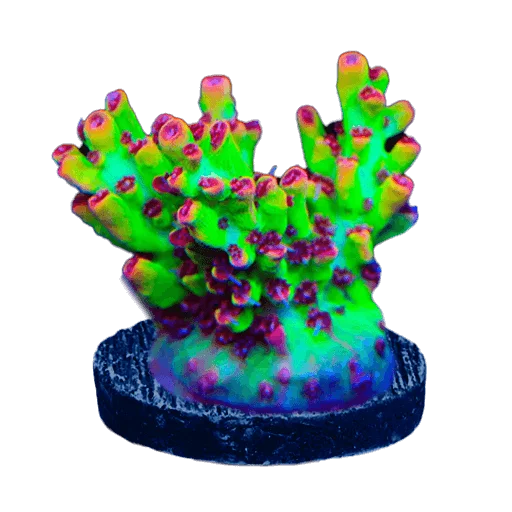
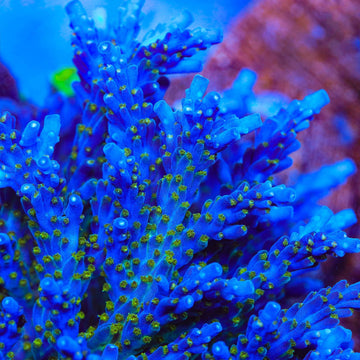
TSA Colonel Mustard Acropora Coral
Overview
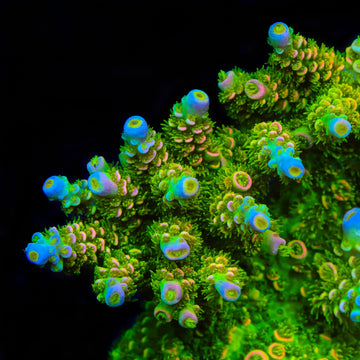
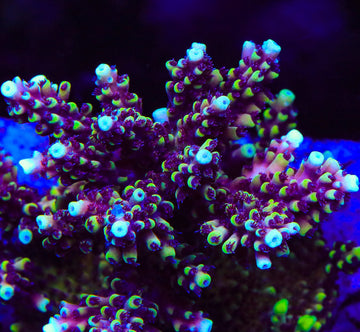
Colonel Mustard Acropora Coral shows yellow to golden branch tips with tight axial corallites. Acropora tenuis is a branching small-polyp stony coral; it prefers strong, stable light and moderate to high, turbulent water flow. It relies mainly on symbiotic algae for energy, but occasional small-particle foods can support growth and maintain color. Place high on the rockwork with room to grow, and keep distance from aggressive or stinging neighbors.
Quick Facts
Care
Difficult
Lighting
High
Flow
High
Placement
High
Temperament
Peaceful (3–6 inches spacing)
Recommended Parameters
Temp
76–80°F
pH
8.1–8.4
Salinity
1.025–1.026
Calcium
420–450 ppm
AlkAlkalinity
7.5–8.5 dKH
Magnesium
1280–1350 ppm
Feeding
photosynthetic, microplankton, very fine zooplankton, rotifers, copepod nauplii, powdered coral foods (e.g., Reef-Roids), amino acid supplements, bacterioplankton
Care & Placement
FAQ
Frequently Asked Questions
About the TSA Colonel Mustard Acropora Coral
-
How do I keep the “Colonel Mustard” yellow tones on Acropora tenuis without washing it out?
Aim for strong light (PAR ~250–350) with a heavy blue spectrum (420–460 nm). Keep nutrients measurable but lean: nitrate 2–10 ppm, phosphate 0.02–0.07 ppm. Avoid ultra-low nutrients that cause paling, and avoid high phosphate that dulls yellow. Stable alkalinity (7.5–8.5 dKH) is key; sudden boosts often mute pigments or burn tips. -
My tenuis encrusts for months before branching—normal for this morph?
Yes. A. tenuis typically encrusts to secure the base, then throws thick axial growth. To speed branching, maintain high, chaotic flow to clear mucus/detritus, ensure steady alk/Ca/Mg, and avoid frequent fragging. Provide space around the base to prevent self-shading; rotating the plug a quarter turn biweekly can even out light and promote symmetrical branching. -
What pests uniquely trouble A. tenuis, and how can I detect them on a yellow morph?
Acropora-eating flatworms and “red bugs” are the big risks. On yellow tissue, bite marks can be subtle—look for dull crescent scarring and excessive polyp retraction. Blast the colony with a baster; AEFW often dislodge as beige ovals. Use prophylactic dips (e.g., iodine, Bayer/CPR protocols) and a 4–6 week observation in a separate system before display. -
Why do my tips pale while the base stays colored?
Tip paling in tenuis is usually from a mismatch of high light and low available nutrients or rapid alkalinity rise. Verify PAR at the tips, raise nutrients slightly, and stop chasing higher alk. If tissue is receding (STN) rather than pale, check for nightly temp or pH swings and increase random flow across the tips to reduce localized stress.