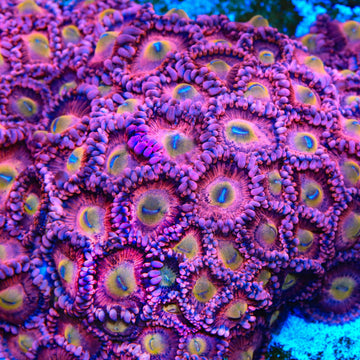
TSA Blueberry Haze Psammocora Coral
Overview
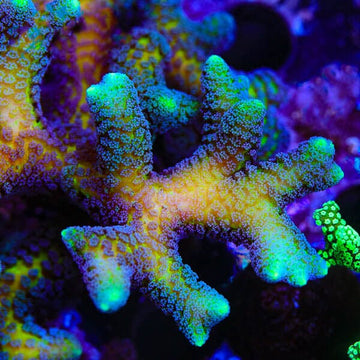
Blueberry Haze Psammocora Coral shows a dense, fine-textured encrusting surface with bluish to purple polyps. Psammocora contigua is a small-polyp stony coral that forms encrusting to plating sheets; it prefers moderate light and moderate to strong, variable flow. It is primarily photosynthetic via symbiotic algae but accepts very fine particulate foods, which can support growth and color. Place on stable rock with space around edges, as it can spread quickly and overgrow nearby corals.
Quick Facts
Care
Moderate
Lighting
Low–Moderate
Flow
Moderate-High
Placement
Low–Mid
Temperament
Semi-aggressive (2–3 inches spacing)
Recommended Parameters
Temp
75–80°F
pH
8.1–8.4
Salinity
1.025–1.026
Calcium
400–450 ppm
AlkAlkalinity
8–9 dKH
Magnesium
1280–1350 ppm
Feeding
photosynthetic (primary), microplankton, phytoplankton, rotifers, copepod nauplii, cyclops, oyster eggs, powdered coral foods (e.g., Reef-Roids), marine snow
Care & Placement
FAQ
Frequently Asked Questions
About the TSA Blueberry Haze Psammocora Coral
-
Why did my Blueberry Haze Psammocora fade from blue to green/brown?
Color shifts usually reflect light spectrum, PAR, and nutrients. Aim for moderate PAR (120–200) with strong royal blue/violet (420–460 nm) for the blueberry glow. Keep nutrients non-zero (NO3 5–15 ppm, PO4 0.03–0.1 ppm); ULNS often washes out color. Stable alk (7.5–8.5 dKH) and balanced trace levels help. Avoid sudden light increases—acclimate over weeks. -
How can I steer its growth—encrusting vs. plating ridges?
Psammocora contigua encrusts under stronger light and broader flow; lower light at the margins with brisk, directional flow encourages small shelves and ridges. Mount on rough, vertical or curved surfaces to promote contouring. Trim edges monthly so it doesn’t smother neighbors; it wins by overgrowing, not by long sweepers. Keep detritus off valleys to prevent recession. -
Mine tolerates sand well, but sometimes sheds slime—normal or trouble?
It’s naturally sediment-tolerant and will shed mucus to clear grains. Occasional sloughing is normal; persistent sheets of tissue loss signal stress. Increase turbulent flow, turkey-baste after sandstorms, and prevent burial of the growing rim. Check for alk swings and vermetid snail webs irritating the surface. If recession starts, frag healthy margins and stabilize parameters. -
What unusual irritants should I watch for with this coral?
Vermetid snails’ mucus nets and spionid worm filaments can cause chronic irritation and recession on ridges. Manually break vermetid tubes and control feeding to limit webs. Large hermits and urchins can scrape tissue on tight shelves. Allelopathy is mild, but close-contact pressure from fast encrusters (cyphastrea, leptoseris) can trigger slow-loss at the boundary—maintain spacing.