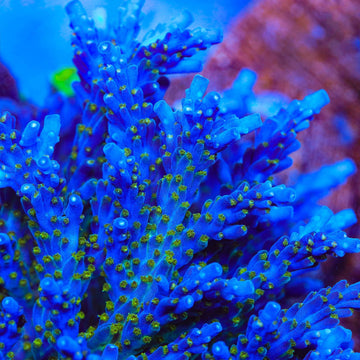
RR Pink Floyd Acropora Coral
Overview
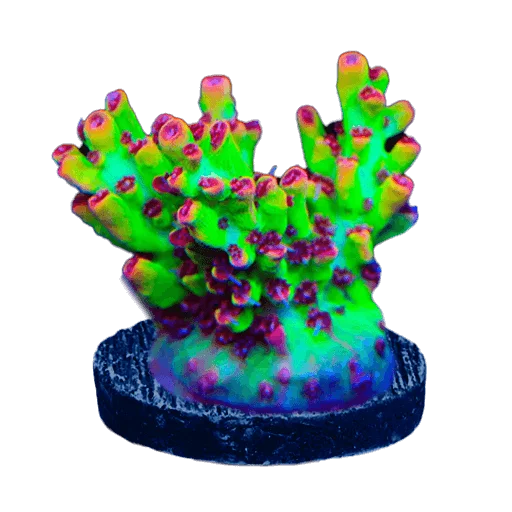
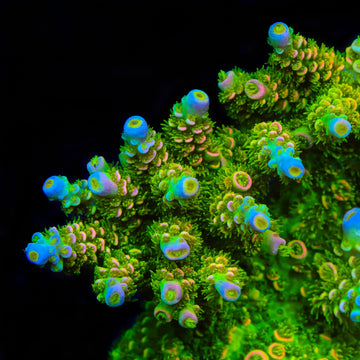
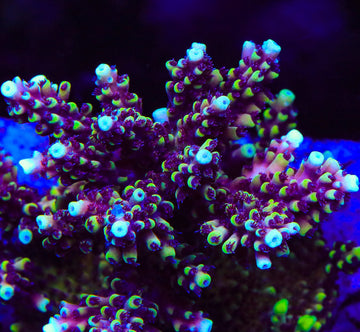
RR Pink Floyd Acropora Coral features vivid pink to yellow-green branch tips with contrasting polyps. Acropora tenuis is a branching small-polyp stony coral that prefers strong light and moderate to high, variable water flow. It relies on symbiotic algae for most nutrition but can take very small planktonic foods; occasional feeding can improve growth and maintain color. Place high on stable rockwork with ample space from stinging corals, and maintain steady alkalinity and nutrient levels.
Quick Facts
Care
Difficult
Lighting
High
Flow
High, turbulent
Placement
High
Temperament
Semi-aggressive (3–4 inches spacing)
Recommended Parameters
Temp
76–80°F
pH
8.1–8.4
Salinity
1.025–1.026
Calcium
420–450 ppm
AlkAlkalinity
8–9 dKH
Magnesium
1280–1350 ppm
Feeding
photosynthetic, microplankton, rotifers, copepod nauplii, powdered coral foods (e.g., Reef-Roids), oyster eggs, amino acids
Care & Placement
FAQ
Frequently Asked Questions
About the RR Pink Floyd Acropora Coral
-
Why is my RR Pink Floyd losing its neon body and pink polyp color?
Color shifts often trace to low PAR, imbalanced nutrients, or spectrum gaps. Aim for 300–400 PAR with strong, turbulent flow. Keep NO3 around 5–15 ppm and PO4 0.03–0.08 ppm—zeroed nutrients mute fluorescence. Provide robust violet/blue (380–470 nm). Avoid rapid alk swings; 7.5–8.5 dKH works well. Reduce shadowing from nearby colonies and maintain consistent trace inputs (especially potassium and iodine). -
It keeps encrusting but won’t branch—normal for this coral?
Yes. This Acropora often plates and thickens its base before pushing vertical shoots. Encourage branching by gradually increasing PAR, adding randomized flow, and giving it open space. Trim nearby fast-growers to reduce shade. Ensure nutrients aren’t bottomed out; ultra-lean systems can stall axial growth. Stability over weeks, not days, triggers new tips. -
How can I spot and manage pests specific to tenuis like this one?
Watch for AEFW crescent bite marks on shaded undersides and tissue thinning; red bugs reduce polyp extension and vibrancy. Inspect after lights out with a flashlight. Use targeted dips for frags, turkey-baste to expose flatworms, and consider a Halichoeres wrasse as a helper. For entrenched AEFW, plan a dip schedule and fallow period for affected frags on racks. -
My tips burned after raising alkalinity—what went wrong?
In low-nutrient tanks, pushing alk above ~8.5 dKH can cause tip burn in tenuis. Align alk with nutrient levels: modest alk (7.5–8.3) for lean systems, slightly higher only if nitrate/phosphate are also higher and stable. Make changes slowly, <0.3 dKH per day. Reduce intense white channels temporarily while tissue recovers and ensure steady flow over damaged areas.