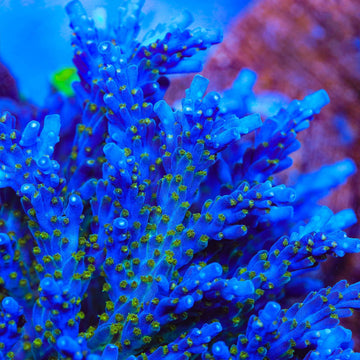
RR Olympus Acropora Coral
Overview
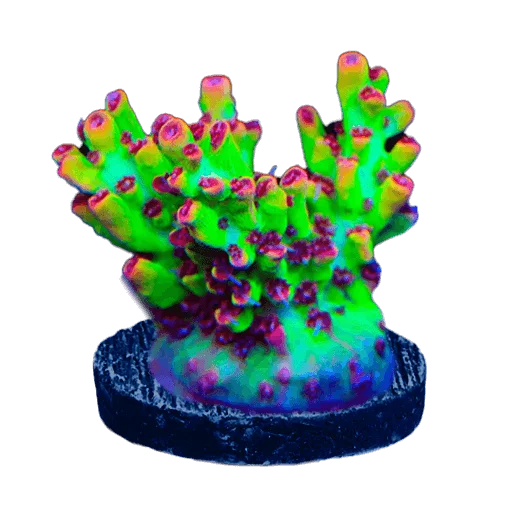
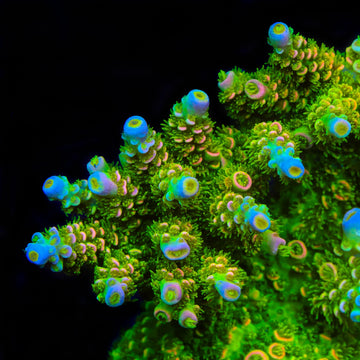
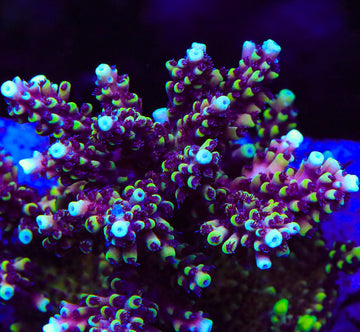
RR Olympus Acropora Coral forms tight branch clusters with fine axial tips and contrasting polyp coloration. Classified as Acropora sp., it is a small-polyp stony branching coral that prefers strong light and strong, turbulent water flow. It relies on symbiotic algae for most nutrition but accepts fine particulate foods, which can support growth and color stability. Place high on stable rockwork with space from aggressive neighbors, and keep parameters stable to prevent tissue recession.
Quick Facts
Care
Difficult
Lighting
High
Flow
High, turbulent
Placement
High
Temperament
Semi-aggressive (3–4 inches spacing)
Recommended Parameters
Temp
76–80°F
pH
8.1–8.4
Salinity
1.025–1.026
Calcium
420–450 ppm
AlkAlkalinity
8–9 dKH
Magnesium
1280–1350 ppm
Feeding
photosynthetic (primary), microplankton, rotifers, copepod nauplii, oyster eggs, cyclops, reef-specific powdered coral foods, phytoplankton
Care & Placement
FAQ
Frequently Asked Questions
About the RR Olympus Acropora Coral
-
How does RR Olympus Acropora typically grow, and how can I guide its shape?
It usually encrusts the plug or rock for stability before pushing axial tips. Provide strong, turbulent flow to keep tissue thick and reduce lower-shading dieback. To encourage a more open, corymbose form, keep PAR in the 300–400 range with cross-flow from multiple pumps. Periodic selective pruning of dense inner branches improves light penetration and maintains compact, colorful growth. -
Why did my RR Olympus dull under intense lighting even though polyp extension looks fine?
It’s often a light–nutrient mismatch. Under very high PAR, ultra-low nutrients can wash out pigments. Target nitrate 2–10 ppm and phosphate 0.02–0.08 ppm, stabilize alkalinity at 7.5–8.5 dKH, and favor blue-heavy spectrum (420–460 nm). Ramp up light over 2–3 weeks. If tips burn while bases brown, lower PAR slightly and increase flow to improve boundary-layer gas exchange. -
What pest issues are most common with this coral, and how can I detect them early?
Watch for AEFW crescent bite marks and tissue thinning on shaded undersides; red bugs cause reduced polyp extension and muted color. Quarantine new frags, perform gentle dips (avoid overdosing oxidizers), and inspect with a turkey baster blast and magnification weekly. Add a Halichoeres wrasse for ongoing pressure. If suspected, increase observation at night when pests are more active. -
My colony recedes after nearby corals slime or sting—how can I prevent chemical stress?
Keep aggressive LPS and soft corals at least 15–20 cm away and run fresh activated carbon changed biweekly. Aim flow so shed mucus moves away from the Acropora. After any contact event, perform a small water change and increase aeration. If unexplained rapid tissue loss occurs, check for metals with an ICP test and add poly-filter while addressing the source.