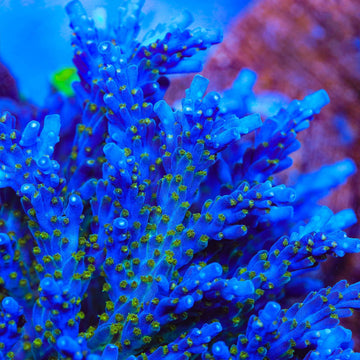
RMF Red Devil Acropora Coral
Overview
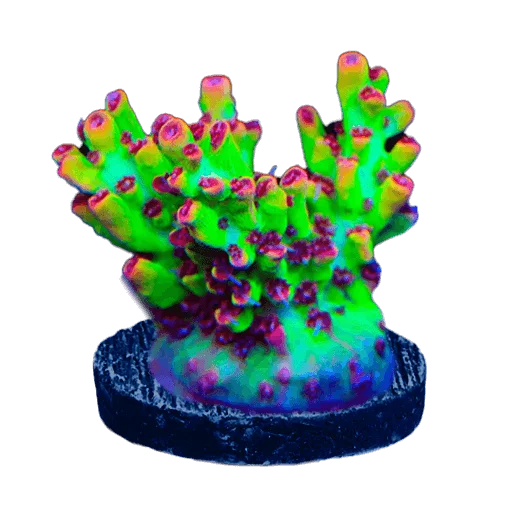
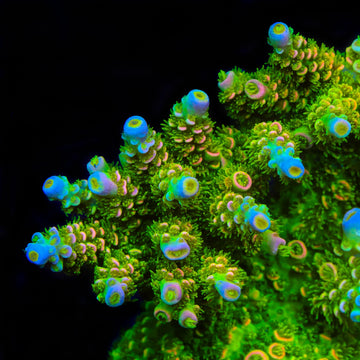
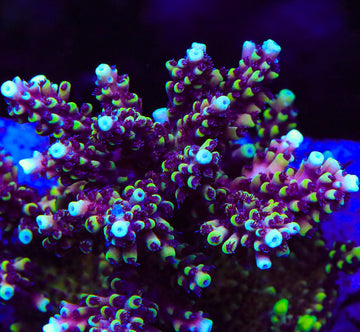
Red Devil Acropora Coral shows bright red branch tips with tight axial corallites. Acropora sp. Coral is a branching small-polyp stony coral that prefers strong lighting and high, turbulent flow. It relies mainly on symbiotic algae for energy, with occasional small plankton or coral foods supporting growth and color. Place high on stable rock with space from aggressive neighbors, and keep alkalinity and temperature stable.
Quick Facts
Care
Difficult
Lighting
High
Flow
High, turbulent
Placement
High
Temperament
Semi-aggressive (3–4 inches spacing)
Recommended Parameters
Temp
78–80°F
pH
8.1–8.4
Salinity
1.025–1.026
Calcium
420–450 ppm
AlkAlkalinity
8–9 dKH
Magnesium
1280–1350 ppm
Feeding
photosynthetic, microplankton, zooplankton, rotifers, copepod nauplii, reef-specific powdered coral foods, marine snow, amino acid supplements
Care & Placement
FAQ
Frequently Asked Questions
About the RMF Red Devil Acropora Coral
-
How do I keep the intense red coloration on my Red Devil Acropora (Acropora sp.)?
Provide strong blue-dominant lighting (PAR ~250–350), with some UV/violet for pigment development. Keep nutrients non-zero: nitrate 2–10 ppm, phosphate 0.03–0.08 ppm. Maintain potassium ~400 mg/L; low K often dulls reds. Avoid sudden increases above ~400 PAR to prevent tip bleaching. Stable alkalinity (7.5–8.5 dKH) and minimal organics help prevent browning while preserving depth of color. -
Why does my colony encrust for weeks before branching, and how should I plan placement?
Red Devil typically builds a wide base before throwing vertical branches, which boosts stability and nutrient uptake. Give it space to expand horizontally and avoid nearby shading competitors. Place where flow keeps the base clean. Expect sudden vertical growth once the base takes hold; pre-plan for upward space and prune neighbors to minimize shadowing and contact warfare. -
I’m seeing slow tissue loss from the base upward—what should I check first?
Verify alkalinity stability (daily swings cause STN). Confirm temp stability and adequate, random flow at the colony’s base. Inspect for pests: AEFW leave crescent bites and sand-like eggs on undersides; red bugs reduce polyp extension. Treat with targeted dips or quarantine; preserve symbiotic Acropora crabs when possible. Improve micro-flow around the base and avoid large parameter corrections in one go. -
What flow pattern works best, and how do I know it’s too much or too little?
Aim for strong, chaotic flow that changes direction frequently. Too little: detritus collects at the base, slime forms, colors dull. Too much: tissue recession on the upstream face or peeling at tips. Use alternating pumps to sweep around the colony, keeping polyp extension active without blasting any single face continuously.