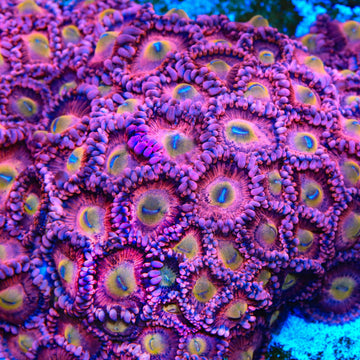
Murder Hornet Zoanthids Coral
Overview
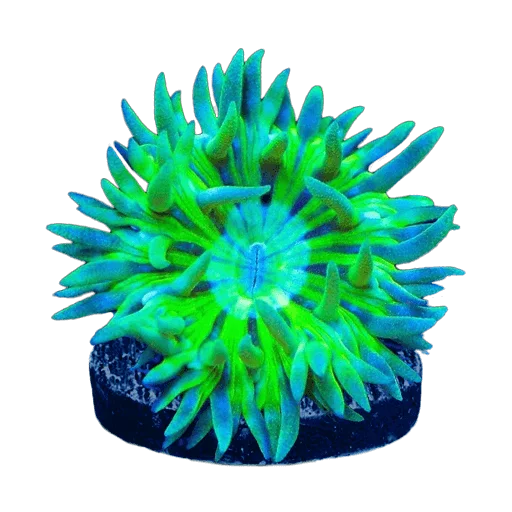
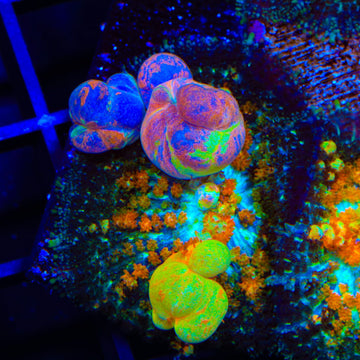
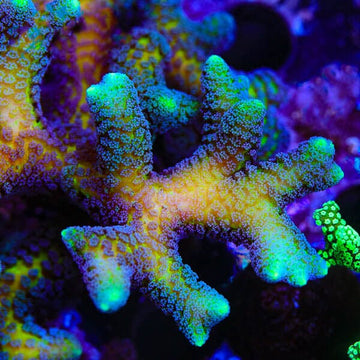
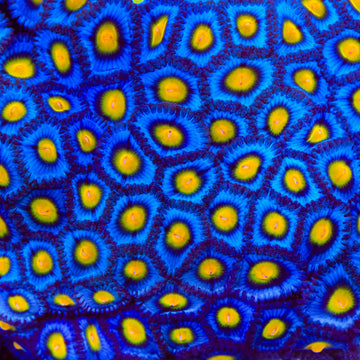
Murder Hornet Zoanthids Coral displays small button-like polyps with contrasting centers and skirts. Classified as Zoanthus sp., it is a soft, mat-forming colonial polyp that does well under moderate lighting and gentle to moderate water flow. Primarily photosynthetic via symbiotic algae, it can take occasional small particulate foods to support faster growth and stronger color. Place on isolated rock to control spreading and give space from stinging or fast-growing neighbors.
Quick Facts
Care
Easy
Lighting
Low–Moderate
Flow
Moderate
Placement
Low–Mid
Temperament
Semi-aggressive (2–4 inches spacing)
Recommended Parameters
Temp
76–80°F
pH
8.1–8.4
Salinity
1.025–1.026
Calcium
400–450 ppm
AlkAlkalinity
8–10 dKH
Magnesium
1250–1350 ppm
Feeding
photosynthetic, microplankton, phytoplankton, zooplankton, rotifers, cyclops, marine snow, powdered coral foods, brine shrimp nauplii
Care & Placement
FAQ
Frequently Asked Questions
About the Murder Hornet Zoanthids Coral
-
Why do my Murder Hornet Zoanthids lose their bold “hornet” rings under certain lighting?
The yellow/orange ring can wash out under intense white light or in nutrient-poor, ultra-clean systems. Shift to a blue-heavy spectrum with moderate PAR (150–200 at the polyp) and increase stability in nitrate (5–15 ppm) and phosphate (0.03–0.1 ppm). Acclimate light changes over 1–2 weeks. Avoid shading—stretching from low light also blurs the ring pattern. -
My colony “melts” after looking fine for weeks—what’s the hidden cause and fix?
Sudden decline often pairs flow dead spots with bacterial stress or pest irritation. Inspect at night for zoa-eating nudibranchs, sundial snails, and spiders. Increase random flow to keep detritus off skirts. For suspected bacterial issues, try Furan-2 dips; for algae/fouling, brief peroxide spot-treatments off-tissue. Run fresh carbon and perform small, frequent water changes to reduce toxins from neighboring soft corals. -
How can I keep Murder Hornets from getting overrun by faster zoa morphs without using a separate rock?
Create a “moat” by scraping a 5–8 mm bare ring around the colony and maintaining it monthly. Use a thin epoxy or superglue barrier line on the rock to slow mat creep. Moderate, cross-flow reduces detritus that fuels encroachers. If mixing morphs, keep at least 3–5 cm spacing so skirts don’t shade each other and distort growth. -
The polyps stay small and tight even though parameters look fine—how do I encourage fuller extension?
Check for trace imbalance and flow quality. Slightly raise iodine and potassium within reef-safe ranges, and verify alkalinity stability (8–9.5 dKH). Increase chaotic flow rather than sheer velocity to avoid skirt whipping. Feed fine particulate foods or amino acids 1–2x weekly at low light to stimulate tissue fullness. Ensure no nearby leathers or xenia are releasing allelopathic compounds; fresh carbon helps.