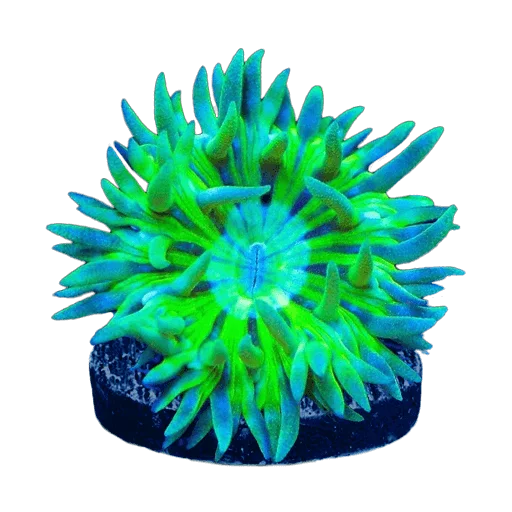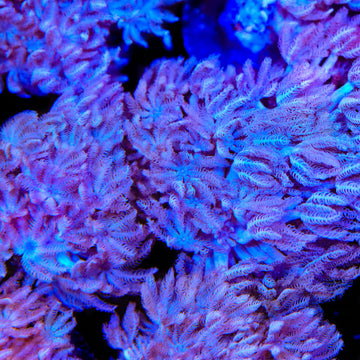
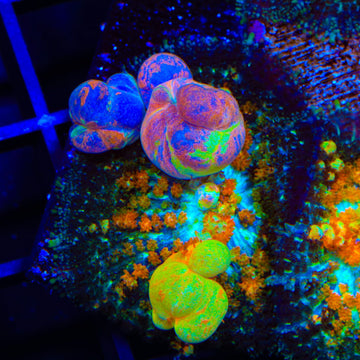
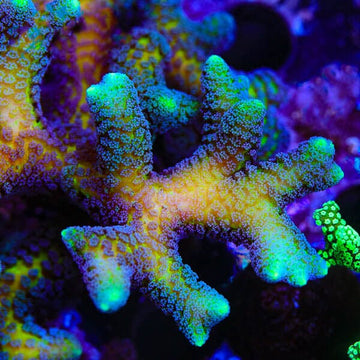
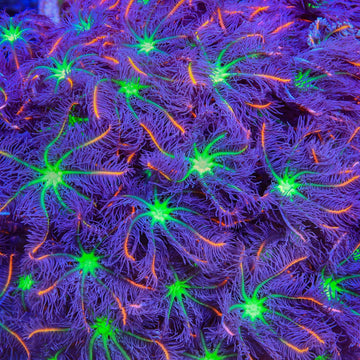
JF Frankie's Hot Pink Rim Montipora Cap Coral

JF Frankie's Hot Pink Rim Montipora Cap Coral

Beginner Corals SPS Montipora

Overview

JF Frankie's Hot Pink Rim Montipora Cap Coral displays a broad plating form with a distinct hot pink rim around a contrasting base. Montipora capricornis is a small-polyp stony, hard plating coral that prefers moderate to high light and moderate, turbulent water flow. It is primarily photosynthetic through symbiotic algae but can take very fine foods; occasional feeding can support faster growth and maintain color. Place it high to mid with room to expand, and keep clear of aggressive corals and shading.

Quick Facts

Care Moderate
Lighting Moderate–High
Flow Moderate–High
Placement Mid–High
Temperament Peaceful (2–3 inches spacing)

Recommended Parameters

Temp 76–80°F
pH 8.1–8.4
Salinity 1.025–1.026
Calcium 400–450 ppm
AlkAlkalinity 8–9 dKH
Magnesium 1280–1350 ppm
Feeding photosynthetic (primary), microplankton, phytoplankton, zooplankton, rotifers, copepod nauplii, coral-specific powdered foods, marine snow, amino acids

Care & Placement

JF Frankie's Hot Pink Rim Montipora Cap Coral (Montipora capricornis) thrives with stable, clean water and steady nutrients. Provide moderate–high light at ~150–250 PAR; start lower and increase over 2–3 weeks to avoid bleaching. Use moderate, cross-flowing water movement to keep the plating surface free of detritus and to support gas exchange; avoid a direct jet at the growing edge. It is largely photosynthetic but benefits from occasional small-particle foods (phytoplankton, rotifers) 1–2x weekly and balanced amino acids. Target parameters: temperature 75–78°F (24–26°C), pH 8.1–8.4, salinity 1.025–1.026, alkalinity 8.0–9.5 dKH, calcium 400–450 ppm, magnesium 1300–1400 ppm, nitrate 2–10 ppm, phosphate 0.03–0.08 ppm. Test weekly (more often after changes) and aim for stability over chasing exact numbers.Place mid to high in the rockwork with horizontal space for its plating growth; provide 3–4 inches clearance from neighbors to prevent shading and avoid stinging LPS and sweepers. Montipora is generally peaceful but can be overgrown by faster encrusters; prune as needed. Acclimate by dipping and quarantining to exclude montipora-eating nudibranchs; inspect at night for egg clusters. Common issues: pale tissue (too much light or low nutrients), edge recession (alkalinity swings, pests), sediment accumulation (insufficient flow). Troubleshoot by correcting stability first, increasing random flow, and adjusting light gradually. Secure frags firmly with epoxy or gel so new plates form without being knocked loose.

FAQ

Frequently Asked Questions

About the JF Frankie's Hot Pink Rim Montipora Cap Coral

  • Why does the hot pink rim on JF Frankie's Montipora cap fade or turn peach?
    Rim color depends on stable high light and balanced nutrients. Target PAR ~250–350 with strong blue/UV channels; warm-heavy spectrums can mute pink to peach. Keep NO3 5–15 ppm, PO4 0.03–0.08 ppm to avoid browning or paling. Maintain alk 7.5–8.5 dKH, K 380–420 ppm, and adequate iodine. Acclimate slowly after any light change to prevent pigment shock.
  • How should I place it to prevent self-shading and detritus buildup under the plates?
    Mount at a slight tilt with crossflow that reaches the underside; caps act like dust pans if placed flat. Aim for randomized, turbulent flow that lifts debris off the lower surfaces. Leave room for vertical whorls and periodic trimming. Siphon trapped detritus during maintenance. Avoid placing directly below aggressive LPS with long sweepers.
  • How can I spot and deal with Montipora-eating nudibranchs on this coral?
    Look for scalloped, bright-white patches starting at the rim and underside; check after lights out with a flashlight. Egg spirals appear as tiny white clusters under plates. Response: manual removal with a pipette/turkey baster, repeated dips (iodine or broad-spectrum coral dips), and quarantine. A vigilant wrasse (e.g., melanurus) can help, but persistence and repeated inspections are key.
  • Why are the edges receding while the center still looks healthy?
    Edge recession often points to alkalinity swings, insufficient underside flow, or detritus trapped under the lip causing bacterial irritation. Confirm stable alk and temperature, increase turbulent flow beneath the plate, and siphon debris. Check for sting marks from nearby corals and for nudibranch bites at night. If widespread, trim back to healthy tissue and re-stabilize parameters.