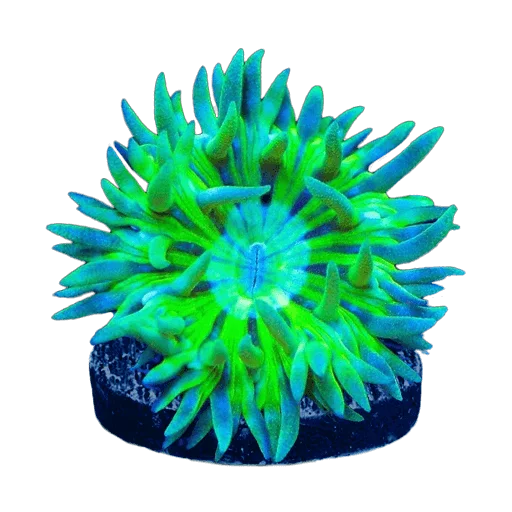
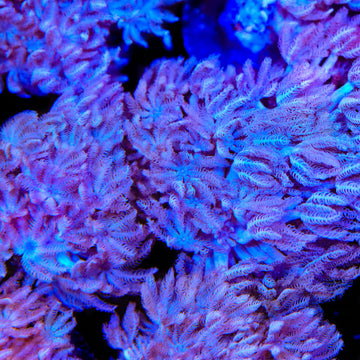
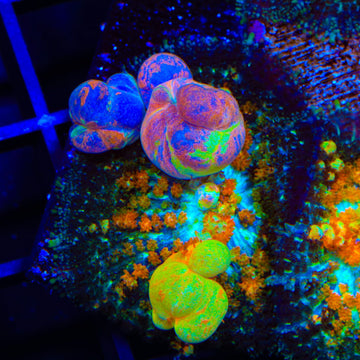
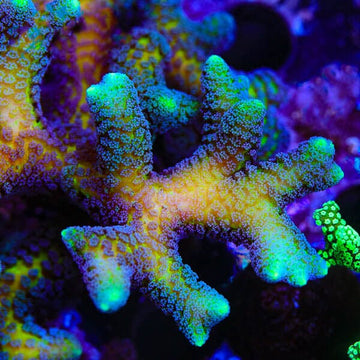
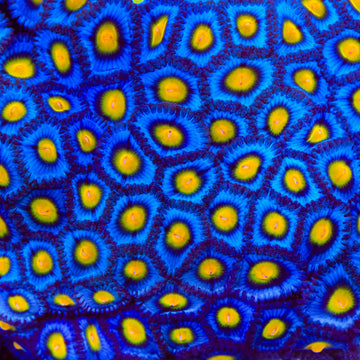
Gold Pocillopora Coral
Overview
Gold Pocillopora Coral displays dense, branching growth with small wart-like bumps on the branches. Pocillopora damicornis is a small-polyp stony branching coral that prefers moderate to high light and moderate to strong, turbulent flow. It is primarily photosynthetic with symbiotic algae; occasional feeding of fine plankton can support faster growth and maintain color. Place high on stable rockwork with space from neighbors, as it can spread and may irritate nearby corals.
Quick Facts
Care
Moderate
Lighting
Moderate–High
Flow
Moderate–High
Placement
Mid–High
Temperament
Semi-aggressive (3–6 inches spacing)
Recommended Parameters
Temp
76–80°F
pH
8.1–8.4
Salinity
1.025–1.026
Calcium
400–450 ppm
AlkAlkalinity
8–9 dKH
Magnesium
1250–1350 ppm
Feeding
photosynthetic, microzooplankton, rotifers, copepod nauplii (Cyclops/Cyclop-eeze), baby brine shrimp (nauplii), oyster eggs, reef-specific powdered coral foods
Care & Placement
FAQ
Frequently Asked Questions
About the Gold Pocillopora Coral
-
How do I keep the “gold” coloration on Pocillopora damicornis from fading to green or brown?
Maintain moderate PAR (200–350) with strong violet/UV (380–420 nm) and a balanced blue/white mix. Keep nutrients non-zero but lean: NO3 ~2–10 ppm, PO4 ~0.03–0.08 ppm. Avoid abrupt light changes; ramp intensity over 2–3 weeks. Stable alkalinity (7.5–8.5 dKH) and trace metals in range help; excess iron can push greener hues. Watch for shading as colonies thicken. -
Why does my Gold Pocillopora shift from compact branches to a more plating or bushy form?
Morphology tracks flow and light. High, chaotic flow yields thicker, tighter branching; lower flow and lateral light promote looser, sometimes plating growth. If tips are fusing and casting heavy shade, increase crossflow or rotate the colony to encourage even branching. Avoid laminar jets that abrade tissue; aim for strong, alternating turbulence. -
How do I prevent Pocillopora from popping up all over my tank?
P. damicornis can broadcast planulae and seed pumps, weirs, and rock. Isolate it on a “rock island,” prune regularly, and run fine mechanical filtration during spawning events (often after large water changes or moonlight cycles). A properly sized UV sterilizer on low-flow bypass can reduce larval survival in the water column. Remove new settlers promptly. -
My colony has great polyp extension but slow calcification—what should I adjust?
Strong extension with slow skeletal build often points to limited building blocks or too little light. Verify calcium 420–460 ppm, magnesium 1300