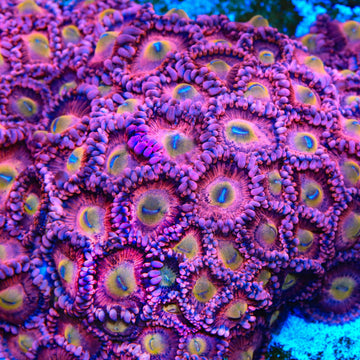
Goblins on Fire Zoanthids Coral
Overview
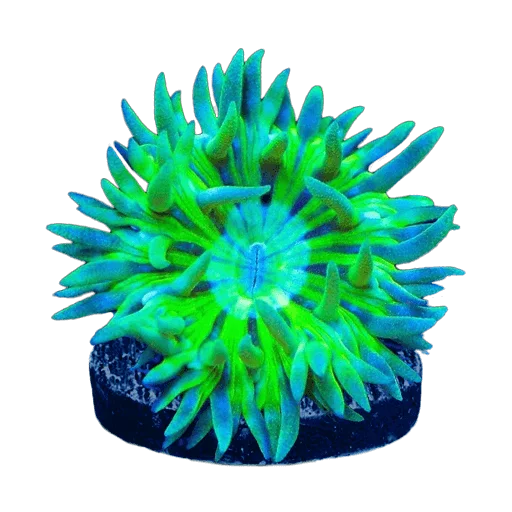
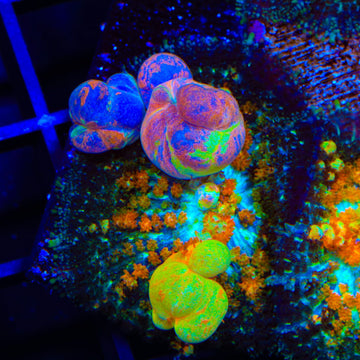
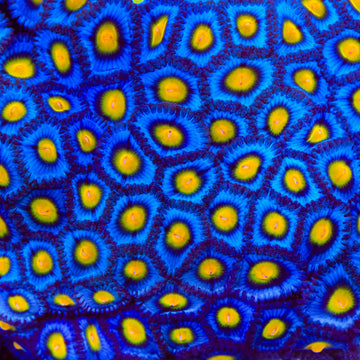
Goblins on Fire Zoanthids Coral shows bright orange to red oral discs with contrasting green skirts. Zoanthus sp. is a soft, mat-forming polyp coral that spreads by encrusting; it prefers moderate light and low to moderate, indirect flow. Primarily photosynthetic through symbiotic algae, it will accept small particulate foods, which can support faster growth and deeper color. Place on isolated rock to manage spread and leave space from stinging neighbors, as polyps can overgrow nearby corals.
Quick Facts
Care
Easy
Lighting
Moderate
Flow
Moderate Indirect
Placement
Low–Mid
Temperament
Semi-aggressive (fast spread; give 2–3 inches)
Recommended Parameters
Temp
76–80°F
pH
8.1–8.4
Salinity
1.025–1.026
Calcium
400–450 ppm
AlkAlkalinity
8–10 dKH
Magnesium
1250–1350 ppm
Feeding
photosynthetic (primary), phytoplankton, rotifers, copepod nauplii, cyclops, microplankton, powdered coral foods
Care & Placement
FAQ
Frequently Asked Questions
About the Goblins on Fire Zoanthids Coral
-
Why did my Goblins on Fire lose their fiery orange and look muted under new lights?
This morph responds strongly to spectrum and PAR. Expect best pop under blue-heavy LEDs (with some UV/violet) at moderate PAR (~100–150). Too white-heavy or very low nutrients can mute reds/oranges. Maintain steady nitrate 5–15 ppm and phosphate 0.03–0.1 ppm. Avoid sudden light jumps; acclimate over 1–2 weeks. Reduce shading from nearby colonies and keep lenses/splash guards clean. -
My Goblins on Fire stay closed while other zoas look fine. What should I check first?
Inspect at night for zoa-eating nudibranchs and eggs, zoa spiders, and sundial snails. Look for pinpoint pustules (zoa pox). Improve flow to prevent detritus lodging at the skirts. Try a sequence of dips: iodine or commercially formulated coral dips; Furan-2 baths help with pox. Stabilize alkalinity and temperature, and avoid recent toxins (aerosols, rust, metals). Repeat pest checks for several nights. -
How can I boost growth without letting this colony overrun the rockwork?
Place the frag on an “island” rock with a sand moat to contain the mat. Provide moderate, turbulent flow and steady mid-level light. Target-feed fine particle foods lightly 1–2× weekly to speed growth without fouling. Keep nutrients non-zero but stable. Trim the leading edge monthly by cutting the mat and rehoming frags. Avoid placing next to slow growers you care about. -
Do they get along with other corals and common tank mates?
They generally coexist, but can overgrow encrusting neighbors and get stung by LPS with sweepers (euphyllia, galaxea). Give several inches of space and run fresh carbon to reduce soft coral chemical warfare. Some fish nip (dwarf angels, certain butterflies), and crabs may pick if underfed. Avoid shadowing by faster-growing colonies. Keep detritus off the skirts to limit irritation and film algae.