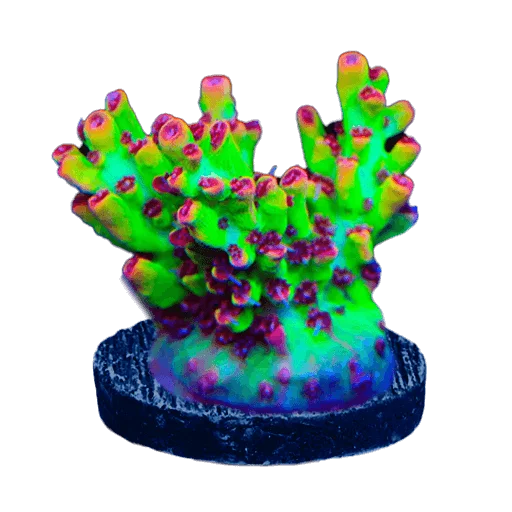
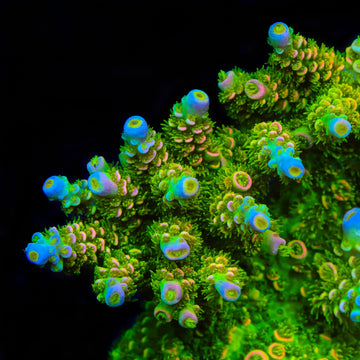
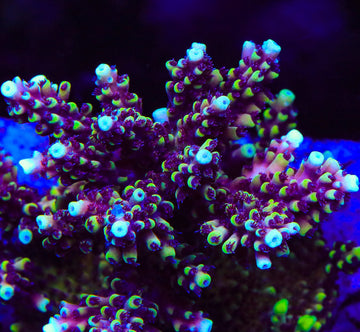
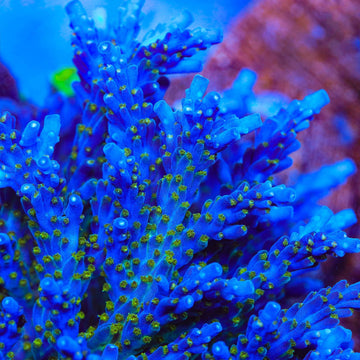
GB Fury Acropora Coral
Overview
GB Fury Acropora Coral displays tightly spaced, upward-branching tips with contrasting axial and radial corallites. Acropora tenuis is a small-polyp stony branching coral that prefers strong lighting and high, turbulent water flow. It is primarily photosynthetic through symbiotic algae but benefits from occasional microplankton or amino-rich foods, which can support growth and color stability. Place high on rockwork with ample space from aggressive neighbors, and maintain stable alkalinity and low nutrients to avoid tissue recession.
Quick Facts
Care
Difficult
Lighting
High
Flow
High
Placement
High
Temperament
Peaceful (2–3 inches spacing)
Recommended Parameters
Temp
76–80°F
pH
8.1–8.4
Salinity
1.025–1.026
Calcium
420–450 ppm
AlkAlkalinity
7–9 dKH
Magnesium
1280–1350 ppm
Feeding
photosynthetic (primary), microzooplankton, rotifers, copepod nauplii, oyster eggs, powdered coral foods (e.g., Reef-Roids), amino acid supplements
Care & Placement
FAQ
Frequently Asked Questions
About the GB Fury Acropora Coral
-
Why does my GB Fury Acropora (A. tenuis) lose neon tips under strong light while other acros don’t?
A. tenuis often shows its best tip fluorescence under high PAR with heavy 420–450 nm and a touch of 400–415 nm. If alk runs high (9.5+ dKH) under intense light, tips can “burn” and pale. Keep alk 7.8–8.5, maintain moderate nutrients (NO3 5–15 ppm, PO4 0.03–0.08), and avoid rapid light increases. Gradual spectrum ramping preserves tip color. -
My colony encrusts fast but stalls on vertical branches—normal for this species?
Yes. Tenuis prefers to encrust a wide base before throwing robust axial branches. Encourage upward growth by providing high, variable flow across the base to prevent detritus film, keeping PAR 250–350 at the base, and slightly lowering nutrients once a healthy plate forms. Mount the frag on a low-profile plug or flat tile so the rim isn’t shaded. -
What subtle pests or stress signs show up uniquely on GB Fury tenuis?
Early AEFW activity shows as tiny, crescent bite marks and reduced polyp extension on shaded undersides. Red bugs cause dulling and chronic minimal extension. Tip burn from alk/light stress looks like clean, white tips without rough bite edges. Address bites with targeted dips and quarantine; for burn, stabilize alk and back down PAR 10–15% for a week. -
How can I keep lower branches from dying off due to self-shading?
Place the colony where crossflow sweeps around it, not just at the tips. Angle the frag slightly so light reaches interior radial corallites. Trim a few inner branches quarterly to open the canopy. Maintain moderate nutrients and consider a small UV/violet bump at photoperiod peak to penetrate deeper structure without raising total PAR too much.