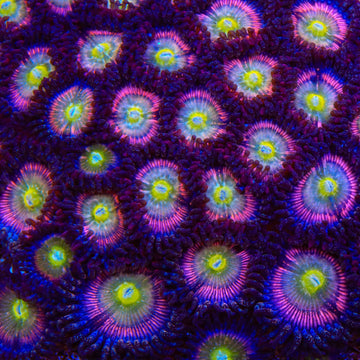
Everlasting Gobstopper Zoanthids Coral
Overview
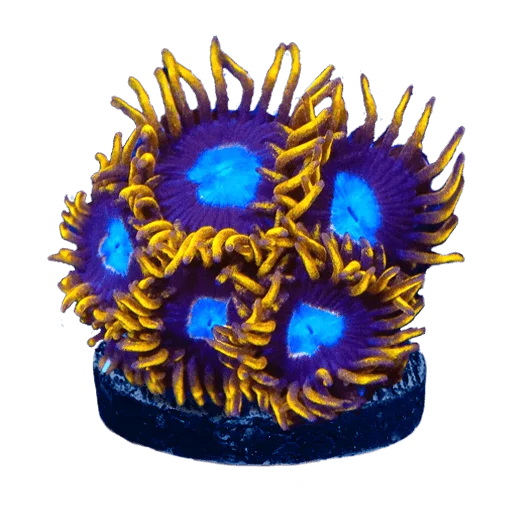
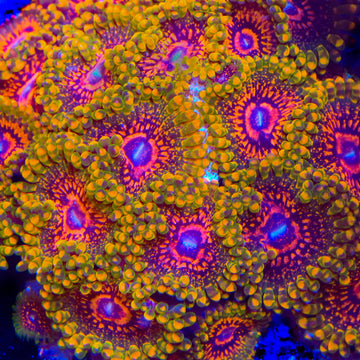
Everlasting Gobstopper Zoanthids Coral shows bright orange centers with green skirts around each polyp. Zoanthus sp., a colonial soft polyp coral, forms mat-like clusters and does well under moderate light and low to moderate water flow. Primarily photosynthetic with symbiotic algae, it can also take occasional small particle or meaty foods to support growth and maintain color. It can spread quickly, so place on a separate rock island and keep space from slower-growing corals.
Quick Facts
Care
Easy
Lighting
Low–Moderate
Flow
Moderate
Placement
Mid–Low
Temperament
Peaceful to semi-aggressive (2–3 inches spacing)
Recommended Parameters
Temp
76–82°F
pH
8.1–8.4
Salinity
1.025–1.026
Calcium
400–450 ppm
AlkAlkalinity
8–10 dKH
Magnesium
1250–1350 ppm
Feeding
photosynthetic, phytoplankton, zooplankton, microplankton, rotifers, cyclops, baby brine shrimp nauplii, powdered coral foods (e.g., Reef-Roids), marine snow
Care & Placement
FAQ
Frequently Asked Questions
About the Everlasting Gobstopper Zoanthids Coral
-
Why do my Everlasting Gobstopper Zoanthids lose their vivid ring colors under strong lights?
They can brown or wash out when PAR is too high or spectrum skews blue-heavy for long photoperiods. Aim for moderate PAR (80–150), shorten the peak photoperiod, and add a brief neutral-white window to maintain pigment balance. Keep nutrients measurable (NO3 5–15 ppm, PO4 0.03–0.1). Ramp light changes slowly over 2–3 weeks to avoid stress and color shifts. -
How can I encourage tight, compact growth instead of long “stretchy” skirts?
Provide moderate, cross-flow that gently waves polyps without folding them over. Increase PAR gradually if polyps are reaching, and keep alkalinity and pH stable to support calcification of the base mat. Avoid chronic low nutrients, which causes shrinkage, and high organics, which promotes algae at the mat edge. Consistent, moderate conditions produce tighter skirts and denser colonies. -
My colony stopped opening after adding new frags—what should I check beyond pests?
Consider chemical aggression. Run fresh activated carbon and increase water changes for a couple weeks. Ensure no nearby LPS sweepers or palys are contacting the mat at night. Verify flow isn’t blasting directly, and raise the colony slightly if sand is irritating skirts. If symptoms persist, try an isolation rack; many reopen within days once allelochemicals are reduced. -
Are there telltale signs of zoa-specific predators on this morph, and how do I respond?
Look for bite marks on skirts, notches on discs, and egg spirals from zoa-eating nudibranchs under the mat. Inspect at night with a flashlight. Remove adults manually, scrape eggs, and perform scheduled dips (iodine or low-dose peroxide) over 2–3 weeks to break life cycles. Also watch for sundial snails and tiny spiders; both require manual removal and repeat checks.