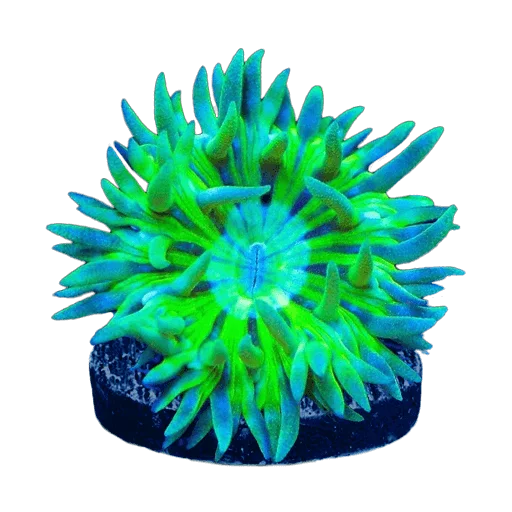
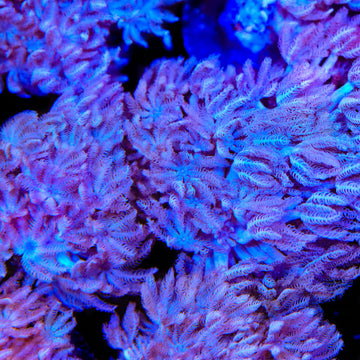
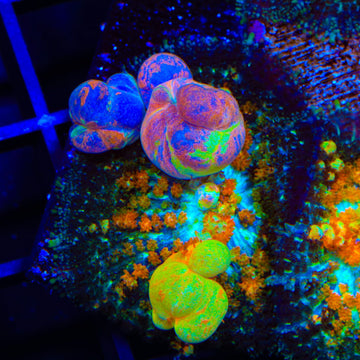
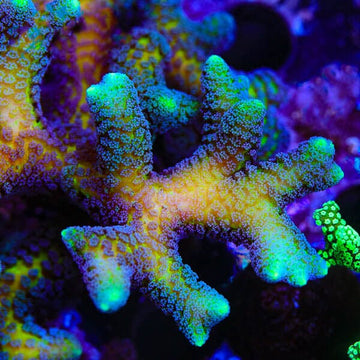
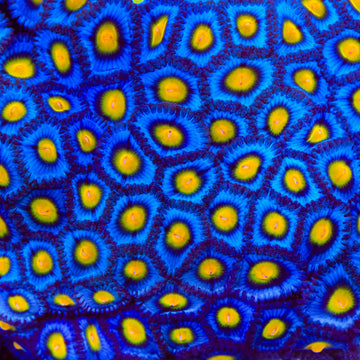
Emerald Green Zoanthids Coral
Overview
Emerald Green Zoanthids Coral displays tight mats of small polyps with bright green centers and contrasting skirts. Classified as Zoanthus sp., this soft, colonial polyp thrives in moderate light and low to moderate water flow. It is primarily photosynthetic via symbiotic algae but accepts small meaty foods or coral foods, which can speed growth and intensify color. Place on an isolated rock with space around it, as it can spread quickly and overgrow neighboring corals.
Quick Facts
Care
Easy
Lighting
Low–Moderate
Flow
Moderate, indirect
Placement
Mid–Low
Temperament
Semi-aggressive (2–3 inches spacing)
Recommended Parameters
Temp
76–82°F
pH
8.1–8.4
Salinity
1.025–1.026
Calcium
380–430 ppm
AlkAlkalinity
8–10 dKH
Magnesium
1250–1350 ppm
Feeding
photosynthetic, microplankton, phytoplankton, rotifers, cyclops, powdered coral foods such as Reef-Roids, marine snow
Care & Placement
FAQ
Frequently Asked Questions
About the Emerald Green Zoanthids Coral
-
Why are my Emerald Green Zoanthids fading or turning brown under strong lights?
Green Zoanthus sp. peak under blue-heavy spectrum. Excess white light or very high PAR can wash fluorescence and push browning. Aim for moderate PAR (~80–180), strong blues, and stable nutrients (nitrate 5–15 ppm, phosphate 0.03–0.08). Avoid ultra-low nutrients, which cause paling and shrinking. Trace balance matters; inconsistent iodine/iron can dull color—don’t chase numbers, just keep regular water changes and stable parameters. -
My polyps stay closed and look like they’re “melting.” What should I check first?
Inspect at night for predators: zoa-eating nudibranchs (and eggs), sundial snails, or zoa spiders. Check for zoa pox (small white nodules) and bacterial film. Increase random flow to prevent detritus. Do a focused dip: iodine for irritation; Furan-2 for pox (separate bath); peroxide (weak) only for algae on the mat. Correct swings in salinity/alkalinity and reduce abrupt lighting changes. -
How do I frag Emerald Green Zoanthids safely and promote fast recovery?
Wear gloves and eye protection; some colonies contain potent toxins. Cut the mat between polyps with a sharp scalpel, avoiding slicing through mouths. Mount frags on rough plugs with a drop of gel glue. Dip in iodine, provide moderate flow, and lower light for a week. Run fresh carbon and strong skimming after large sessions. Keep hands, tools, and work area thoroughly rinsed. -
Will they overrun my rockwork, and how can I control spread without harming them?
Zoanthus grows as a creeping mat and can climb over nearby corals. Place colonies on isolated “islands” with a sand moat or cut a small groove around them to limit advance. Periodically peel and trim the mat at the edges. Avoid placing them next to slow encrusters. Use carbon to reduce chemical aggression, and maintain space from sensitive SPS to prevent shading and irritation.