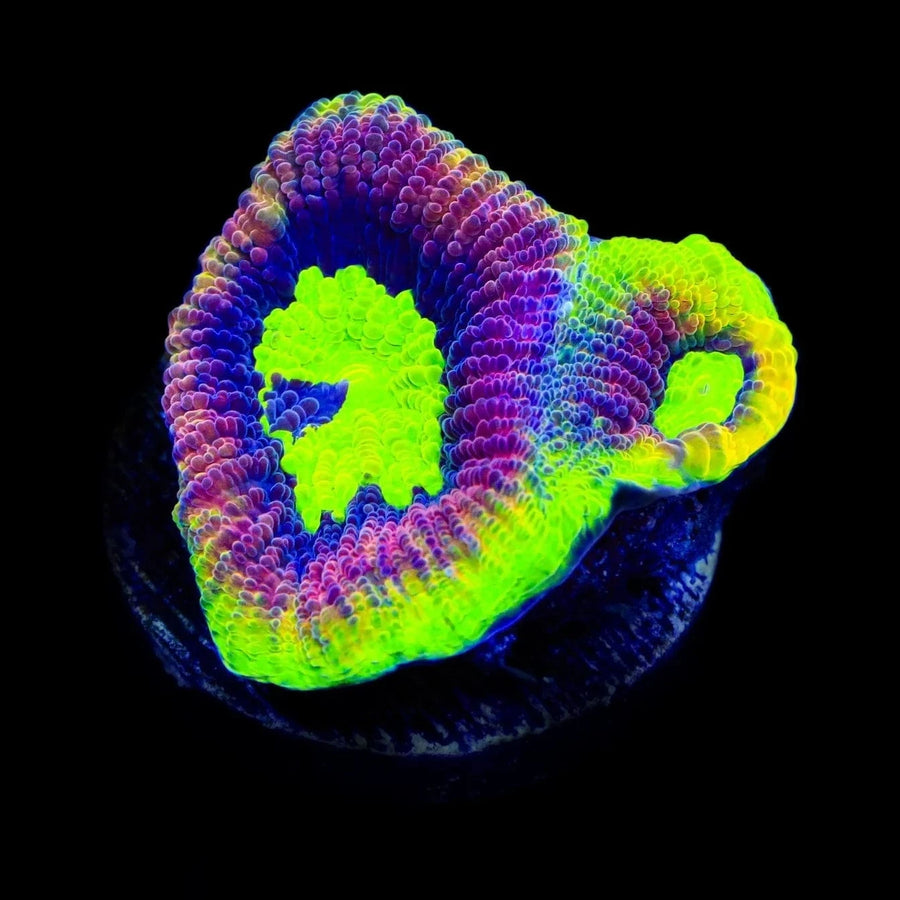
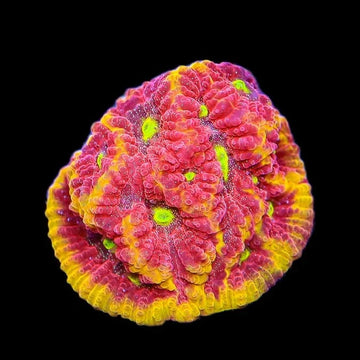
Dragon Soul Favia Coral
Overview
Dragon Soul Favia Coral shows bright contrasting centers with ridged, polygonal corallites. Favia favus is a stony, encrusting to mounding coral that does well under moderate light and low to moderate, steady flow. It is photosynthetic via symbiotic algae but benefits from occasional small meaty foods at night, which can support faster growth and deeper coloration. Give it space, as long sweeper tentacles can sting nearby corals; place on stable rock with room to expand.
Quick Facts
Care
Moderate
Lighting
Low–Moderate
Flow
Moderate
Placement
Low–Mid
Temperament
Aggressive (3–6 inches spacing)
Recommended Parameters
Temp
76–80°F
pH
8.1–8.4
Salinity
1.025–1.026
Calcium
400–450 ppm
AlkAlkalinity
8–9.5 dKH
Magnesium
1250–1350 ppm
Feeding
photosynthetic, mysis shrimp, enriched brine shrimp, finely chopped seafood (shrimp, clam), zooplankton, rotifers, copepods, microplankton, marine snow, coral-specific foods
Care & Placement
FAQ
Frequently Asked Questions
About the Dragon Soul Favia Coral
-
Why does my Dragon Soul Favia’s color shift from neon gold/green to dull brown or teal under the same PAR?
Spectrum and nutrients matter more than PAR alone. This morph holds best under strong blue bias (14–20K look) with stable nitrate/phosphate; excess food or very high white light increases zoox density, muting fluorescence. Sudden alkalinity swings also wash out color at septa. Stabilize alk (8–9 dKH), run modest nutrients, increase blue spectrum gradually, and allow 2–4 weeks for pigments to rebound. -
My Favia shows recession along the ridges while the mouths look fine—what’s causing it?
The septal ridges trap detritus and promote low-flow microzones where bacteria can irritate tissue. Aim a gentle cross-flow to sweep valleys, turkey-baste weekly, and avoid direct blasting. Check for alk swings and elevated temperature; both accelerate ridge recession. If tissue lifts, perform an iodine or broad-spectrum coral dip, trim dead skeleton, and reduce light slightly until recovery. -
The coral inflates at night but keeps mouths gaping during the day—normal or a problem?
Brief daytime gaping after feeding is fine; persistent gaping signals stress or hunger. Check for nocturnal pests (flatworms, nipping snails) with a red light. Increase small, meaty feedings at lights-out 2–3 times weekly. Verify salinity and alk stability, reduce PAR slightly for a week, and run fresh carbon to limit allelopathy from nearby LPS like chalices or acans. -
Why does tissue recede where the frag meets the plug, even though parameters are stable?
Contact irritation and algae creep are common at the interface. Keep adhesive off living tissue, seal exposed skeleton edges with a thin superglue rim, and maintain clean, laminar flow to prevent film algae. Place the frag on a smooth, non-porous surface first; move to rock only after encrustment begins. Maintain phosphate low but not zero to avoid starvation-driven recession.