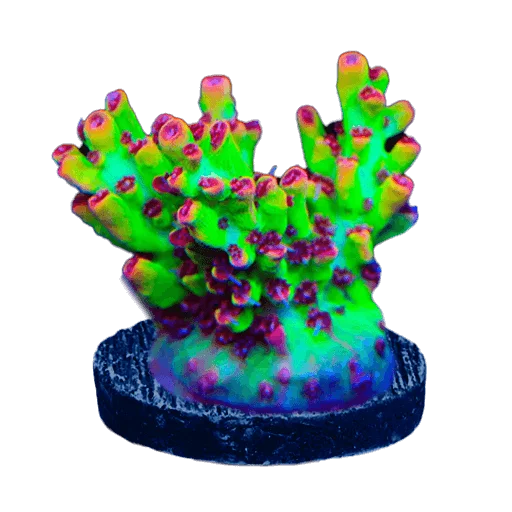
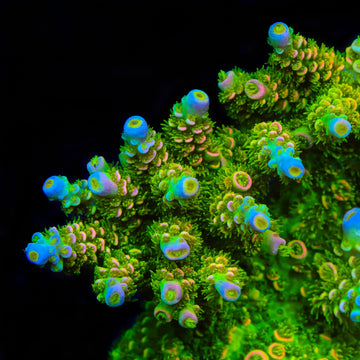
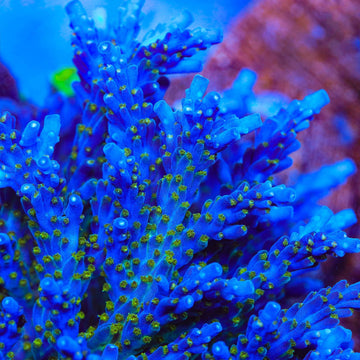
CRT Golden Eye Acropora Coral
Overview
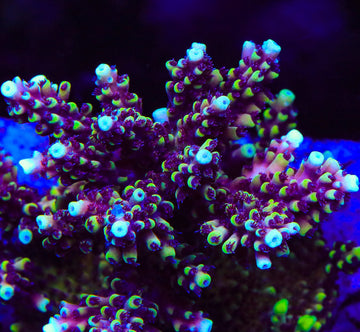
CRT Golden Eye Acropora Coral shows golden to green polyps with contrasting branch tips. Acropora sp. Coral is a branching stony coral that prefers strong lighting and moderate to high, turbulent water flow. It relies on symbiotic algae for energy but can accept fine particulate foods; occasional target feeding may support growth and color stability. Place high on rockwork with space from aggressive neighbors, and maintain stable alkalinity and calcium to prevent tissue loss.
Quick Facts
Care
Difficult
Lighting
High
Flow
High, turbulent
Placement
High
Temperament
Peaceful (3–4 inches spacing)
Recommended Parameters
Temp
76–80°F
pH
8.1–8.4
Salinity
1.025–1.026
Calcium
420–450 ppm
AlkAlkalinity
7.5–9 dKH
Magnesium
1280–1350 ppm
Feeding
photosynthetic, microzooplankton, rotifers, copepod nauplii, coral-specific powdered foods, marine snow, amino acid supplements
Care & Placement
FAQ
Frequently Asked Questions
About the CRT Golden Eye Acropora Coral
-
How do I keep the “golden eye” coloration vivid on CRT Golden Eye Acropora?
Aim for 300–400 PAR with strong blue/violet (420–470 nm) and a touch of UV; keep nitrate 5–15 ppm and phosphate 0.03–0.08 ppm to prevent washing out. Maintain alk 8–9 dKH, Ca 420–450, Mg ~1350, and stable temperature. Potassium 380–420 ppm and low, regular iron help yellow/gold tones. Avoid abrupt spectrum shifts; acclimate new bulbs/LED profiles over 2–3 weeks. -
Why does it encrust for weeks before vertical growth, and can I influence colony shape?
This coral often builds a thick base before branching to withstand high-energy flow. Mount frags at a slight angle on a clean, cuttable plug or rock, giving 5–8 cm clearance to reduce self-shading. Higher, cross-flow encourages compact, upright branching; lower, laminar flow can promote tabling. Rotate the frag 90° every few weeks during early growth to steer even branch formation. -
My tips are pale while the base darkens—what’s the likely cause and fix?
Pale tips with a dark base often indicate high light with lower nutrients or elevated alkalinity driving rapid calcification. Verify PAR at the tips; reduce to ~300–350 if exceeding 400. Keep nitrate 5–10 ppm, phosphate ~0.05, and stabilize alk at 8–8.5 dKH. Increase turbulent flow to prevent boundary-layer stress. If tissue thins, pause amino dosing and large water changes until color returns. -
Are there pests or diseases this strain is especially sensitive to, and how do I screen for them?
Watch for AEFW (crescent bite marks, sand-like eggs on undersides) and red bugs (tiny orange specks on polyps). Quarantine frags 4–6 weeks, inspect with a magnifier, and use a rotating dip regimen (e.g., Bayer/imidacloprid, potassium salts, and mechanical turkey-baster blasts). For sudden STN/RTN, frag 3–5 mm into healthy tissue, increase flow, add fresh carbon, and stabilize parameters immediately.