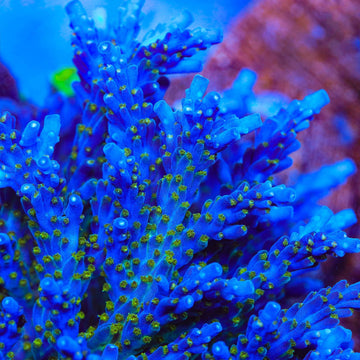
CC Banana Hammock Acropora Coral
Overview
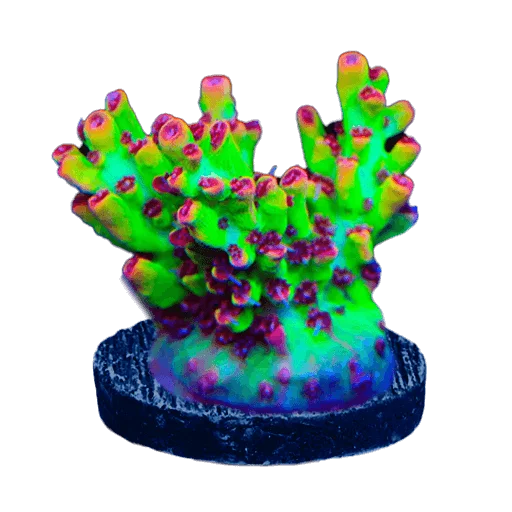
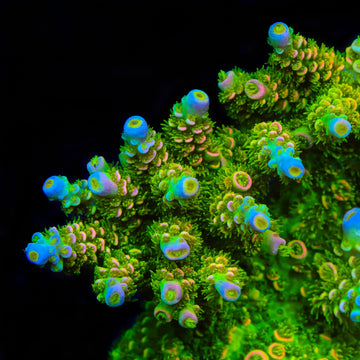
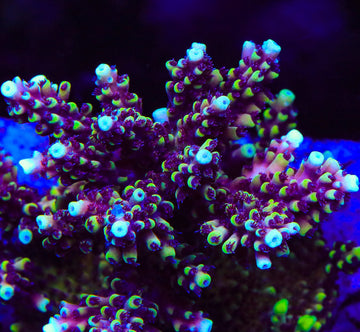
Banana Hammock Acropora Coral displays thick, staghorn-like branches with rounded axial corallites and bright yellow to green tips. Acropora tenuis is a branching small-polyp stony coral that prefers strong lighting and high, turbulent water flow. It is primarily photosynthetic through symbiotic algae, with occasional small plankton feedings supporting growth and color. Place high in the rockwork with space for branching, and avoid shading or contact with aggressive corals.
Quick Facts
Care
Difficult
Lighting
High
Flow
High
Placement
High
Temperament
Peaceful (2–4 inches spacing)
Recommended Parameters
Temp
76–80°F
pH
8.2–8.4
Salinity
1.025–1.026
Calcium
420–450 ppm
AlkAlkalinity
8–9 dKH
Magnesium
1280–1350 ppm
Feeding
photosynthetic (primary), microzooplankton, rotifers, copepod nauplii, oyster eggs, reef roids–type coral foods, marine snow, amino acid supplements
Care & Placement
FAQ
Frequently Asked Questions
About the CC Banana Hammock Acropora Coral
-
Why does my Banana Hammock Acropora (Acropora tenuis) lose its yellow and turn green or brown?
Color swings often track nutrient/light balance and trace elements. Elevated nitrate/phosphate or low PAR push green/brown. Aim for stable, moderate nutrients (e.g., NO3 5–15 ppm, PO4 0.03–0.08 ppm) and 250–400 PAR with strong blue spectrum. Check potassium (380–420 ppm) for blue tips; excess iron can green the tissue. Improve chaotic flow, avoid shading, and stabilize alkalinity before chasing supplements. -
My tenuis tips are burning or receding despite “good” parameters. What’s the likely cause?
Tip burn often follows high PAR paired with high alkalinity in low-nutrient systems. Keep alk steady around 7.5–8.5 dKH, ramp light intensity slowly, and ensure nutrients aren’t bottoming out. Increase turbulent flow rather than blasting the colony. If necrosis starts, clip healthy margins, iodine or commercial dip, boost flow, and remove detritus traps at the base. -
How can I encourage faster plating and branch density in this coral?
Mount frags horizontally or at a slight angle to promote a wide encrusting base, then branching. Provide cross-flow that alternates direction to keep polyps extended on all sides. Maintain stable calcium/magnesium and feed small particle foods or aminos sparingly at night to support tissue without elevating nutrients. Avoid overcrowding; tenuis shades itself quickly, so prune nearby SPS to keep light around the base. -
Are there pests or interactions uniquely troublesome for Acropora tenuis?
A. tenuis is a prime target for Acropora-eating flatworms and red bugs. Use a strict quarantine and periodic inspections (flashlight at night, baster blasts to spot flatworms). Soft corals can chemically irritate tenuis; run fresh carbon and keep distance from LPS with long sweepers. Spiders on Acropora are rare but possible—dip new pieces and scrutinize at branch junctions and axial tips.