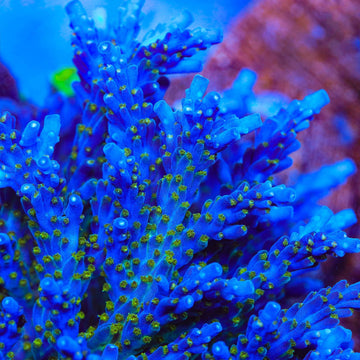
CB Maleficent Acropora Coral
Overview
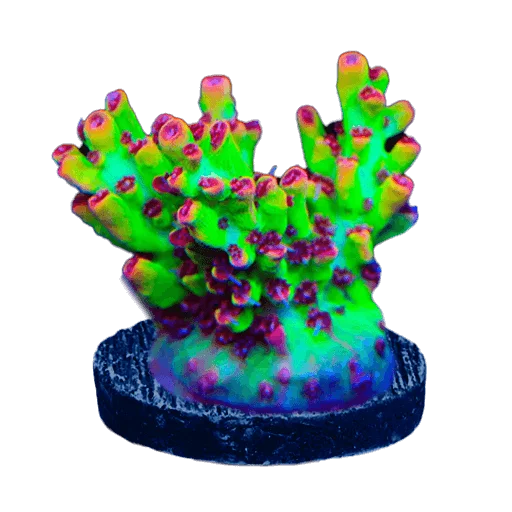
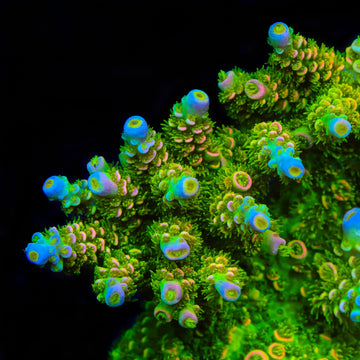
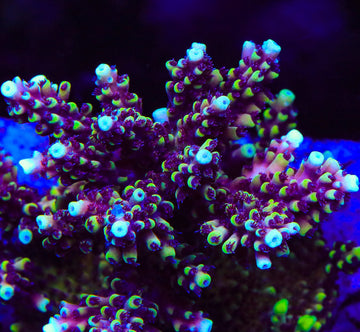
CB Maleficent Acropora Coral forms compact, branching colonies with short, tapered branches and distinct corallite ridges, often showing contrasting branch tips. Acropora tenuis is a small-polyp, branching stony coral that prefers high light and strong, variable water flow. It is primarily photosynthetic through symbiotic algae, with occasional feeding of fine planktonic foods helping growth and color stability. Place high on stable rockwork with room for outward growth, and keep distance from aggressive corals to prevent tissue damage.
Quick Facts
Care
Difficult
Lighting
High
Flow
High
Placement
High
Temperament
Peaceful (short sweepers; 2–3 inches spacing)
Recommended Parameters
Temp
76–80°F
pH
8.1–8.4
Salinity
1.025–1.026
Calcium
420–450 ppm
AlkAlkalinity
7.5–9 dKH
Magnesium
1280–1350 ppm
Feeding
photosynthetic (primary), microplankton, rotifers, copepod nauplii, oyster eggs, Reef-Roids, amino acid supplements
Care & Placement
FAQ
Frequently Asked Questions
About the CB Maleficent Acropora Coral
-
Why does my CB Maleficent Acropora (A. tenuis) look dull under white lights but glow under blues?
This morph expresses strong fluorescence under 420–460 nm. Run a blue-heavy spectrum (peaks near 430–450 nm) for color pop, but maintain enough broad spectrum to prevent browning. Sudden spectrum shifts can wash out pigments; acclimate over 2–3 weeks. Stable nutrients (NO3 5–15 ppm, PO4 0.02–0.06) and consistent alkalinity (7.5–8.5 dKH) help sustain its dark base and neon tips. -
My colony encrusts fast but won’t branch—normal for this coral?
Yes. A. tenuis often encrusts to anchor before vertical growth. Improve cross-flow to clear mucus and detritus, and avoid shadowing by nearby colonies. Keep PAR 250–350 at the tips, slightly lower on the base. If PAR is too low or alk swings occur, branching stalls. Once a stable platform forms, axial tips usually push rapidly. -
How can I preserve the signature tip color while boosting growth?
Push growth with moderate nutrients and stable alk, but avoid high alk (>9 dKH) under intense light, which can cause tip burn and faded pigments. Dose trace elements tied to tenuis coloration—potassium, iron, and manganese—in small, tested increments. Feed fine particulates or aminos sparingly at night for polyp uptake. Overfeeding shifts to brown; aim for steady, not ultra-lean, conditions. -
Best strategy to spot and manage pests specific to Acropora like this?
Inspect nightly with a blue flashlight and orange filter for bite marks or faded patches. For AEFW, look for oval bite scars and egg clusters on undersides; turkey baste to dislodge. Quarantine new frags, perform weekly dips (iodine or coral-specific) for 3–4 weeks, and increase flow to discourage settlement. Red bugs respond to targeted treatments; maintain pod populations after treatment.