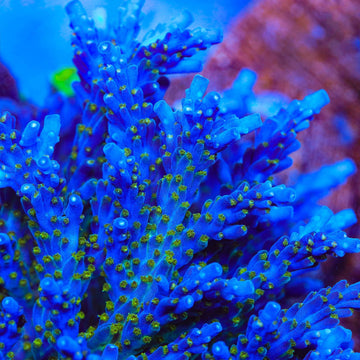
CB Golden Jawdropper Acropora Coral
Overview
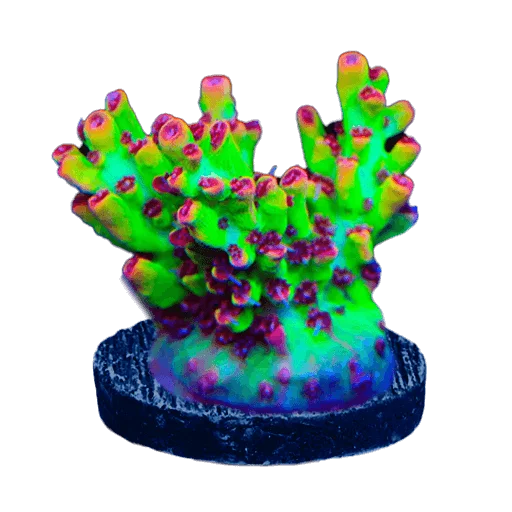
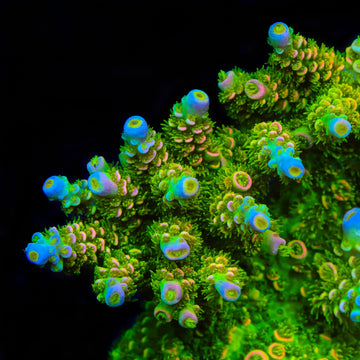
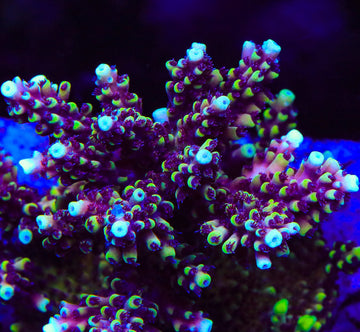
CB Golden Jawdropper Acropora Coral shows bright golden branch tips with tightly spaced axial corallites. Acropora tenuis is a branching small-polyp stony coral that prefers strong light and moderate to strong, turbulent flow. It relies on symbiotic algae for most nutrition but will take fine particulate foods, which can support growth and color. Place high with good spacing from aggressive corals, and avoid shading or direct contact.
Quick Facts
Care
Difficult
Lighting
High
Flow
High
Placement
High
Temperament
Semi-aggressive (short sweepers; 3–4 inches spacing)
Recommended Parameters
Temp
76–80°F
pH
8.1–8.4
Salinity
1.025–1.026
Calcium
420–450 ppm
AlkAlkalinity
7.5–9 dKH
Magnesium
1280–1380 ppm
Feeding
photosynthetic (primary), microzooplankton, rotifers, copepod nauplii, coral-specific powdered foods, amino acids
Care & Placement
FAQ
Frequently Asked Questions
About the CB Golden Jawdropper Acropora Coral
-
Why did my CB Golden Jawdropper Acropora lose its golden tones after increasing light?
Acropora tenuis colors depend on spectrum and nutrients, not just PAR. Keep strong blue-violet (420–470 nm) with modest white. Avoid “ultra-low nutrient” conditions; aim for nitrate 5–15 ppm and phosphate 0.03–0.08 ppm. Maintain stable alkalinity (7.8–8.6 dKH) and potassium ~390–420 ppm. Trace metals (iron, manganese) in small, monitored doses can support yellow fluorescence—verify with ICP before dosing. -
How can I promote its signature branching without self-shading and tip burn?
Let it fully encrust before pushing PAR. Use high, chaotic flow that oscillates rather than a direct jet at tips. Periodically trim inner branches to open channels and prevent tissue loss at the base. Mount on a pedestal or isolated rock to keep light around the colony’s lower half. Increase light gradually (10–15% weekly) to avoid burnt tips. -
Are there pests this tenuis morph is especially vulnerable to, and how do I catch them early?
Acropora-eating flatworms often target tenuis; look for crescent bite marks and pale patches between corallites. Dip new frags and inspect undersides with a flashlight 1–2 hours after lights out. Red bugs reduce polyp extension and color richness. Quarantine all Acropora, employ wrasses (e.g., Halichoeres) as sentries, and use targeted treatments only after confirming pests to avoid stress. -
My colony is receding from the base while tips look fine—what should I adjust first?
Improve turbulent flow to the base to reduce detritus and boundary layer buildup. Nudge nutrients upward if near zero. Verify alk stability (daily swings trigger STN), and check for shadowing—thin or trim interior branches. Temporarily lower PAR 10–20% while correcting conditions. If recession continues, frag healthy tips ahead of the necrosis line and consider a short iodine dip.