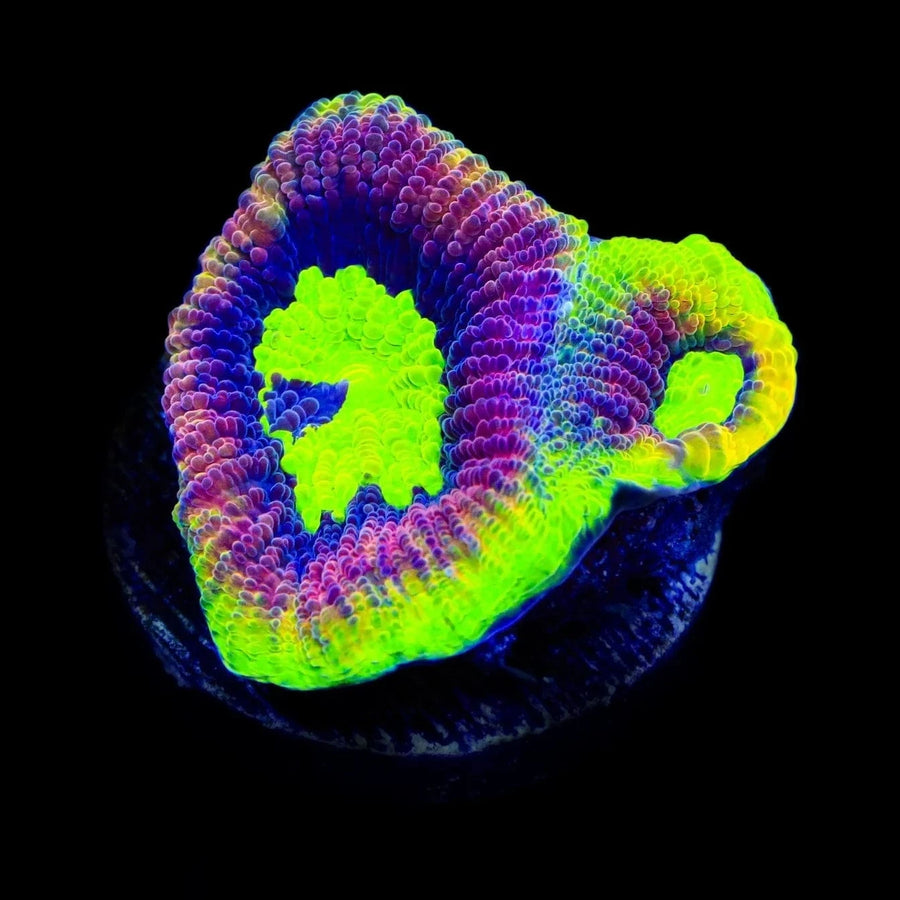
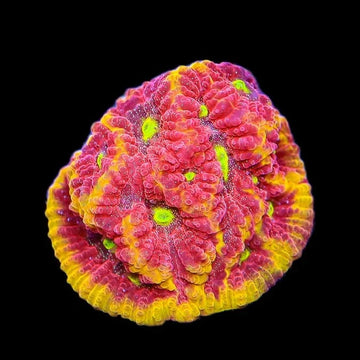
CB Angel Eye Favia Coral
Overview
CB Angel Eye Favia Coral shows round, raised corallites with contrasting centers and rims. Scientifically Favia favus, it is a stony, colonial brain coral that prefers moderate lighting and low to moderate, steady water flow. It relies on symbiotic algae for energy but accepts small meaty foods at night, which can boost growth and maintain color. Place with space around it, as night sweeper tentacles can sting nearby corals.
Quick Facts
Care
Easy
Lighting
Low–Moderate
Flow
Moderate, indirect
Placement
Low–Mid
Temperament
Semi-aggressive (4–6 inches spacing)
Recommended Parameters
Temp
76–80°F
pH
8.1–8.4
Salinity
1.025–1.026
Calcium
400–450 ppm
AlkAlkalinity
8–10 dKH
Magnesium
1280–1350 ppm
Feeding
photosynthetic, mysis shrimp, enriched brine shrimp, finely chopped krill or clam, copepods, zooplankton, microplankton, coral-specific powdered foods
Care & Placement
FAQ
Frequently Asked Questions
About the CB Angel Eye Favia Coral
-
Why does my CB Angel Eye Favia show bright “eyes” at night but look dull by day?
Favia favus inflates polyps and extends feeder tentacles after lights out, exposing fluorescent pigments concentrated around corallite mouths (“eyes”). Under strong daytime intensity it may keep tissue tighter, muting the glow. Try a dusk/dawn ramp, moderate PAR (80–150), and stable nutrients. A brief blue-only viewing period at night reveals peak fluorescence without stressing the coral. -
How far can its sweeper tentacles reach, and which neighbors are most at risk?
Sweepers commonly reach 2–4 inches, sometimes more in higher flow. They pack potent nematocysts that can burn other LPS and zoanthids; chalices and acans are frequent casualties. Give 4–6 inches clearance, aim flow to carry sweepers away from prized neighbors, and avoid placing it downstream of sensitive fleshy corals. Nighttime observations help confirm safe spacing. -
My “Angel Eye” started receding from the base while new heads still feed—what’s the likely cause?
This pattern points to alk/calcium instability or vermetid snail irritation rather than lighting alone. Check dKH drift, maintain steady Ca/Mg, and look for mucous threads from vermetids abrading tissue. Improve flow around the base, epoxy over offending snail tubes, and run a brief iodine dip if recession edges are ragged. Resume small, frequent feedings to support recovery. -
Why did the center “eye” colors shift after I increased blue light?
The species can upregulate or downregulate fluorescent proteins with spectral changes. Increased blue often boosts fluorescence but can mask underlying pigments or push the coral to shed some chromoproteins. Balance spectrum with moderate white/UV, keep PAR stable for 2–3 weeks, and avoid rapid nutrient reductions. Mild target feeding at night supports pigment redevelopment while the coral acclimates.