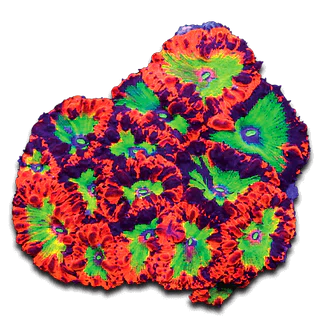
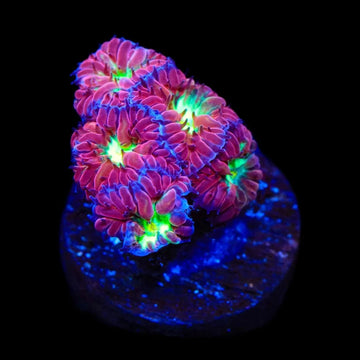
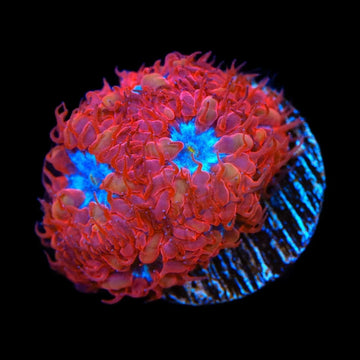
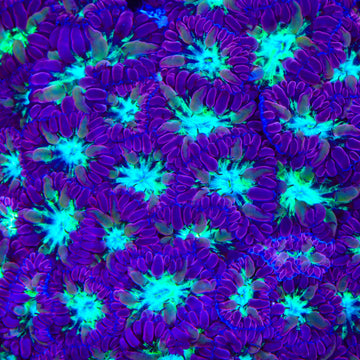
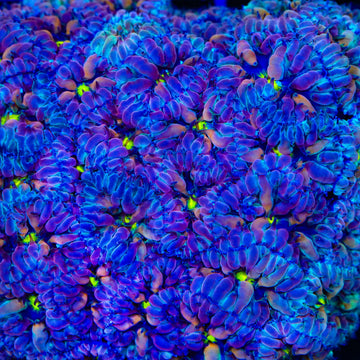
BSA Titty Twister Blastomussa Coral
Overview
BSA Titty Twister Blastomussa Coral displays thick, fleshy polyps with contrasting central mouths. Blastomussa wellsi is a large-polyp stony coral forming clustered heads; provide low to moderate light and gentle, low flow. It relies on symbiotic algae for energy but benefits from occasional small meaty feedings, which can speed growth and deepen color. Place on sand or isolated rock with space around it, as it can extend short sweepers and may sting nearby corals.
Quick Facts
Care
Moderate
Lighting
Low–Moderate
Flow
Low–Moderate
Placement
Low–Mid
Temperament
Semi-aggressive (3–4 inches spacing)
Recommended Parameters
Temp
76–80°F
pH
8.1–8.4
Salinity
1.025–1.026
Calcium
400–450 ppm
AlkAlkalinity
8–9.5 dKH
Magnesium
1280–1350 ppm
Feeding
photosynthetic, mysis shrimp, enriched brine shrimp, finely chopped shrimp or clam, zooplankton, microplankton, Reef Roids, LPS pellets
Care & Placement
FAQ
Frequently Asked Questions
About the BSA Titty Twister Blastomussa Coral
-
Why does my BSA Titty Twister Blastomussa Coral inflate and deflate at odd times, and does that affect placement?
B. wellsi polyps cycle inflation to regulate gas exchange and light exposure. Mid, indirect flow helps prevent tissue abrasion when fully inflated. Sudden deflation can follow alkalinity or temperature swings; verify stability before moving it. Place where light is diffuse (edges of rockwork) to avoid bleaching of high-chroma morphs while keeping enough PAR to maintain color without browning. -
My B. wellsi lost color after a month—how can I bring back the vivid tones without bleaching?
Color often fades from low PAR combined with depleted nutrients or trace imbalance. Aim for moderate PAR (~80–120), steady nitrate 5–15 ppm, phosphate 0.03–0.1 ppm. Target feed small meaty foods 1–2x/week at night when feeders extend. Maintain consistent alkalinity 8–9 dKH and adequate magnesium. Gradually increase light over 2–3 weeks; rapid jumps can wash out pigments. -
Are there pests or hidden irritants that uniquely bother this fleshy LPS?
Vermetid snails’ mucus webs and hydroids can cause chronic retraction and tissue pinching. Amphipod swarms occasionally nip at stressed polyps. Inspect for brown jelly after shipping; early signs are milky slime and rapid recession. Respond with a broad-spectrum coral dip, siphon affected tissue, and boost flow slightly around the base. Avoid hydrogen peroxide on flesh; it burns this species. -
Can I keep it near torches or acans, and does it have long sweepers?
B. wellsi has short, non-violent sweepers but a wide, delicate mantle. Euphyllia and aggressive acanthophyllia can sting through inflation cycles, causing slow recession. Give at least 7–10 cm clearance, more in variable flow. Zoas can overgrow the base; prune them back. If space is tight, place B. wellsi on an isolated island rock to prevent encroachment while maintaining stable flow.