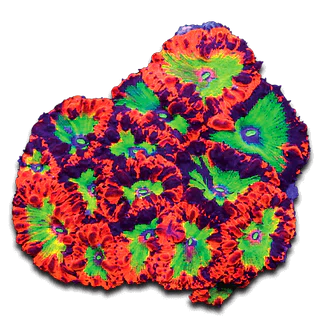
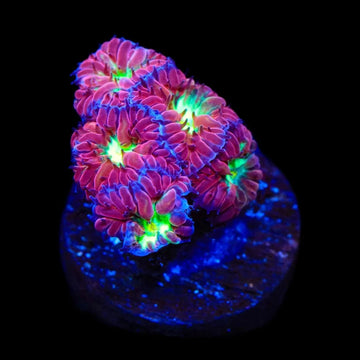
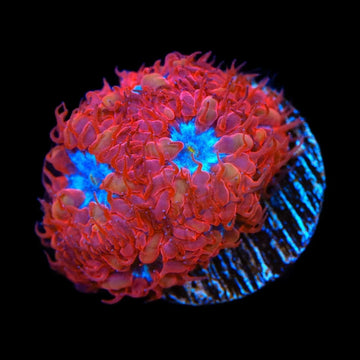
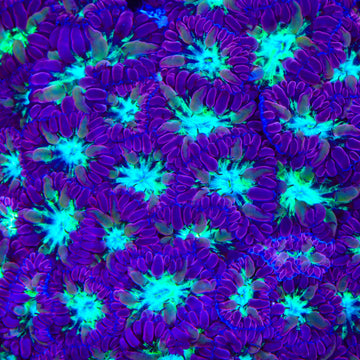
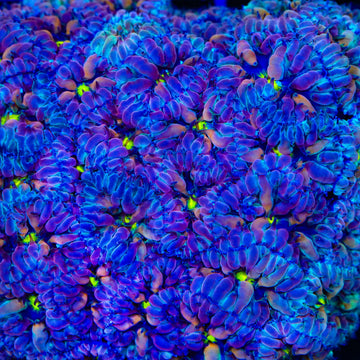
Barbie Party Blastomussa Coral
Overview
Barbie Party Blastomussa Coral shows fleshy, round polyps with raised ridges and a central mouth. Blastomussa wellsi is a large-polyp stony coral that forms dome-shaped colonies; it prefers low to moderate light and gentle, indirect flow. It hosts symbiotic algae for energy but benefits from occasional small meaty feedings, which support faster growth and fuller polyp extension. Place it on stable rock or sand with space around it, and avoid strong light or flow that can cause tissue recession.
Quick Facts
Care
Moderate
Lighting
Low–Moderate
Flow
Low–Moderate
Placement
Low–Mid
Temperament
Semi-aggressive (3–4 inches spacing)
Recommended Parameters
Temp
76–80°F
pH
8.1–8.4
Salinity
1.025–1.026
Calcium
400–450 ppm
AlkAlkalinity
8–10 dKH
Magnesium
1280–1350 ppm
Feeding
photosynthetic, mysis shrimp, enriched brine shrimp, finely chopped krill or clam, zooplankton, microplankton, coral-specific powdered foods
Care & Placement
FAQ
Frequently Asked Questions
About the Barbie Party Blastomussa Coral
-
My Barbie Party Blastomussa Coral inflates huge by day but shrinks at night—normal or a stress sign?
Normal. Blastomussa wellsi from deeper, calmer zones expand tissue in lower light and contract after lights out. If nighttime shrinkage shows exposed, receding rims or slime, check for too much flow, vermetid snail irritation, or nocturnal feeders stealing food. Maintain gentle, indirect flow and keep PAR ~50–120. Non-zero nutrients help keep tissue plump. -
Why is the pink/magenta fading to beige under strong LEDs?
This morph often washes out under high PAR or heavy white channels. Gradually reduce intensity and bias spectrum toward blue-violet. Keep nitrate 5–15 ppm and phosphate 0.03–0.1 ppm; ultra-low nutrients starve pigments. Stable potassium and iodine support reds/pinks. Allow 2–3 weeks for recoloration after changes—avoid rapid swings. -
The colony is receding from the base while the tops look fine—what causes this?
Detritus and bacterial films trapped at the skeleton base are common triggers. Lift the coral, turkey-baste the underside weekly, and ensure low, cross-flow to prevent buildup. Inspect for vermetid snails and remove if present. If tissue damage is visible, do an iodine dip and place in lower light during recovery. Maintain stable alkalinity to prevent further loss. -
Can I keep it on the sandbed, or does it need a rock ledge?
Sandbed is fine if the grains are not coarse and the area stays clean. Place on a small, smooth tile or flat rubble to prevent abrasion and make future moves easy. Avoid direct blast from pumps; the coral should gently sway, not pucker. Keep aggressive LPS (e.g., Favids, some Euphyllia) a few inches away to prevent stings.