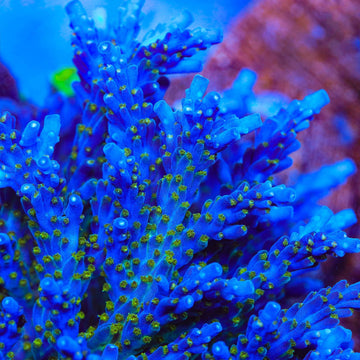
Banana Lokani Acropora Coral
Overview
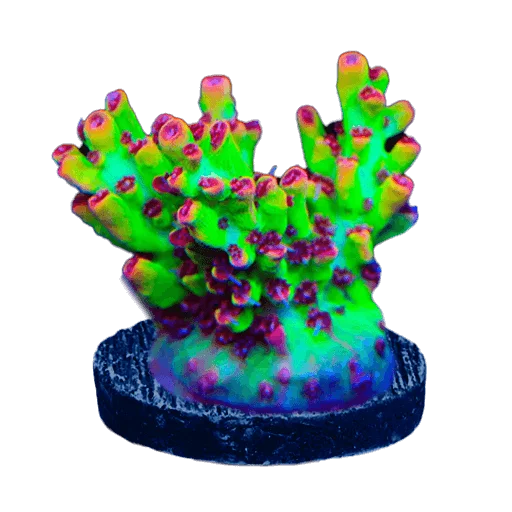
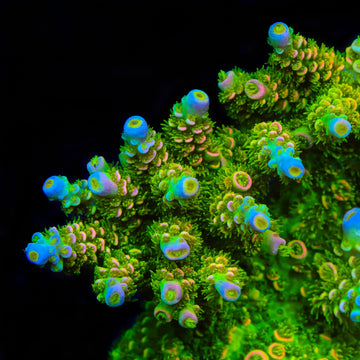
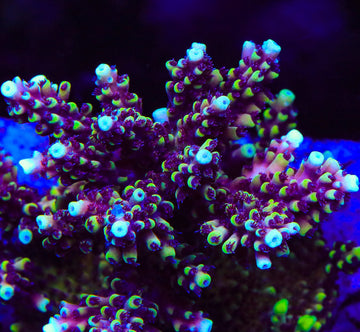
Banana Lokani Acropora Coral shows bright yellow to green branches with smooth axial tips. Acropora lokani is a branching small-polyp stony coral requiring strong light and moderate to strong, turbulent water flow. It relies mainly on symbiotic algae for energy but can benefit from occasional small particulate foods, which may support growth and maintain color. Place high on stable rockwork with space from aggressive neighbors, and keep parameters stable to prevent tissue loss.
Quick Facts
Care
Difficult
Lighting
Moderate
Flow
High, turbulent
Placement
Mid–Low
Temperament
Semi-aggressive (2–4 inches spacing)
Recommended Parameters
Temp
76–80°F
pH
8.1–8.4
Salinity
1.025–1.026
Calcium
420–450 ppm
AlkAlkalinity
7–9 dKH
Magnesium
1250–1350 ppm
Feeding
photosynthetic (primary), microplankton, rotifers, copepod nauplii, powdered coral foods (e.g., Reef-Roids), oyster eggs/oyster feast, amino acid supplements
Care & Placement
FAQ
Frequently Asked Questions
About the Banana Lokani Acropora Coral
-
Why does my Banana Lokani lose its yellow and turn olive/brown under blues?
Acropora lokani is a deepwater species; its yellow pigments wash out if PAR is too low or spectrum is overly blue-heavy without enough white/cyan. Increase PAR gradually to the 180–250 range, add some 10–12K daylight channels for a few hours, and keep nutrients moderate (NO3 ~5–15 ppm, PO4 ~0.03–0.08). Avoid red/green overshoot, which can push it toward drab tones. -
My Lokani shows “burnt” tips after a water change—what’s the likely cause?
Tip burn in A. lokani often follows alkalinity spikes or rapid shifts in CO2/pH. Deepwater acros are touchy about stability. Match new water’s alkalinity to within 0.2 dKH, spread dosing over multiple smaller additions, and maintain strong, alternating flow around the tips. If damage occurs, hold parameters steady; avoid large corrections and watch for RTN. -
Detritus keeps settling between the blades—any tips to prevent recession there?
Lokani’s flattened branches trap fines. Use a periodic “storm” routine: once or twice weekly, baste the colony and rockwork before filtration peaks, and run a short surge of mechanical filtration. Adjust flow to create cross-currents rather than a single jet. Keep vermetid snails in check; their mucus nets amplify detritus buildup and can irritate tissue, triggering STN lines. -
What night-time care changes improve polyp extension and growth?
This species extends more after lights out. Run a gentle feeding window 30–60 minutes into darkness with fine zooplankton (e.g., 100–300 µm) and modest amino dosing. Temporarily reduce return flow slightly to keep food suspended without settling on blades, then restore normal flow. Don’t overfeed—excess organics fuel film algae on the plate surfaces and stress tissue.