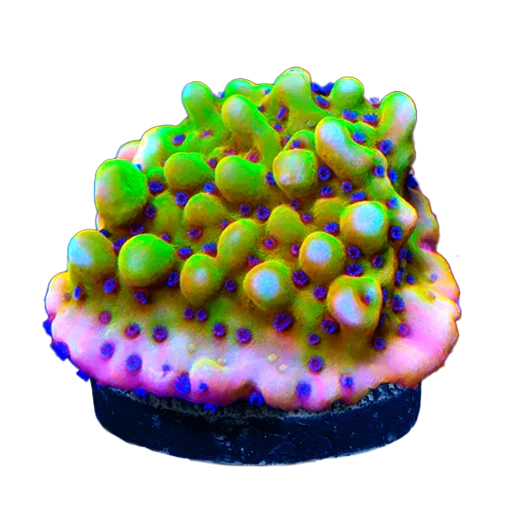
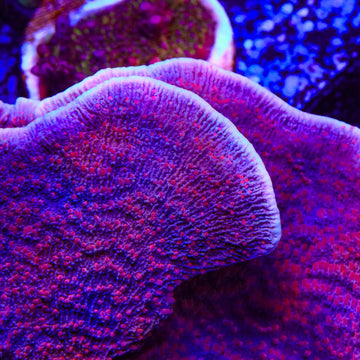
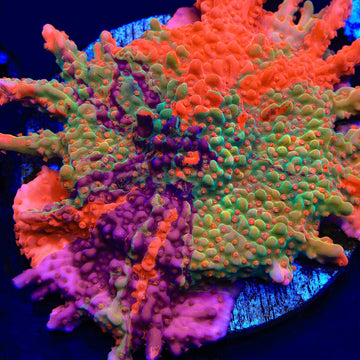
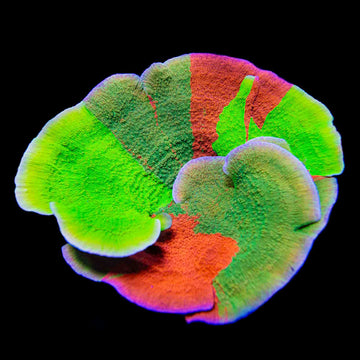
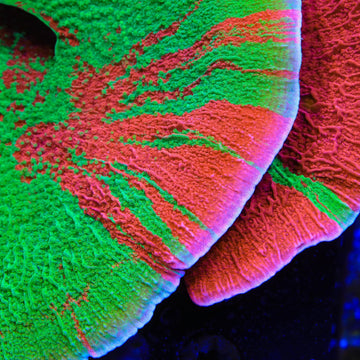
ACI Manila Spy Montipora Coral
Overview
ACI Manila Spy Montipora Coral shows a plating to encrusting growth form with fine, closely spaced polyps. Montipora sp., a small-polyp stony coral, prefers moderate to strong light and moderate to high, stable water flow. It is primarily photosynthetic through symbiotic algae but can benefit from occasional small-particle foods, which may support growth and coloration. Place on stable rock with room to spread, and keep distance from aggressive, stinging neighbors to avoid tissue damage.
Quick Facts
Care
Moderate
Lighting
Moderate–High
Flow
Moderate-High
Placement
Mid–High
Temperament
Peaceful (2–3 inches spacing)
Recommended Parameters
Temp
76–80°F
pH
8.1–8.4
Salinity
1.025–1.026
Calcium
420–450 ppm
AlkAlkalinity
8–10 dKH
Magnesium
1280–1350 ppm
Feeding
photosynthetic (primary), phytoplankton, rotifers, copepod nauplii, microplankton, powdered coral foods (e.g., Reef-Roids), marine snow, bacterioplankton, amino acid supplements
Care & Placement
FAQ
Frequently Asked Questions
About the ACI Manila Spy Montipora Coral
-
Why does my ACI Manila Spy Montipora switch from encrusting to plating, and how can I encourage that signature shelf growth?
Many Montipora start by encrusting to anchor, then plate once they sense stable light and flow. Give strong, turbulent flow and a wide, evenly lit area with minimal shading. Mount the frag on a vertical edge or the lip of rock so new growth can “catch” light. Avoid crowding; self-shading stalls shelf formation. -
Color looks dull under whites but pops under blues—is this normal for Manila Spy?
Yes. This strain often shows higher contrast polyps and base under blue-heavy spectrum. Keep PAR moderate-high but avoid sudden jumps. Maintain steady nutrients (nitrate 5–15 ppm, phosphate 0.03–0.1 ppm). Trace balance matters: potassium near 400 ppm supports reds/pinks, iron/manganese help greens. Excess nutrients brown it; ultra-low levels wash it out. -
I’m noticing tiny scalloped bite marks and nighttime “fuzz” on the edges—what should I do?
That suggests Montipora-eating nudibranchs. Inspect after lights out with a flashlight; remove adults with tweezers and siphon egg spirals. Perform repeated dips (iodine or coral-safe pest dips) every 4–5 days to catch hatch cycles. Increase random flow around edges. Isolate the colony, and consider a wrasse known for picking pests as a support, not a cure. -
The base is receding slowly (STN) despite stable numbers—any advanced steps beyond “check parameters”?
Trim 3–5 mm into healthy tissue ahead of the receding line and remount the healthy piece in stronger cross-flow. Do an iodine or antibiotic-bath per label if bacterial stress is suspected. Verify daily alkalinity stability (swing <0.3 dKH), calibrate probes, and run fresh carbon if nearby leathers are present. Improve micro-turbulence; stagnant spots trigger basal recession.