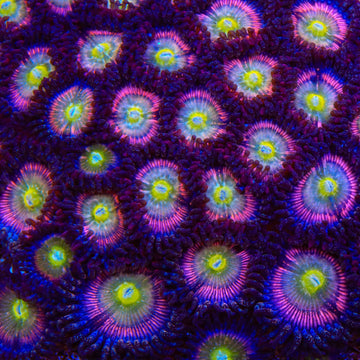
ACI Lorax Zoanthids Coral
Overview
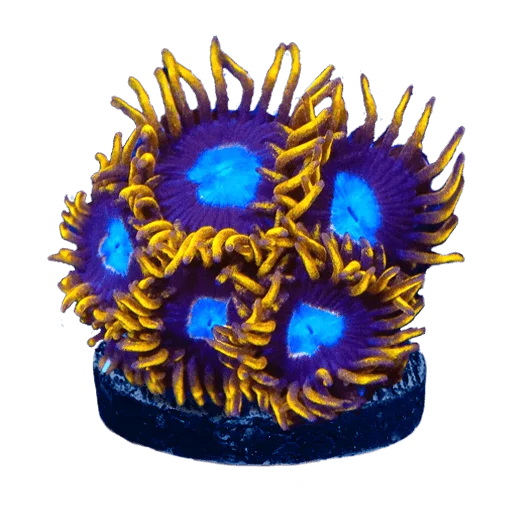
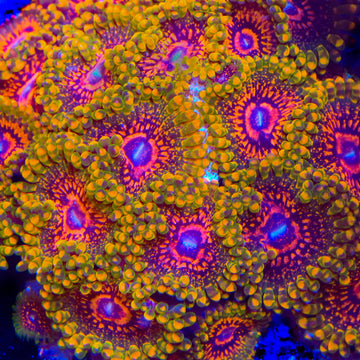
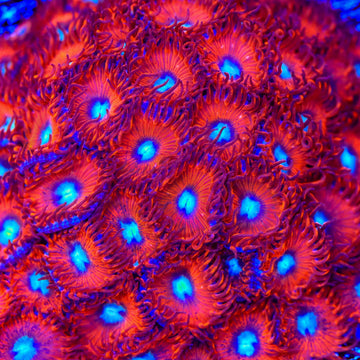
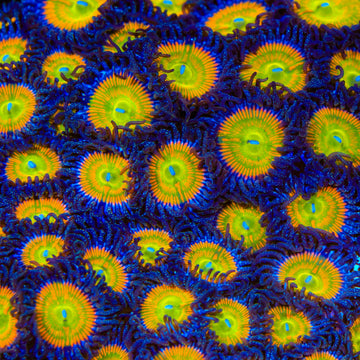
ACI Lorax Zoanthids Coral displays small button-like polyps with a contrasting disc and skirt. Classified as Zoanthus sp., it is a soft colonial polyp that forms mats and prefers moderate light with moderate, variable water flow. It is photosynthetic via symbiotic algae but accepts occasional small meaty or planktonic foods, which can support faster growth and stronger color. Place on an isolated rock to control spread and keep distance from aggressive neighbors; handle with care and avoid contact with eyes and mouth.
Quick Facts
Care
Easy
Lighting
Moderate
Flow
Moderate, indirect
Placement
Low–Mid
Temperament
Semi-aggressive (2–4 inches spacing)
Recommended Parameters
Temp
76–80°F
pH
8.1–8.4
Salinity
1.025–1.026
Calcium
380–450 ppm
AlkAlkalinity
8–9 dKH
Magnesium
1250–1350 ppm
Feeding
photosynthetic (primary), dissolved organics, amino acids, phytoplankton, rotifers, copepods/cyclops, powdered coral foods (e.g., Reef-Roids), marine snow
Care & Placement
FAQ
Frequently Asked Questions
About the ACI Lorax Zoanthids Coral
-
Why do my ACI Lorax Zoanthids shrink or stay closed after looking fine the first week?
They often react to rapid light or nutrient changes. Acclimate to 80–150 PAR with strong blue/UV and moderate, indirect flow. Keep detectable nutrients (nitrate 5–15 ppm, phosphate 0.03–0.1 ppm). Inspect at night for pests. If you see pox-like bumps, a Furan-2 bath can help. For general irritation, try an iodine dip, reduce white light, and stabilize alkalinity and salinity. -
How can I keep the Lorax coloration vivid without browning or washing out?
Prioritize 420–470 nm spectrum with modest whites and stable nutrients. Too low nutrients dulls color; too high grows film algae that irritates skirts. Maintain nitrate 5–15 ppm, phosphate 0.03–0.1 ppm, and steady alkalinity 8–9 dKH. Trace balance matters—avoid heavy dosing; small, regular water changes typically suffice. Increase blue intensity gradually over weeks to avoid photobleaching and reduced polyp extension. -
What’s a safe, high-keep propagation method for this Zoanthus sp.?
Wear eye/skin protection and work in ventilated areas. Slice the mat between polyps, not through mouths. Rinse and dip in iodine, then mount on plugs using a thin glue line around the mat’s edge to prevent lift. Heal in lower light and gentle flow for 5–7 days. Avoid heavy feeding during healing; resume normal light slowly once full extension returns. -
Which pests target Lorax zoas, and what’s the best eradication plan?
Zoa-eating nudibranchs, sundial snails, and zoa spiders are the main threats. Look for bite scallops on skirts, tiny egg spirals, or stuttering polyp extension. Manually remove adults, then perform repeated dips (every 3–4 days for 2 weeks) to catch hatch cycles. Night inspections help. A wrasse (e.g., Melanurus) can add pressure, but dips and quarantine are the backbone.