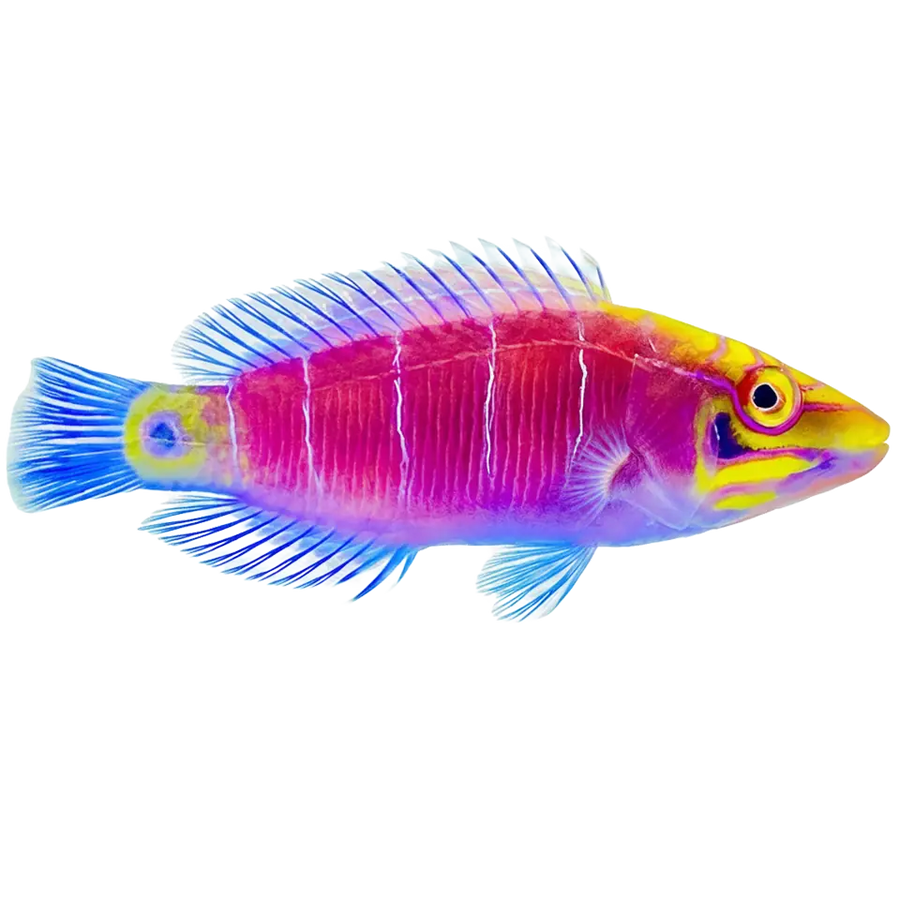
Orangeback Fairy Wrasse saltwater fish care guide

Overview:
The Orangeback Fairy Wrasse (Cirrhilabrus aurantidorsalis) is a vibrant and active marine fish that thrives in a well-maintained aquarium environment. This species requires a tank of at least 55 gallons, with plenty of live rock for hiding and exploration. Optimal water conditions include a temperature range of 72-78°F, a pH of 8.1-8.4, and a salinity of 1.020-1.025. A moderate water flow and a well-oxygenated environment are essential. The Orangeback Fairy Wrasse is known for its peaceful nature, making it an excellent addition to a community reef tank. It is important to have a secure lid on the aquarium as this species is prone to jumping.

Compatibility:
The Orangeback Fairy Wrasse is generally peaceful and can coexist with a variety of other non-aggressive fish species. Ideal tankmates include other fairy wrasses, gobies, blennies, and small tangs. It is advisable to avoid housing them with aggressive or territorial species such as larger wrasses or dottybacks, as these can cause stress or aggression. Introducing multiple fairy wrasses simultaneously can help reduce territorial disputes. Providing ample hiding spaces and maintaining a balanced male-to-female ratio can further promote harmony within the tank.

Health and Quarantine:
Regular monitoring of water parameters and maintaining a clean environment are crucial for the health of the Orangeback Fairy Wrasse. Common health issues include marine ich and bacterial infections, which can be mitigated through proper quarantine procedures and maintaining optimal water quality. New additions should be quarantined for 2-4 weeks before introduction to the main tank to prevent the spread of disease. Observing fish behavior and appearance can help detect early signs of illness. Providing a diet rich in nutrients and vitamins can boost their immune system, reducing the likelihood of health issues. Regular tank maintenance, including water changes and equipment checks, is essential for preventing disease and promoting a healthy aquarium ecosystem.

Pellets Mysis Finely Chopped Seafood
The Orangeback Fairy Wrasse is an active swimmer, often exploring all levels of the aquarium. It exhibits peaceful social behavior, thriving in groups with other non-aggressive fish. This species is not territorial, making it a suitable addition to community tanks. They coexist well with other peaceful reef-safe species but should not be housed with aggressive fish. Known for their vibrant display, they are best kept in a 50-gallon tank or larger, with plenty of hiding spots and open swimming space, feeding on mysis shrimp, brine shrimp, and chopped seafood.

FAQ

Frequently Asked Questions

About the Orangeback Fairy Wrasse

  • Can male Orangeback Fairy Wrasses change color depending on mood or hierarchy, and what does it look like in the home aquarium?
    Yes. Males show dynamic coloration based on mood, social status, and courtship. A relaxed male displays a solid orange back with pink to reddish sides and bluish highlights. When displaying to females or competing with another male, he can intensify his colors dramatically: the orange back glows brighter, the pink/red body deepens, and blue and purple edges along fins become more vivid, sometimes with rapid flashing. This “display mode” is usually brief and most often seen at dusk, when fairy wrasses naturally perform courtship and “flashing” behavior. Providing a consistent day–night schedule, stable water parameters, and at least one female often brings out these natural displays.
  • How prone is the Orangeback Fairy Wrasse to jumping compared to other fairy wrasses, and what tank-cover details are important for this species?
    Orangeback Fairy Wrasses are extreme jumpers, among the worst offenders even within the fairy wrasse group. They launch at high speed when startled, especially at lights on/off, sudden room movement, or aggression from tankmates. A tight-fitting cover is essential: gaps should be under 6 mm (¼") around plumbing and cords, and mesh should be ¼" or smaller to prevent the fish from squeezing through. Glass lids work, but condensation and reduced gas exchange can be issues, so many keepers prefer rigid net covers. Ensure no gaps at overflow boxes and that canopy lids are fully closed; many losses come from “tiny gap” escapes rather than open tops.
  • Why does my Orangeback Fairy Wrasse dive into the rockwork at night instead of burying in sand like some wrasses?
    Unlike Halichoeres and some other wrasse genera that bury in the sand, Orangeback Fairy Wrasses (Cirrhilabrus) naturally sleep in crevices and among branching corals. At night, they dive into rockwork and wedge themselves tightly, often secreting a thin mucus coating that masks scent and deters parasites and predators. This is normal and not a sign of stress. In captivity, provide porous live rock with plenty of crevices and caves; they do not require sand for sleeping. If you see your wrasse “disappear” at lights out and reappear in the morning from the rocks, this is typical behavior for the species.
  • Can I keep multiple Orangeback Fairy Wrasses together, and how do I form a peaceful harem in a reef tank?
    Yes, you can keep a harem (one male with several females) in sufficiently large systems, generally 75–90 gallons or more with plenty of rock structure. Start with one known male and 2–4 females, or a small group of juveniles that will sort out hierarchy and develop one dominant male. Add all fairy wrasses in the group at the same time if possible. Avoid keeping two established males in smaller tanks; intense chasing and stress can occur. Provide broken lines of sight and strong, varied flow so subordinates can escape. The dominant male will display to females, boosting coloration and natural behavior. If you add a new male into an existing male’s territory, use an acclimation box to gauge aggression before release.
  • My Orangeback Fairy Wrasse constantly cruises the mid-water and seems restless; how much flow and swimming space does this species really need to thrive?
    Orangeback Fairy Wrasses are highly active, open-water cruisers. They do best in tanks at least 4 feet long, where they can continuously swim in the mid to upper water column. Provide moderate to strong, varied flow using wavemakers or gyres aimed across the length of the tank, not directly at the fish. They like to swim in and out of current rather than being blasted in a single stream. Too little flow and cramped layouts can make them seem bored and edgy, sometimes leading to pacing and increased jump attempts. Aquascape with open channels for swimming plus rock formations for shelter; this combination supports their constant cruising behavior while providing secure retreat zones.