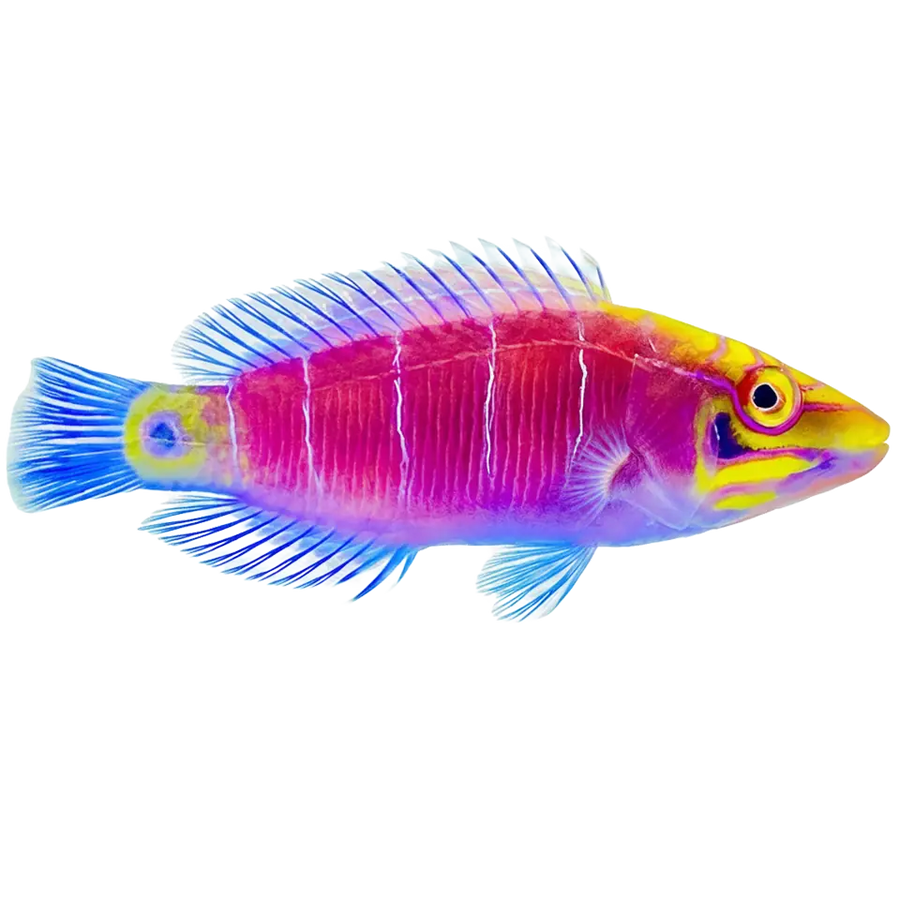
Yellow-Flanked Fairy Wrasse saltwater fish care guide

Overview:
The Yellow-Flanked Fairy Wrasse, a vibrant and active marine fish, thrives in well-maintained reef aquariums. It requires a tank of at least 50 gallons with plenty of live rock for hiding and exploring. The ideal water conditions include a temperature range of 72-78°F, a pH of 8.1-8.4, and a specific gravity of 1.020-1.025. A moderate to strong water flow is beneficial to mimic their natural habitat and encourage active swimming. Ensure a secure lid, as they are known to jump.

Compatibility:
Peaceful by nature, the Yellow-Flanked Fairy Wrasse is generally compatible with other non-aggressive fish species. They coexist well with other wrasses, tangs, and clownfish. Avoid housing them with larger, aggressive fish that may intimidate or outcompete them for food. When introducing multiple wrasses, add them simultaneously to reduce territorial disputes. Provide ample hiding spots to allow for retreat and minimize stress.

Health and Quarantine:
Maintaining optimal water quality is crucial for the health of the Yellow-Flanked Fairy Wrasse. Regular water changes and monitoring of parameters help prevent common issues such as ich and fin rot. Quarantine new additions for 2-4 weeks before introducing them to the main tank to prevent the spread of disease. Observe for signs of stress or illness, such as loss of appetite, lethargy, or visible spots. A varied diet and stable environment support a strong immune system.

Pellets Mysis Finely Chopped Seafood
The Yellow-Flanked Fairy Wrasse is an active swimmer, often seen darting around the tank. It exhibits peaceful social behavior, making it suitable for community aquariums. This species is non-territorial, rarely engaging in aggressive displays. It thrives in groups of its own kind or with other peaceful fish. Compatible with other non-aggressive species, it poses no threat to invertebrates, making it ideal for reef tanks. Its carnivorous diet requires regular feeding of mysis shrimp, brine shrimp, and chopped seafood.

FAQ

Frequently Asked Questions

About the Yellow-Flanked Fairy Wrasse

  • How can I reliably distinguish a male Yellow-Flanked Fairy Wrasse from a female or juvenile in a home aquarium, especially before purchasing?
    Males show stronger coloration and more defined body markings than females or juveniles. Look for: 1) More intense yellow band or wash along the flanks, sharply contrasting with the body; 2) More pronounced red/orange to pink tones on the body and dorsal region; 3) Slightly larger size and a more elongated, “streamlined” appearance; 4) Extended and more pointed dorsal and anal fin rays in mature males; 5) More visible iridescent highlights on the fins and body when viewed under strong lighting. Females and juveniles tend to be smaller, with softer, duller color, less fin extension, and a more “plain” appearance. Under store lighting males will often display more, especially when near another fairy wrasse or a mirror, revealing their stronger hues and fin extension.
  • My Yellow-Flanked Fairy Wrasse hides a lot and only darts out for food. Is this normal behavior, and how can I encourage it to be more active and visible?
    This species is naturally shy for the first week or two in a new environment, especially if introduced to a bright, open aquascape or aggressive tankmates. To encourage more visible activity: 1) Provide multiple caves and overhangs so it feels secure with several exit routes; 2) Keep lighting moderate, or start with dimmer lights and gradually increase intensity over a week; 3) Introduce it before more boisterous fish so it can claim hiding spots; 4) Use a peaceful community with no large or fin-nipping species; 5) Feed small, frequent meals (e.g., enriched brine shrimp, mysis, copepods) in the same area so it learns the “feeding zone”; 6) Avoid sudden movements near the glass. As it gains confidence and understands the feeding routine, it will spend much more time cruising midwater and exploring the rockwork.
  • What type of tank cover and layout is best for keeping a Yellow-Flanked Fairy Wrasse, considering their known jumping behavior?
    Yellow-Flanked Fairy Wrasses are powerful jumpers and can launch themselves through surprisingly small gaps during startle responses or at lights-on/lights-off. Use a tight-fitting lid that allows gas exchange but blocks all exit points: 1) A mesh screen top with 1/4" (about 6 mm) or smaller openings, framed to fit snugly; 2) Block gaps around plumbing, overflows, cables, and light mounts with mesh, acrylic strips, or foam weatherstripping; 3) Avoid heavy glass lids that trap heat and reduce oxygen; if you must use glass, leave space for airflow and compensate with extra surface agitation. For layout, provide rock structures and ledges high in the water column where the wrasse can sleep and retreat, reducing panic dashes. Also schedule gradual light ramp-up and ramp-down (with dimmable LEDs or a “room light on first, tank light on after” routine) to reduce startle-induced jumps.
  • How do I maintain the coloration of a Yellow-Flanked Fairy Wrasse so the yellow flanks and body hues stay bright instead of washing out over time?
    Stable, high-quality conditions and a varied diet are key. Aim for: 1) Excellent water quality: low nutrients (nitrate under ~20 ppm, phosphate under ~0.1 ppm), consistent salinity (1.025–1.026 SG), and temperature around 24–26°C (75–79°F); 2) Strong but not harsh lighting: fairy wrasses display better under full-spectrum LED or T5 lighting with some blue, but avoid extremes that stress them; 3) A diet rich in natural pigments: rotate frozen mysis, enriched brine, finely chopped seafood, calanus, copepods, and high-quality marine pellets or flakes containing astaxanthin, spirulina, and marine oils; 4) Regular feeding: 2–3 small meals per day helps maintain metabolism and coloration much better than one large feeding; 5) Social stimulation: a peaceful community and, in larger systems, the presence of other fairy or flasher wrasses can bring out display colors, but watch for interspecies aggression. Stress, bullying, poor nutrition, and unstable parameters are the main reasons coloration fades.
  • Can I keep a small group or harem of Yellow-Flanked Fairy Wrasses, and what is the best strategy to manage sex changes and aggression in the group?
    Keeping a group is possible in a sufficiently large tank (ideally 4 feet / 120 cm long or more, 75+ gallons) with lots of rockwork and multiple territories. The best approach: 1) Start with one clearly male individual and two to four smaller, less colorful females/juveniles, or a group of all juveniles and allow one to become male; 2) Introduce them together if possible to prevent an established fish from dominating new arrivals; 3) Provide numerous hiding spots and separate “zones” in the rockwork, including elevated perches; 4) Expect some chasing and displaying, but watch for relentless persecution, tattered fins, and refusal to feed—signs that the group size or tank size is insufficient; 5) Avoid mixing with similarly colored or closely related Cirrhilabrus species in smaller tanks, as this can trigger cross-species rivalry and excessive male display aggression; 6) Understand that if the male dies, the dominant female will likely transition to male over weeks to months, changing behavior and coloration. Maintaining space, cover, and a proper social ratio is essential for long-term harmony.