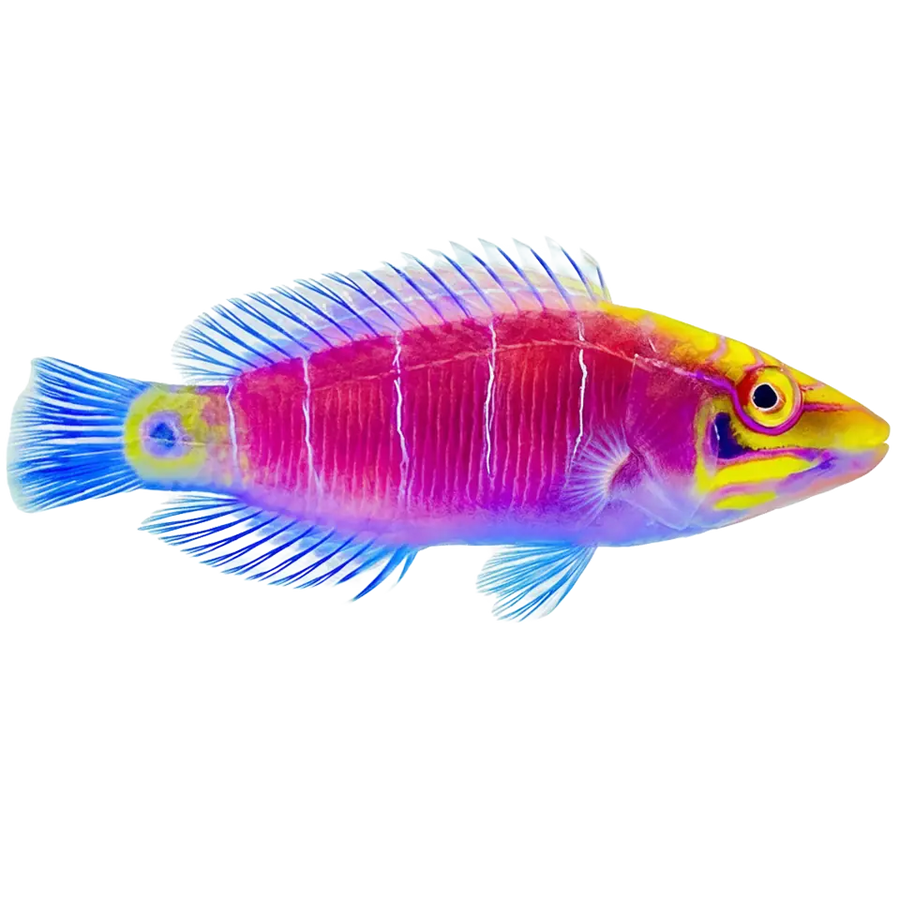
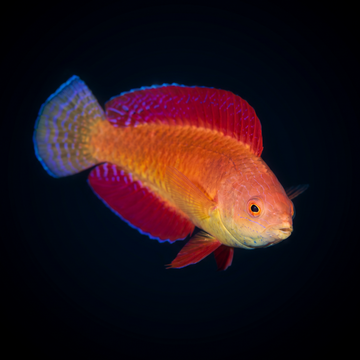
The Yellow Patch Cleaner Wrasse is a specialized cleaner that naturally takes ectoparasites and other material during interactions with reef fishes. Cleaning activity is not proof that the animal receives adequate captive nutrition, and a closed aquarium cannot be assumed to supply enough natural food.
Confirm exactly which prepared foods the individual already accepts. Captive-bred fish may be more familiar with prepared diets, but the label alone cannot establish that every food offered will be accepted.
Offer a balanced selection that includes:
Frozen mysis shrimp
Enriched brine shrimp
Appropriately sized marine crustaceans
Finely chopped clam, mussel, and other marine seafood
Balanced frozen marine carnivore blends
Suitable marine pellets when accepted
Provide three or more small meals daily, adjusting amount and frequency to activity, age, and actual consumption. Growing juveniles and thin new arrivals may need extra small opportunities rather than one oversized meal.
Distribute food at more than one location, including areas near shelter. This helps reduce crowding and makes it easier to see whether the wrasse is receiving its share.
Offer several small, suitable prepared-food opportunities and monitor for actual swallowing. Persistent chasing of client fishes can reflect a feeding problem or an unsuitable social arrangement and should not simply be encouraged.
Avoid relying exclusively on unenriched brine shrimp or a single frozen food. Marine-based foods are appropriate; freshwater feeder fish and terrestrial meat are unnecessary. Remove uneaten portions before they collect inside caves or beneath rockwork.
Check the abdomen and overall body condition regularly. Persistent pinching, reduced activity, repeated food rejection, or a fish disappearing whenever feeding begins calls for closer assessment of water quality, competition, and the feeding arrangement.
Do not buy this species as a substitute for quarantine or disease management. Natural cleaning relationships cannot be relied upon to eliminate aquarium pathogens, and the animal still needs its own suitable habitat and complete nutrition.
Choose a community that tolerates the individual's behavior without repeatedly chasing it, and monitor whether cleaning attempts become persistent irritation for other residents.
Choose appropriately sized companions that use different feeding and resting areas, while avoiding fish small enough to be taken as prey.
Avoid fin nippers and persistent chasers. A fish forced to hide throughout the photoperiod cannot use the aquarium normally even if its fins remain intact.
Use a covered acclimation box when it is suitable for evaluating reactions, with good water exchange and shelter. Observe both the newcomer and established residents. Behavior through a barrier is useful information, but it does not guarantee permanent compatibility after release.
Watch interactions around feeding areas and nighttime shelters. Repeated chasing, exclusion from food, damaged fins, or a fish trapped in one corner indicates that changes are needed. Do not wait for severe injury before separating incompatible residents.
Temperament can change with maturity or a new social arrangement. Reassess compatibility after growth, new additions, or significant changes to the aquascape.
A complex layout and additional space can reduce encounters, but they do not make an unsuitable combination dependable. Keep a practical removal or isolation plan available before introducing another closely related or similarly patterned fish.
The Yellow Patch Cleaner Wrasse is considered reef safe with corals. Its cleaning specialization does not make it a coral-feeding wrasse, although its interactions with other fishes still need monitoring.
Reef safe does not mean that microscopic crustaceans or every newly settled tiny invertebrate will be ignored. Small benthic prey and pods may be consumed during normal feeding. Consider the size and vulnerability of animals actually present.
Established ornamental cleanup-crew animals are generally less vulnerable than they are with large predatory wrasses. Nevertheless, avoid treating the label as an absolute guarantee for unusually small shrimp or newly molted animals.
Arrange coral growth so it does not block swimming routes or access to shelters. Retain crevices that remain usable as coral colonies grow, rather than letting the only retreat close over.
A mature reef still needs an appropriate feeding plan. Excellent coral water chemistry and abundant visual cover do not compensate for a fish that cannot compete at feeding time.
Monitor the individual after introduction and after major livestock changes. Distinguish harmless inspection from repeated tissue damage or sustained disturbance of another animal, and adjust the arrangement if a problem develops.
Maintain undetectable ammonia and nitrite with stable temperature, salinity, and good oxygenation. Frequent feeding increases nutrient input, so filtration and maintenance should match actual consumption and waste rather than a lightly stocked aquarium's previous routine.
Avoid sudden changes in temperature, salinity, or pH. Use calibrated instruments, consistent top-off, and a predictable maintenance schedule. Steady conditions within an appropriate range are preferable to repeated adjustments made solely to chase an exact number.
Clean trapped food and detritus from sheltered areas without repeatedly dismantling the fish's only resting site. Maintain surface movement and restore normal circulation promptly after feeding adjustments.
Quarantine in a fully supported system that reflects this fish's shelter and feeding needs. Provide suitable inert shelters and a covered aquarium. A bare, unstable holding tank can create stress or ammonia problems; medications and treatment decisions should be species-appropriate.
FAQ
Frequently Asked Questions
About the Yellow Patch Cleaner Wrasse
-
What size aquarium does an adult Yellow Patch Cleaner Wrasse need?
Plan at least 75 gallons for a fish reaching approximately 5.5 inches (14 cm), with a suitable adult footprint. -
Does the Yellow Patch Cleaner Wrasse need sand?
It uses protected rock crevices for resting; a deep burial sand bed is not required. -
Is the Yellow Patch Cleaner Wrasse reef safe?
The Yellow Patch Cleaner Wrasse is considered reef safe with corals. Its cleaning specialization does not make it a coral-feeding wrasse, although its interactions with other fishes still need monitoring. Reef safe does not mean that microscopic crustaceans or every newly settled tiny invertebrate will be ignored. Small benthic prey and pods may be consumed during normal feeding. Consider the size and vulnerability of animals actually present. Established ornamental cleanup-crew animals are generally less vulnerable than they are with large predatory wrasses. Nevertheless, avoid treating the label as an absolute guarantee for unusually small shrimp or newly molted animals. Arrange coral growth so it does not block swimming routes or access to shelters. Retain crevices that remain usable as coral colonies grow, rather than letting the only retreat close over. A mature reef still needs an appropriate feeding plan. Excellent coral water chemistry and abundant visual cover do not compensate for a fish that cannot compete at feeding time. Monitor the individual after introduction and after major livestock changes. Distinguish harmless inspection from repeated tissue damage or sustained disturbance of another animal, and adjust the arrangement if a problem develops. -
What should a Yellow Patch Cleaner Wrasse eat?
The Yellow Patch Cleaner Wrasse is a specialized cleaner that naturally takes ectoparasites and other material during interactions with reef fishes. Cleaning activity is not proof that the animal receives adequate captive nutrition, and a closed aquarium cannot be assumed to supply enough natural food. Confirm exactly which prepared foods the individual already accepts. Captive-bred fish may be more familiar with prepared diets, but the label alone cannot establish that every food offered will be accepted. Provide three or more small meals daily, adjusting amount and frequency to activity, age, and actual consumption. Growing juveniles and thin new arrivals may need extra small opportunities rather than one oversized meal. Distribute food at more than one location, including areas near shelter. This helps reduce crowding and makes it easier to see whether the wrasse is receiving its share.