Sohal Tang saltwater fish care guide

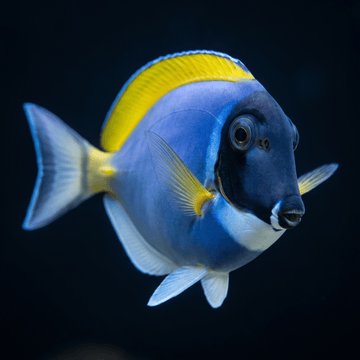
Acanthurus sohal is among the most commanding surgeonfish available to the hobby, built on the flattened, disc-shaped frame typical of the genus. The body ranges from dark blue to gray or silver and carries bold horizontal white and blue striping, with yellow fins accented in blue and orange highlights near the caudal peduncle, where the sharp defensive spine sits. Native to the Red Sea, the Persian and Arabian Gulf region, and portions of the western Indian Ocean, it patrols wave-swept shallow reefs and lagoon flats. Juveniles typically arrive around three to four inches, while adults reach roughly 12 to 16 inches.

Adult housing begins at 250 gallons, and a footprint of at least eight feet in length is strongly preferred for a fish that swims constantly and covers ground at speed. Structure matters, but for a different reason than usual: generous live rock with caves and crevices primarily serves as refuge for tankmates rather than shelter for the tang itself. Leave broad open lanes across the length of the tank, since cramped layouts sharpen an already forceful temperament. Strong, turbulent flow suits a fish adapted to surge zones, and stable water quality in a mature, well-established system is expected.

This is an expert-level animal, and much of that difficulty comes down to spatial and social management rather than fragility. Plan the stocking order before the fish arrives, because a Sohal should be the last addition to an established community. A secure lid is sensible given the pace and energy of its swimming.

In the wild, the Sohal Tang grazes more or less continuously, working algae across reef flats throughout the day. Captive feeding should mirror that pattern with a primarily vegetable-based menu: dried marine seaweed and nori, macroalgae such as ulva or sea lettuce, quality herbivore pellets and flakes, and spirulina-enriched preparations. Enriched brine or mysis shrimp may be offered occasionally for variety, but meaty items should never displace the algae portion of the diet.

Feed two to three times daily, and keep grazing material available between feedings when possible. Consistent, plentiful algae intake supports color, condition, and long-term health, and it also does real behavioral work: a well-fed Sohal is less driven to compete over food and far less likely to begin sampling coral polyps out of hunger.

Dried Marine Seaweed Nori Ulva Macroalgae Sea Lettuce Herbivore Pellets Spirulina-Enriched Flakes Enriched Mysis Shrimp
Few tangs match the Sohal for sheer territorial drive. It is widely regarded as one of the most aggressive members of the group, particularly hostile toward other tangs and surgeonfish, and it may turn on new arrivals even when it coexists reasonably with long-established tankmates. Expect near-constant motion. Keep one specimen per system, introduce it last, and use volume, length, and abundant rock refuge to soften the pressure it places on the rest of the community.

Robust but reasonable tankmates fare best, including wrasses, gobies, blennies, and anthias with the size and confidence to hold their own. Avoid other tangs, especially additional Acanthurus species, and skip the most belligerent triggers. On the reef, this fish is a grazer rather than a coral predator and generally leaves polyps untouched, using Acropora thickets for shelter in the wild rather than as food. The caveat is dietary: an underfed specimen may start nibbling LPS polyps, so heavy and consistent algae feeding is the safeguard that keeps it reef safe.

FAQ

Frequently Asked Questions

About the Sohal Tang

  • How large should the aquarium be for an adult Sohal Tang?
    Plan on a minimum of 250 gallons, ideally with a footprint at least eight feet long. That length provides the open swimming lanes this fast, perpetually active fish requires.
  • Is the Sohal Tang safe with corals?
    Yes, as a herbivorous grazer it generally leaves coral polyps alone and uses branching corals for shelter in the wild. An underfed specimen may begin nibbling LPS polyps, so heavy algae feeding is essential.
  • Can a Sohal Tang be housed with other tangs?
    It is not advisable. The species is intensely territorial toward other tangs and surgeonfish and should be kept singly, introduced last into an established aquarium.