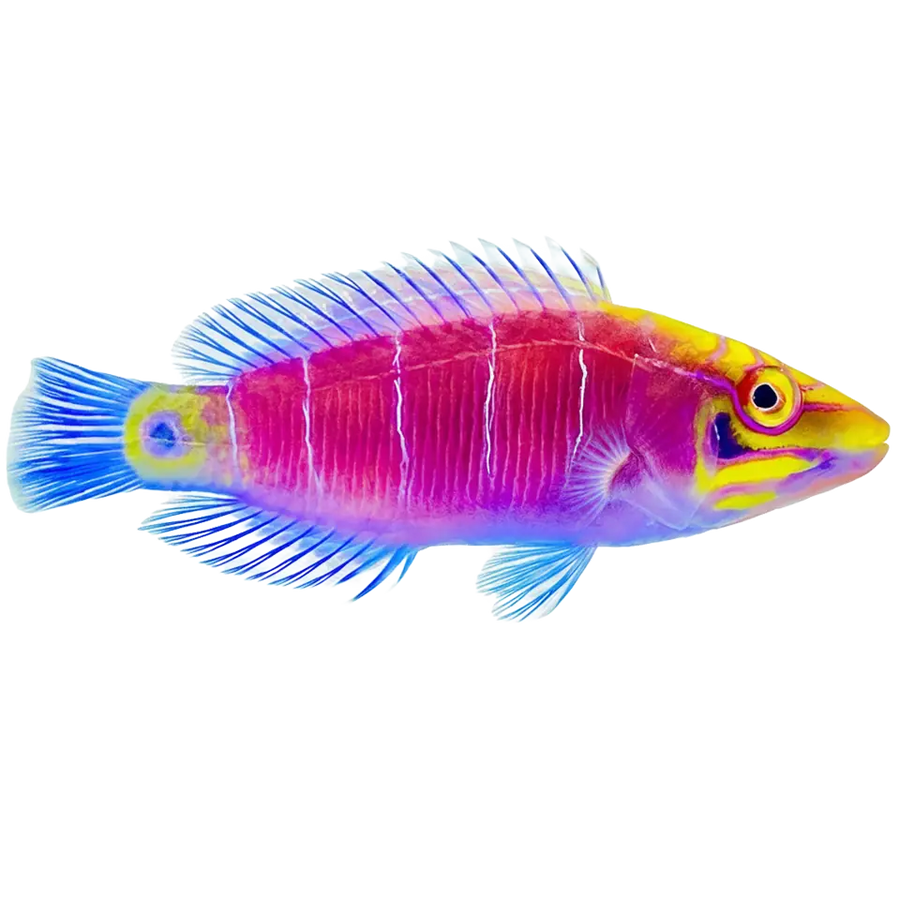
Ruby Longfin Fairy Wrasse saltwater fish care guide

Overview:
The Ruby Longfin Fairy Wrasse is a vibrant and active marine fish, ideal for intermediate aquarists. It thrives in a well-established reef aquarium with plenty of live rock for hiding and exploring. The ideal tank size is at least 50 gallons, with stable water parameters: a temperature of 72-78°F, pH of 8.1-8.4, and specific gravity of 1.020-1.025. A moderate current and ample swimming space are essential, as this species is an active swimmer. Ensure the tank is covered, as they are known to jump.

Compatibility:
The Ruby Longfin Fairy Wrasse is generally peaceful and can coexist with other non-aggressive fish species. Avoid housing them with overly aggressive or territorial fish. They do well in a community setting with other wrasses, gobies, and clownfish. It's best to introduce them to the tank simultaneously with other fish to minimize territorial disputes. Provide ample hiding spots to reduce stress and ensure a harmonious environment.

Health and Quarantine:
Regular monitoring of water quality is crucial to prevent common marine diseases. Quarantine new arrivals for at least two weeks to observe for signs of illness such as ich or fin rot. Maintain optimal water conditions and a stress-free environment to promote robust health. If signs of disease appear, treat promptly with appropriate medications. Regularly check for parasites and ensure a balanced diet to support their immune system.

Pellets Mysis Finely Chopped Seafood
Ruby Longfin Fairy Wrasse, originating from Sri Lanka, is a peaceful, reef-safe fish reaching up to 4 inches. It exhibits active swimming habits, often exploring the middle to upper water columns. Socially inclined, it thrives in groups, displaying vibrant colors and intricate dances during interactions. Non-territorial, it coexists harmoniously with other peaceful species. A carnivorous diet includes mysis shrimp, brine shrimp, and finely chopped seafood. Suitable for tanks of at least 55 gallons, this easy-care species is ideal for community aquariums.

FAQ

Frequently Asked Questions

About the Ruby Longfin Fairy Wrasse

  • Can a male Ruby Longfin Fairy Wrasse change color or pattern as it matures, and how can I tell if mine is developing full terminal-phase coloration?
    Yes, males change quite a bit as they mature. Juveniles and initial-phase males are more subdued, with softer reds and less defined fin edging. As a terminal-phase male develops, you’ll see: (1) deeper, richer ruby or cherry-red body coloration; (2) more pronounced blue or purple edging along the long dorsal and caudal fins, which appear more extended and “flared”; (3) intensified facial markings, especially around the cheeks and gill plates; and (4) dramatic “flash” colors during displays, where the fins appear brighter and more opaque, and the fish swims in quick bursts toward other wrasses or reflective surfaces. Consistent, high-quality diet and low stress help the fish fully express these colors. Poor lighting, aggression, or suboptimal nutrition can delay or mute the transition, even if the fish is fully mature.
  • My Ruby Longfin Fairy Wrasse sometimes swims frantically near the surface at lights-out. Is this normal for the species, and how should I manage lighting for them?
    This species is very sensitive to sudden lighting changes. At lights-out, if the tank goes from bright to dark instantly, Ruby Longfin Fairy Wrasses often panic, dash near the surface, and may jump. To manage this: use a dim “ramp-down” schedule on a programmable LED or manually switch to a dim room light for 15–30 minutes before full darkness; avoid turning on bright room lights suddenly when the tank is dark; and consider a low-intensity “moonlight” setting so they are not in total darkness immediately. This species also forms a mucus “sleeping cocoon” in the rockwork, so stable dusk and dawn periods help them find a secure spot and reduce stress-related behavior and injury.
  • How aggressive is a male Ruby Longfin Fairy Wrasse toward other wrasses, and what tankmates or wrasse species are best and worst to pair with him?
    Ruby Longfin Fairy Wrasses are generally in the mild-to-moderate range for fairy wrasse aggression, but males can be territorial with similar-shaped or similar-colored fairy wrasses. Best companions are smaller, less assertive Cirrhilabrus species with different body color emphasis (e.g., more yellow/orange or blue rather than red), and flasher wrasses (Paracheilinus), which are usually tolerated. Avoid mixing with other strongly red or pink male fairy wrasses of similar size, as they may see each other as rivals. Also avoid large, dominant fairy wrasses like some Scott’s or Lineatus, which may bully the Ruby Longfin. Introduce the Ruby Longfin after more aggressive wrasses are already settled, and use an acclimation box so existing fish can see but not attack the newcomer for several days.
  • What specific diet and feeding pattern brings out the best red coloration and fin extension in a Ruby Longfin Fairy Wrasse?
    This fish thrives on a varied, protein-rich, marine-based diet offered in small portions multiple times per day. For color and fin condition, focus on: (1) high-quality frozen foods with marine proteins (mysis shrimp, enriched brine, finely chopped krill, calanus, and marine plankton); (2) color-supporting ingredients like astaxanthin and spirulina, found in many premium marine pellets and flakes; (3) very small live foods (copepods, enriched baby brine, or live blackworms in moderation) a few times per week to encourage natural hunting behavior; and (4) at least 2–3 feedings daily, rather than one heavy meal, to match their active, constant-foraging nature. Avoid a diet that’s predominantly freshwater-based foods (like beef heart) or low-quality pellets, as this can affect color intensity and overall vigor over time.
  • My Ruby Longfin Fairy Wrasse keeps jumping into the overflow or onto the lid even though the water parameters are fine. Is this typical for the species, and how can I reduce this behavior?
    This species is an extremely strong jumper by nature, even in ideal conditions. They often bolt upward in response to quick movements near the glass, sudden shadows, aggressive tankmates, or abrupt light changes. To reduce this: make sure the tank has a tight-fitting mesh lid with no gaps larger than about 1/4 inch, including around plumbing and light mounts; minimize startle triggers by approaching the tank slowly and avoiding sudden tapping or banging on the glass; ensure tankmates are not harassing the wrasse, especially at dusk when they seek a sleeping spot; and use gradual lighting transitions at on/off times. Providing complex rockwork and caves also helps, as a secure sleeping area reduces stress and the impulse to bolt when alarmed. Even with these steps, always assume this species will attempt to jump and keep the tank fully covered.