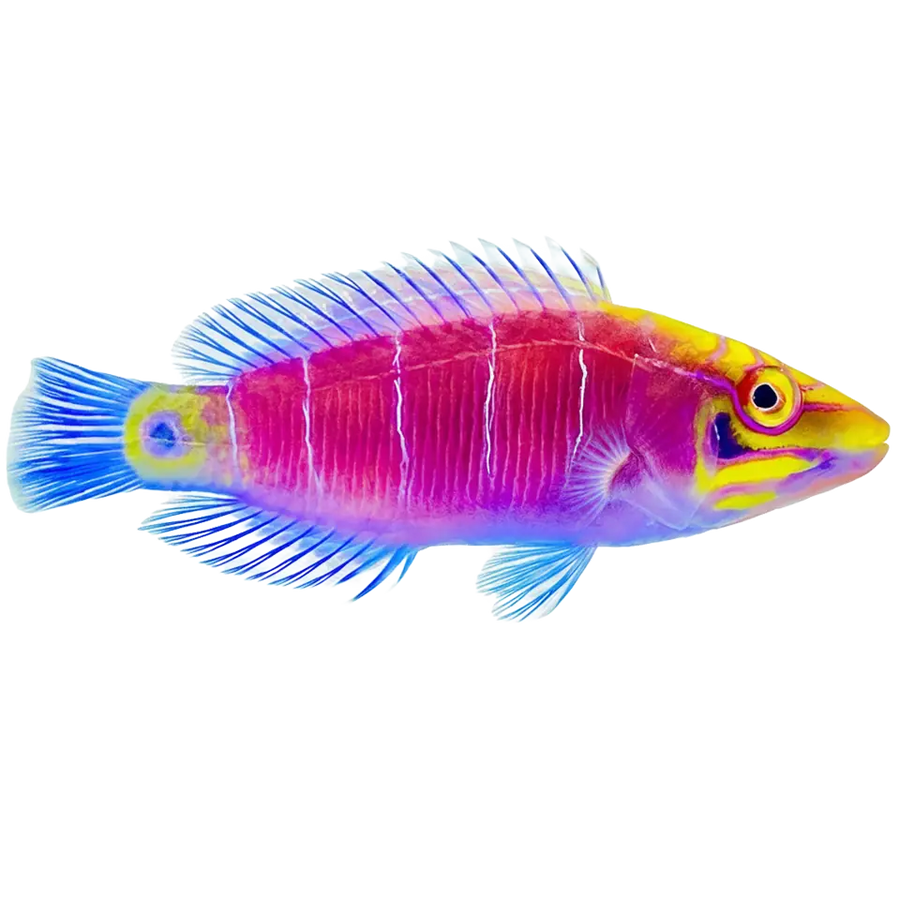
Red Velvet Fairy Wrasse saltwater fish care guide

Overview:
The Red Velvet Fairy Wrasse (Cirrhilabrus rubrisquamis) is a vibrant and active marine fish, ideal for intermediate aquarists due to its specific care requirements. This species thrives in a well-maintained reef aquarium with plenty of live rock for hiding and exploring. A tank size of at least 55 gallons is recommended to provide ample swimming space. Water conditions should be stable, with a temperature range of 72-78°F, pH between 8.1-8.4, and specific gravity of 1.020-1.025. Strong water movement and efficient filtration are crucial to mimic their natural habitat and maintain water quality.

Compatibility:
These wrasses are generally peaceful and can coexist with a variety of other non-aggressive fish species. However, they may become territorial towards other wrasses or similar-sized fish, especially in smaller tanks. It's advisable to introduce them as one of the last additions to the aquarium to minimize territorial disputes. Avoid housing them with overly aggressive species or those that may outcompete them for food. They are reef-safe and will not harm corals or invertebrates, making them an excellent choice for a community reef tank.

Health and Quarantine:
Red Velvet Fairy Wrasses are susceptible to common marine diseases such as ich and velvet. Quarantining new arrivals for 2-4 weeks before introducing them to the main tank is essential to prevent disease transmission. Regularly monitor water parameters and perform routine water changes to maintain optimal conditions. Observing their behavior and appetite can provide early indicators of health issues. If signs of illness appear, such as spots, rapid breathing, or lethargy, promptly address with appropriate treatments. Providing a stress-free environment with plenty of hiding spots can significantly reduce the likelihood of disease and promote overall well-being.

Pellets Mysis Finely Chopped Seafood
The Red Velvet Fairy Wrasse is a peaceful, reef-safe fish, ideal for community tanks. Originating from the Maldives, it swims actively in the mid to upper water column. It exhibits low territorial behavior, making it compatible with other non-aggressive species. This wrasse thrives in groups, displaying vibrant coloration when comfortable. With a carnivorous diet, it enjoys mysis shrimp, brine shrimp, and finely chopped seafood. Requiring a minimum 55-gallon tank, it reaches up to 4 inches, contributing to its ease of care.

FAQ

Frequently Asked Questions

About the Red Velvet Fairy Wrasse

  • Can I keep a single male Red Velvet Fairy Wrasse, or do they really need a harem to maintain their best coloration and behavior?
    A single male Red Velvet Fairy Wrasse (Cirrhilabrus rubrisquamis complex; often sold as “Red Velvet” or “Rosy-Fin”) can live perfectly well on his own, but his social and color dynamics are more interesting in a group. In the wild they live in harems with one dominant male and multiple females. In home aquaria, a lone male will usually maintain good color as long as tankmates are peaceful and lighting is appropriate. If you want natural social behavior and more active displays, keep one male with 2–4 females in a tank of at least 90 gallons. Never keep multiple males of similar Cirrhilabrus species in small tanks; this usually leads to stress and constant chasing, even if actual damage is rare.
  • My Red Velvet Fairy Wrasse dives into the sand at night instead of using the rocks like my other wrasses. Is this normal, and what substrate depth do they actually need?
    That’s normal behavior. Red Velvet Fairy Wrasses typically wedge into rock crevices or sleep in the water column when they feel safe, but many individuals in aquariums will also dive into the sand or wedge under rock overhangs at night if given the option. They do not need a deep sand bed like Halichoeres or leopard wrasses; about 1–2 inches of fine to medium aragonite is sufficient for comfort and natural behavior. Avoid coarse, sharp substrates and bare-bottom setups for this species, as they feel more secure and settle in faster when they have sand and some lower rockwork to retreat into at night.
  • Why does my Red Velvet Fairy Wrasse lose its intense red color and look washed out a few weeks after I bring it home, even though it’s eating well?
    Color loss in Red Velvet Fairy Wrasses is usually due to a combination of lighting spectrum, stress, social context, and diet. Under very white or low-blue lighting, their reds and pinks look less saturated than under blue-heavy reef LEDs. Chronic low-level stress from aggressive tankmates or poor acclimation can cause a subdued, “dusty” appearance. Without female wrasses or similar “rivals” to display to, males sometimes relax their full breeding colors and revert to a more subdued everyday pattern. Diet also matters: feed a varied menu of high-quality frozen foods (mysis, enriched brine, finely chopped seafood), small pellets with astaxanthin and marine algae, and frequent small feedings. Provide stable water quality, peaceful tankmates, and blue-heavy reef lighting and you’ll see much stronger reds.
  • My Red Velvet Fairy Wrasse keeps jumping into the overflow or onto the floor, even with calm tankmates. Is this species really that prone to jumping, and how can I realistically prevent it?
    Red Velvet Fairy Wrasses are extremely strong and frequent jumpers, especially during the first 2–4 weeks as they explore boundaries and react to shadows, sudden movements, or nighttime disturbances. Even calm individuals can bolt when startled. A fully enclosed top is essential: use a tight-fitting mesh lid (1/4" or smaller openings) that covers every gap, including around plumbing, light mounts, and overflows. Standard glass canopies are often not enough because wrasses aim for edges and corners. Avoid sudden light changes, keep the room relatively calm during the first hour after lights out and lights on, and give them a complex rock layout with shaded retreats. Without a proper lid, it’s only a matter of time before a Red Velvet Wrasse is lost to jumping.
  • How sensitive is the Red Velvet Fairy Wrasse to shipping and acclimation, and what is the best way to introduce one to avoid the “3–7 day sudden death” some hobbyists report?
    Red Velvet Fairy Wrasses can be sensitive to handling and shipping stress, especially wild-caught males. “Sudden death” in the first week is often due to a combination of ammonia exposure in the shipping bag, rapid salinity or pH shifts during acclimation, internal parasites, or unseen gill damage. To minimize risk: 1) Float the bag for 15–20 minutes for temperature only; then check bag salinity and pH. 2) If the bag water is very different from your tank, match tank water closer to the bag before release, or use a short drip (no more than 30–40 minutes) to avoid prolonging exposure to bag ammonia. 3) Keep lights dim for several hours after introduction. 4) Ideally quarantine in a separate tank with plenty of PVC and rock, observe for heavy breathing, flashing, or rapid weight loss, and treat proactively for flukes and internal worms if needed (per label guidelines). 5) Provide strong oxygenation and excellent water quality. Following a careful, time-limited acclimation and a calm, low-stress introduction dramatically improves survival in this species.