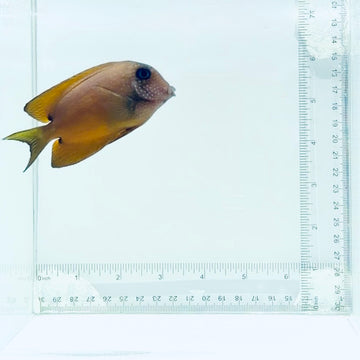
Naso Tang saltwater fish care guide

Naso lituratus is a large, laterally compressed surgeonfish built along clean, elegant lines. The gray-to-brown body is set off by orange lips, a black facial mask outlined in yellow, an orange anal fin, and a pair of conspicuous orange-highlighted spines on each side of the caudal peduncle. The forehead slopes smoothly with no horn or protuberance, which separates this species immediately from the horned unicornfishes. Mature males extend long trailing streamers from the upper and lower lobes of the tail. The species ranges across the eastern Indian and Pacific Oceans on tropical reefs and reaches roughly 18 inches as an adult.

Housing must be planned around that adult size and the fish's near-constant motion. A well-established marine system of at least 180 gallons is the working minimum, and a longer footprint with broad, unobstructed swimming lanes matters as much as raw volume. Arrange rockwork securely so it supplies grazing surfaces, caves, and retreats for nighttime rest or moments of alarm, while leaving open water along the length of the tank. Moderate to heavy flow suits this fish, and filtration, circulation, and oxygenation should be sized for an active grazer that produces substantial waste. A tight-fitting lid is important, since startled specimens will jump. Care is best described as moderate rather than beginner-friendly, largely because of the space and dietary commitment involved.

On the reef this tang feeds predominantly on leafy brown algae, with Sargassum and Dictyota forming much of the natural diet. Captive feeding should mirror that emphasis. Dried seaweed such as nori is the practical foundation, offered at least three times per week and ideally secured where the fish can graze at length. Live macroalgae, spirulina-rich preparations, algae-based flakes or pellets, and frozen herbivore blends round out the plant portion. Small meaty items such as mysis and enriched brine shrimp are worthwhile supplements, but they should never displace algal foods. Established rockwork that grows a film of algae provides valuable additional grazing between meals.

Acclimation deserves attention. Some specimens are slow to recognize prepared aquarium foods, and larger individuals may take days or occasionally weeks before feeding confidently. Select a fish that is active, full through the back and shoulders rather than pinched, and visibly eating an appropriate algae-based food before it comes home. A specimen already depleted by inadequate feeding is difficult to turn around, so patience at the point of selection pays off far more than any intervention afterward.

Dried Seaweed Nori Live Macroalgae Spirulina-Based Foods Algae Flakes And Pellets Frozen Herbivore Preparations Mysis Shrimp Enriched Brine Shrimp
This is an energetic diurnal swimmer that spends most of the day cruising open water and grazing. Wild adults are often seen in small groups, and juveniles may aggregate with similarly sized surgeonfishes. In the aquarium the species is semi-aggressive: it generally coexists well with unrelated fish but will challenge conspecifics and other tangs of similar shape. Keeping more than one Naso Tang, or pairing it with closely related surgeonfishes, is only realistic in an exceptionally large system. The sharp caudal-peduncle spines can inflict serious injury during disputes and during handling, so avoid nets that the spines can catch on.

Tankmates should be chosen from peaceful and semi-aggressive marine fish that will not intimidate this tang away from its food. It is reef safe and is not expected to sample corals, clams, shrimp, crabs, or snails, and it generally ignores small unrelated fish. The real considerations in a reef are mechanical and environmental: a fast-moving adult can dislodge unsecured frags or loose rockwork, and its waste output places real demand on filtration. Keeping algae-based food consistently available also keeps grazing pressure aimed where it belongs.

FAQ

Frequently Asked Questions

About the Naso Tang

  • Is a standard home aquarium large enough for an adult Naso Tang?
    Usually not, since 180 gallons is the practical minimum for a fish approaching 18 inches. Tank length and open swimming room matter as much as nominal volume because this species is almost constantly in motion.
  • What should I verify before buying one?
    Choose an active specimen that is not thin through the back and confirm that it is eating algae-based food such as nori before purchase. Some individuals are slow to accept captive foods, and a fish already weakened by poor feeding is hard to recover.
  • Can it live in a reef aquarium with other tangs and invertebrates?
    It is reef safe and is not expected to target corals or common reef invertebrates, provided the system is spacious, securely aquascaped, and well filtered. It may quarrel with conspecifics or similarly shaped tangs, so those pairings call for substantial space and caution.