Mimic Half Black Tang saltwater fish care guide

Overview:
The Mimic Half Black Tang, also known as Acanthurus chronixis, is a captivating marine species that requires specific care to thrive in a home aquarium. Ideally, they should be housed in a tank of at least 75 gallons to accommodate their active swimming nature and potential growth up to 8 inches. The tank should be equipped with plenty of live rock for grazing and hiding, as well as open swimming spaces. Water conditions should be stable, with a temperature range of 72-78°F, pH between 8.1-8.4, and salinity of 1.020-1.025. Efficient filtration and regular water changes are crucial to maintain water quality.

Compatibility:
When considering tankmates for the Mimic Half Black Tang, it's important to choose species that are peaceful and non-aggressive. They generally coexist well with other tangs, provided the tank is large enough to prevent territorial disputes. Avoid housing them with overly aggressive or territorial fish, as this can lead to stress and health issues. They are also compatible with a variety of reef-safe fish, invertebrates, and corals, making them a suitable addition to a community reef tank.

Health and Quarantine:
Mimic Half Black Tangs are susceptible to common marine diseases such as ich and marine velvet, so preventive care is essential. Quarantine new arrivals for at least two weeks before introducing them to the main tank to monitor for signs of illness and to prevent the spread of disease. Maintain optimal water quality and provide a stress-free environment to support their immune system. Regularly observe them for any signs of stress or illness, such as changes in behavior, appetite, or appearance. If health issues arise, prompt treatment with appropriate medications is necessary.

Nori Pellets Mysis
The Mimic Half Black Tang, or Acanthurus pyroferus, is a semi-aggressive, reef-safe species from the Indo-Pacific. It requires a minimum of 90 gallons due to its territorial nature and active swimming habits. While it can coexist with various species, it may show aggression towards similar-sized fish. Providing ample space and hiding spots can help mitigate this behavior. Its omnivorous diet includes algae, spirulina, mysis, and brine shrimp. This tang is a strong swimmer, patrolling the tank actively, and plays a beneficial role in controlling algae in reef setups.

FAQ

Frequently Asked Questions

About the Mimic Tang

  • How can I correctly identify a true Mimic Half Black Tang (Acanthurus chronixis) versus similar tangs like the Half Black Mimic Tang (A. tristis) or other mimic species when purchasing for my reef tank?
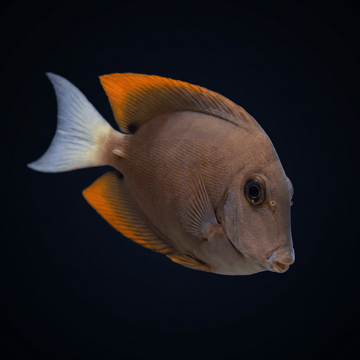
    A true Mimic Half Black Tang, Acanthurus chronixis, has a distinct two-tone pattern: the front half of the body is dark (almost black to deep brown) while the rear half is lighter, often grayish to tan, with a fairly clean, sharp division around the midpoint of the body. Key points: - Juveniles are already two-toned, not “dwarf angel mimics” like A. tristis juveniles, which resemble Centropyge angels. - The caudal fin tends to be more uniformly colored rather than bright yellow or orange like some related species. - Look at the head: A. chronixis usually has a darker, more uniform head with minimal facial patterning compared with A. tristis, which often has more angel-like facial markings as juveniles. - Ask the supplier for the scientific name, collection location, and to provide high-resolution side-profile photos. Compare carefully with reputable online reference photos before purchase; mislabeling is common.
  • What tank size and aquascape layout best suit a Mimic Half Black Tang to minimize stress and aggression in a mixed-reef community?
    For a Mimic Half Black Tang, plan for a minimum of 125 gallons (6-foot length) for long-term housing; larger is always better. This species is active and appreciates swimming lanes: - Layout: Build a rock “spine” down the center or along the back wall, leaving open sand and clear paths along the front and sides. Avoid cluttered rockwork that breaks the tank into small compartments. - Provide at least 2–3 archways or “tunnels” so it can dart through and feel secure without dead-ending. - Create both high-flow and moderate-flow zones. They rest and graze more in moderate flow, then sprint through higher flow areas. - Ensure clear surface area on rock for algae and film growth; flat and sloped ledges are ideal grazing stations. - Avoid narrow, maze-like scapes that trap fish and intensify territorial fights. A long, open run is more important than total water volume.
  • How can I manage aggression from a Mimic Half Black Tang when introducing other tangs or similarly shaped fishes to an established tank?
    Mimic Half Black Tangs can be quite pushy, especially with other Acanthurus or similar-shaped tangs. To reduce aggression: - Add the Mimic Half Black last when possible; they tend to be less territorial if others were established first. - If it is already established, rearrange rockwork right before introducing new tangs to “reset” territories. - Add multiple tangs at the same time (in a suitable large tank) so no single new fish is singled out. - Prioritize mixing different body shapes and genera: pair with Zebrasoma or Ctenochaetus over other Acanthurus, and avoid similarly colored half-black patterns. - Use an acclimation box for 3–7 days so existing fish can see the newcomer without physical contact. - Supplement heavy feeding for a week (multiple small algae- and nori-based feedings) to reduce food guarding. If persistent tail-slashing, torn fins, or cornering continue beyond a few days, be ready to remove the aggressor or the victim.
  • What specific diet and feeding strategy keeps a Mimic Half Black Tang in peak health and prevents head and lateral line erosion (HLLE)?
    Mimic Half Black Tangs are herbivorous-leaning omnivores that need fiber-rich algae plus varied marine-based foods: - Daily base: Multiple feedings of dried seaweed (nori) clipped in different spots, ideally brown and red varieties mixed with green. - Prepared foods: Use high-quality pellets and frozen blends with a strong plant component (spirulina, kelp, chlorella) plus marine proteins (mysis, krill, fish, squid) rather than land-based fillers. - Fresh items: Occasionally add blanched, rinsed macroalgae (Gracilaria, Ulva) or tank-grown algae from a refugium. - Vitamins: Soak foods 2–3 times per week in a vitamin supplement rich in vitamin C and HUFA (omega-3 fatty acids). This helps with HLLE prevention. - Water quality and carbon: Maintain excellent water quality, run high-quality, low-dust carbon in a reactor if used at all, and avoid carbon fines in the water column, which have been linked to HLLE in surgeonfish. - Grazing: Allow some natural algae growth on rocks; constant grazing behavior is normal and beneficial.
  • Are Mimic Half Black Tangs safe in coral-rich reef tanks, and do they pose any special risks to invertebrates or certain coral types?
    Mimic Half Black Tangs are generally excellent reef citizens with a few considerations: - Corals: They do not target corals for food under normal conditions. Occasional incidental nipping may occur when they graze algae near fleshy LPS (e.g., acans, favias, brains), but true coral predation is rare. Well-fed fish are less likely to bother coral tissue. - Invertebrates: They are usually safe with shrimp, snails, crabs, and clams. They may occasionally knock over small frags or newly placed clams while grazing, so secure frags and position delicate clams on stable surfaces. - Cleanup crew: They may outcompete some herbivorous snails for algae, so stock a slightly smaller cleanup crew than you would in a tang-free system and supplement with nori. - Behavior around corals: Because they are active swimmers, give extra space around branching SPS or delicate corals; tight clusters near high-traffic swim lanes are more likely to be bumped. Overall, with ample algae feeding and a properly sized tank, they coexist very well in reef systems.