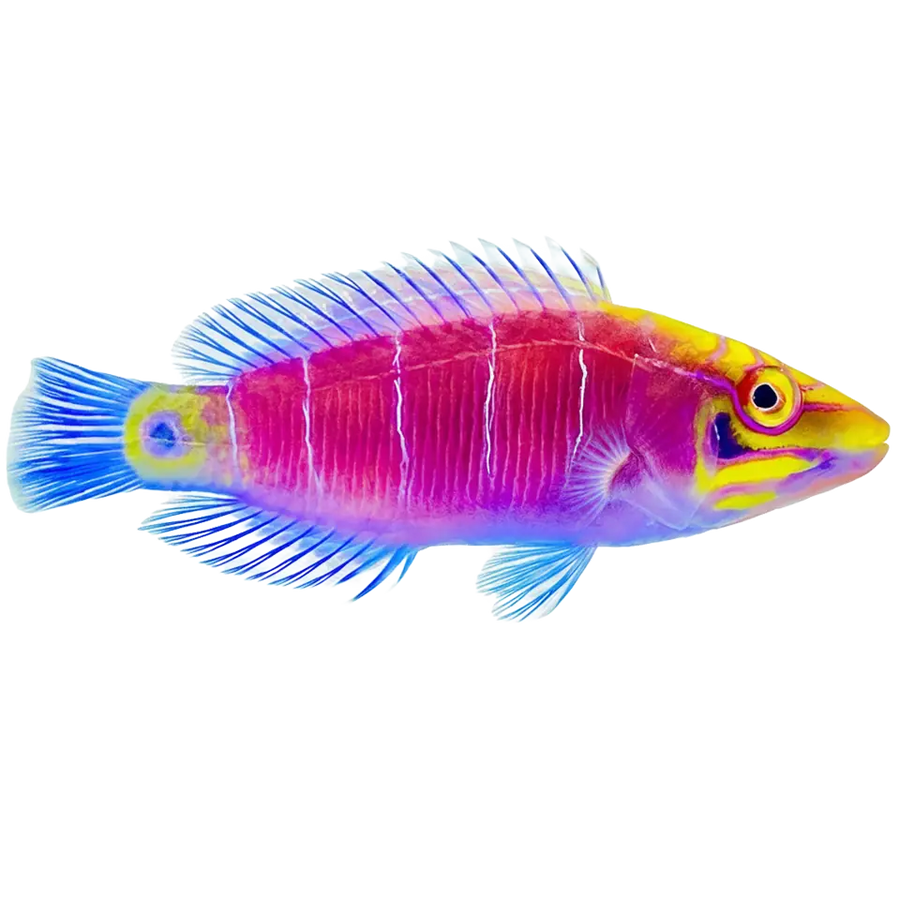
Lunare Wrasse

The Moon Wrasse, also traded as the Lunare or Lyretail Wrasse, is one of the most vividly colored wrasses available to reef aquarists. The streamlined, cigar-shaped body carries a shifting blend of electric blue, violet, green and chartreuse, with red facial markings that intensify as the fish matures. Mature specimens develop the crescent-shaped caudal fin that gives the species its common name. The species ranges widely across the Indo-Pacific, from the Red Sea and East Africa to the Central Pacific, where it patrols shallow tropical reefs, and adults can reach up to 18 inches.

Housing should be built around constant motion. This wrasse swims nonstop during daylight hours, so a 180-gallon aquarium is the practical minimum for an adult, with long, unobstructed runs of open water rather than a rock-choked layout. Live rock remains important for territory, shelter, and a place to sleep, and many individuals will dive into and bury themselves in a sandy bed, so a soft substrate is worth including even though it is not strictly required. Moderate to strong flow suits the species well.

A fast metabolism and heavy feeding schedule translate into real bioload, so pair robust biological and mechanical filtration with a capable protein skimmer and keep up with water changes. A mature, established system handles an adult Moon Wrasse far better than a new one. A tight-fitting lid is not optional: this is a notorious jumper, and open-top aquaria routinely lose them. Care level is moderate, largely because of the size, aggression, and containment demands rather than any fragility.

On the reef, Thalassoma lunare hunts benthic invertebrates, crustaceans, zooplankton, mollusks, fish eggs, and small fishes. It is a powerful feeder, capable of carrying larger crustaceans and snails to hard surfaces and smashing them against rock to break the shells into swallowable pieces. That predatory toolkit shapes everything about how the fish behaves in a closed system.

In the aquarium, offer a varied carnivore diet of meaty foods: mysis shrimp, brine shrimp, ghost shrimp, krill, crab meat, squid, chopped clam and fish, silversides, and bloodworms, rounded out with quality carnivore pellets or flakes. Two to three feedings per day match the fish's metabolism and help blunt its interest in tankmates. Newly introduced specimens benefit from more frequent offerings until they settle in and begin foraging naturally across the rockwork.

Mysis Shrimp Brine Shrimp Krill Squid Chopped Clam Silversides Bloodworms Carnivore Pellets
Expect relentless activity. A settled Moon Wrasse cruises the entire tank from lights-on to lights-out, and it becomes distinctly territorial once it claims that space. Semi-aggressive is an honest label; established adults show little patience with newcomers and can escalate quickly, and smaller fish may simply be eaten. Add this species last, and stock it only alongside similarly sized or larger, equally assertive tankmates capable of standing their ground. A male and female pair can be maintained together. Consistent feeding, generous swimming room, and plenty of rockwork retreats all help take the edge off aggressive displays.

This wrasse is not reef safe. It will hunt ornamental shrimp and crabs, snails, sea urchins, serpent stars, and other members of a standard cleanup crew, and it will make short work of small fish. Corals themselves are not the target, but the invertebrate losses make a fully stocked reef impractical. The same appetite has a useful side: Moon Wrasse are effective against pest Pyramid snails, flatworms, and bristleworms, which makes them a considered choice for aggressive fish-only systems or reefs where the keeper has accepted the loss of the invertebrate population.

FAQ

Frequently Asked Questions

About the Moon Wrasse

  • Is the Moon Wrasse safe with shrimp, crabs, and snails?
    No. It readily consumes ornamental shrimp, crabs, snails, sea urchins, bristleworms, and serpent stars, and can smash larger shelled prey against rock to eat it.
  • How large an aquarium does an adult Moon Wrasse require?
    Plan on a 180-gallon aquarium at minimum, arranged with long open swimming lanes and covered by a tight-fitting lid, since this species is a determined jumper.
  • Can a Moon Wrasse be kept with other fish?
    Only with similarly sized or larger, robust species that can defend themselves. Introduce the wrasse last, because an established adult becomes territorial and may bully or eat smaller newcomers.