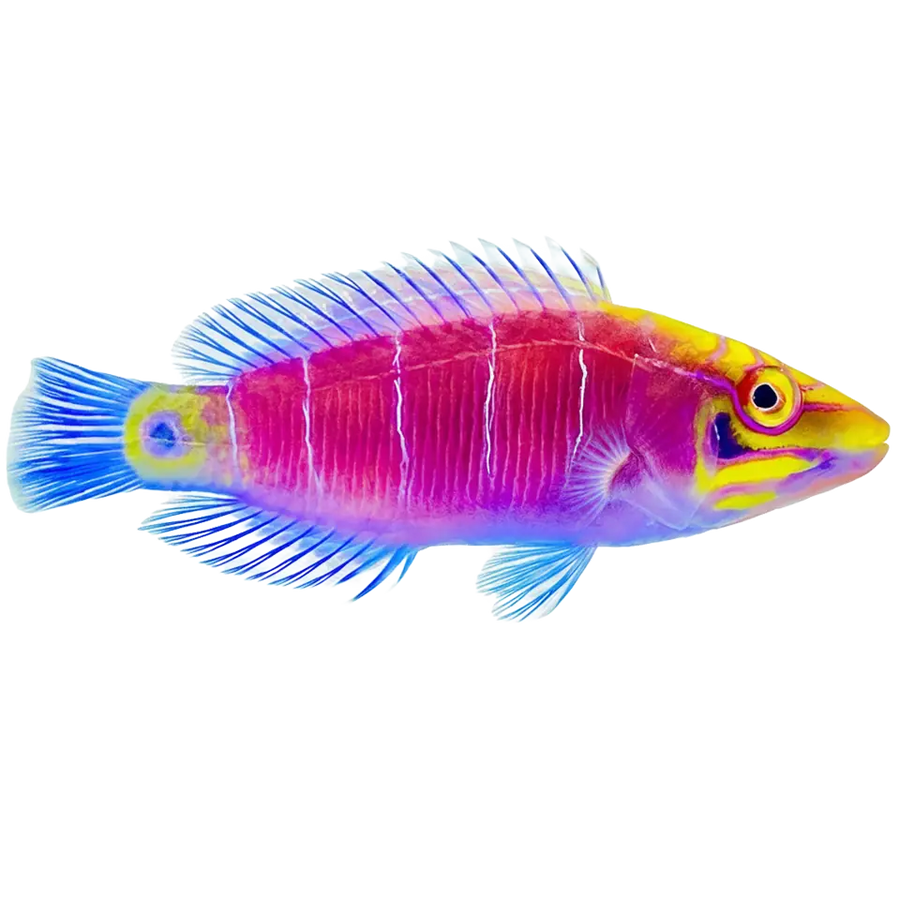
Laboute’s Fairy Wrasse saltwater fish care guide

Overview:
Laboute’s Fairy Wrasse, scientifically known as Cirrhilabrus laboutei, is a vibrant marine species known for its striking colors and active nature. This fish thrives in a well-established aquarium with a minimum size of 55 gallons to accommodate its active swimming habits. The ideal habitat should mimic its natural environment, featuring live rock formations for hiding and exploring. Maintain water temperatures between 72-78°F, with a pH level of 8.1-8.4 and specific gravity of 1.020-1.025. Ensure strong water movement and efficient filtration to keep the environment clean and oxygenated. Adequate lighting is essential to highlight their vivid colors and support any photosynthetic organisms in the tank.

Compatibility:
Laboute’s Fairy Wrasse is generally peaceful and can coexist with a variety of tankmates. They are best kept with other non-aggressive fish species. Avoid housing them with overly aggressive or territorial fish, as this can cause stress and potential harm. They can be kept in small groups, but ensure there is enough space and hiding spots to prevent dominance issues. Exercise caution when introducing them to tanks with invertebrates, as they may occasionally nip at small crustaceans.

Health and Quarantine:
To maintain the health of Laboute’s Fairy Wrasse, regular monitoring of water parameters and tank conditions is crucial. Quarantine new arrivals for 2-4 weeks before introducing them to the main tank to prevent the spread of diseases. Watch for signs of common marine diseases such as ich or fin rot, and treat promptly if symptoms appear. Maintain a stress-free environment by providing plenty of hiding spaces and avoiding sudden changes in water conditions. Regularly inspect the fish for any physical changes or behavioral shifts that might indicate health issues. A balanced diet and stable environment are key to preventing health problems and ensuring a long, vibrant life for Laboute’s Fairy Wrasse.

Pellets Mysis Finely Chopped Seafood
Laboute’s Fairy Wrasse is a peaceful, reef-safe species that thrives in a 70-gallon tank. Reaching up to 5 inches, it swims actively in the mid to upper water column. It displays social behavior, often forming small groups, and shows low territoriality, making it compatible with other peaceful fish. Diet consists of mysis shrimp, brine shrimp, and finely chopped seafood. Originating from Vanuatu and the Coral Sea, it prefers an environment with ample hiding spots to reduce stress and promote natural behaviors.

FAQ

Frequently Asked Questions

About the Laboute’s Fairy Wrasse

  • How can I keep a male Laboute’s Fairy Wrasse displaying his brightest colors without causing him stress or aggression issues in my reef tank?
    Provide a peaceful, active environment with plenty of open swimming space and high rockwork for display circuits. Use moderate to strong, but diffuse lighting—blue-heavy reef lighting tends to pull out their blues and violets. Keep them with other peaceful or moderately assertive planktivores (like other Cirrhilabrus or Paracheilinus wrasses, anthias, or chromis) so he has “an audience” and some mild social stimulation without being bullied. Avoid very aggressive tankmates (large damsels, dottybacks, big wrasses like Thalassoma) that will suppress his behavior. A small harem (one male with 2–4 females, added before or at the same time as the male) often triggers the most frequent flashing and courtship, but you must ensure ample space (minimum 4 ft tank length; 75–90 gallons or more preferred) and lots of hiding spots so females can retreat. Stable, high-quality water (temp 24–26 °C, salinity 1.025–1.026, very low nutrients but not sterile) and a varied diet rich in carotenoids (mysis, enriched brine, quality pellets, and frozen blends with krill/plankton) will help maximize saturation of their colors without resorting to risky “color-boosting” additives.
  • My new Laboute’s Fairy Wrasse is pacing the glass and repeatedly “testing” the surface; what specific lid design and escape-prevention measures work best for this species?
    Laboute’s Fairy Wrasse is a notorious jumper—fright, sudden shadows, or evening “bedtime” dashes can send it straight out of the tank. Use a tight-fitting top that covers every gap larger than about 6 mm, including cutouts around cords, overflows, and auto-feeders. Clear mesh screen tops in the 1/4" (6 mm) range are ideal because they prevent escape while allowing good gas exchange and light penetration. Avoid egg crate light diffusers; the openings are usually wide enough for a slender wrasse to squeeze through. Check that your lid sits flush and cannot shift if bumped. If you run a rimless tank, custom-cut polycarbonate or mesh frame lids are strongly recommended. Also, dimming lights gradually at “sunset,” avoiding sudden room light changes, and not making abrupt movements at the tank in the evening can reduce panicked launches, but a proper lid is still mandatory for this fish.
  • Are Laboute’s Fairy Wrasses safe with high-end LPS and SPS corals, and do they have any special behaviors that might still bother delicate reef setups?
    Laboute’s Fairy Wrasses are generally coral-safe: they do not nip at coral tissue or polyps and are considered excellent candidates for mixed-reef and SPS-dominant systems. They are mid-water planktivores, spending most of their time cruising and only occasionally picking at the rockwork for small crustaceans. The main consideration is their activity level—they are fast, constant swimmers. In very shallow or low-flow frag racks, their motion can dislodge poorly secured frags or topple light plugs. Mount corals securely with adequate epoxy or glue and ensure small frags are well seated in racks. Also, they can reduce populations of tiny beneficial microfauna (like small copepods in the water column), though usually not enough to harm the ecosystem in a balanced tank. They are safe around clams and ornamental shrimp of moderate size, but newly molted very small shrimp can be vulnerable, so add shrimp first and allow them to settle before introducing the wrasse.
  • What is the best strategy for introducing a Laboute’s Fairy Wrasse to a tank that already has other fairy and flasher wrasses to minimize hybrid aggression or chasing?
    Fairy wrasses often show tension when similar-shaped or similarly colored species are present, especially if adult males are involved. To reduce conflict, rearrange some rockwork just before introduction to “reset” territories. Use an acclimation box (clear perforated container in the tank) for 3–7 days so existing wrasses can see, posture at, and get used to the newcomer without physical contact. Introducing the Laboute’s as a slightly smaller subadult or female is usually smoother than dropping in a full, dominant male. Adding multiple fairy/flasher wrasses at once can diffuse aggression, as no single fish stands out as “the intruder.” Avoid mixing with species known for high fairy-wrasse aggression (some large male C. scottorum, C. rubrimarginatus, or C. cyanopleura can be problematic in smaller tanks). Ensure enough horizontal swimming length (4 ft minimum; 5–6 ft is better) and plenty of caves and overhangs so any chased fish can break line-of-sight. Feed small, frequent meals for the first week after introduction to keep everyone busy and less focused on combat.
  • I’ve heard deepwater fairy wrasses can be fragile after shipping. What specific acclimation and quarantine routine works best for a Laboute’s Fairy Wrasse?
    Laboute’s Fairy Wrasse can arrive stressed due to collection depth and transport. Float the bag to match temperature for 15–20 minutes, then use a drip acclimation process over 30–45 minutes, but do not exceed about an hour total in the shipping water to avoid ammonia toxicity (especially if the bag pH rises once opened). Ideally, match salinity in the quarantine tank to the shipping water or only slightly higher, then slowly bring it up over the next few days. Quarantine in a calm, covered tank with dimmed lighting and plenty of PVC or rock hiding spots. A 20–30 gallon QT is fine for a single specimen. They often respond poorly to harsh medications; copper should be used carefully, within appropriate levels, and with good aeration. Many keepers favor a more gentle approach: observation with prophylactic treatments like a short-course praziquantel for flukes and a formalin or freshwater dip only if there are signs of external parasites. Offer small amounts of varied frozen foods (mysis, small krill, cyclops, finely chopped seafood) several times per day; do not panic if eating is hesitant the first 24–48 hours. Stable temperature, high oxygenation, and low light during the first week are key for this species to settle and recover from transport.