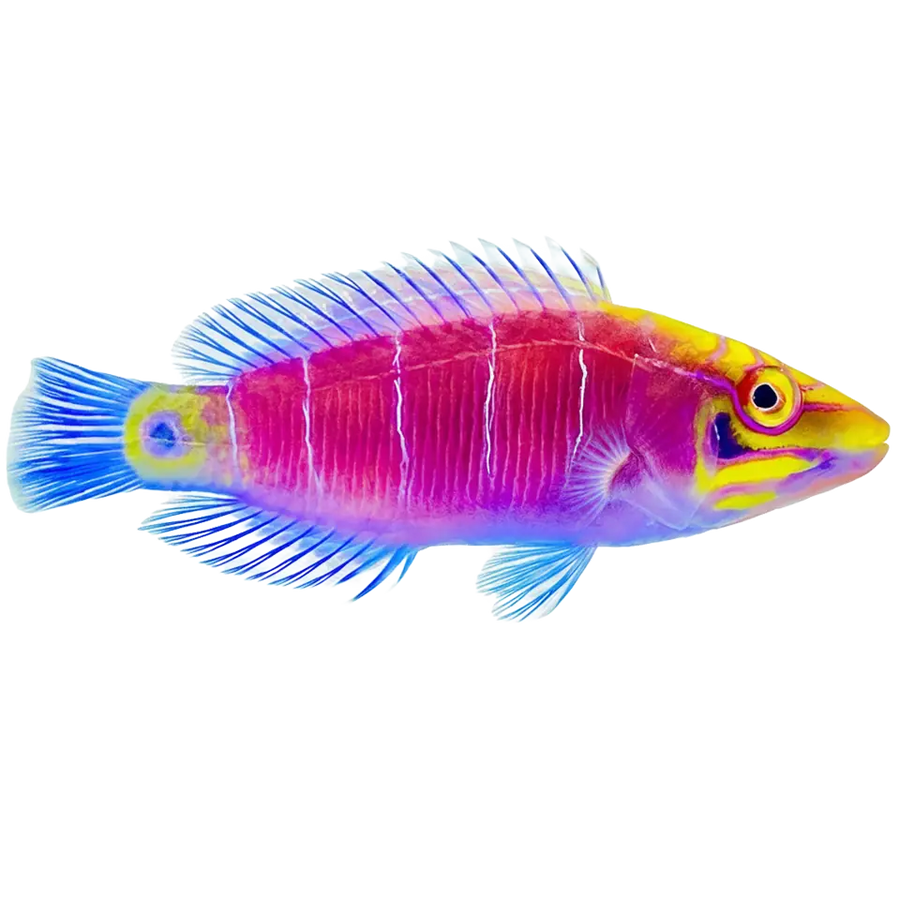
Formosa Wrasse saltwater fish care guide

Overview:
Formosa Wrasse requires a well-maintained marine environment with plenty of swimming space and hiding spots. Ideal conditions include a tank size of at least 100 gallons with a temperature range of 72-78°F, a pH of 8.1-8.4, and a salinity of 1.020-1.025. The tank should have live rock for natural foraging and hiding, as well as a sandy substrate to accommodate their burrowing behavior. Adequate water movement and efficient filtration are essential to maintain water quality.

Compatibility:
Formosa Wrasse are generally peaceful but can become territorial as they mature. They are best kept with other semi-aggressive or similarly sized fish. Avoid housing them with small, timid species or invertebrates, as they may become prey. Suitable tankmates include larger angelfish, tangs, and other robust wrasses. Introduce them to the tank last to minimize territorial disputes. Provide ample hiding spaces to reduce stress and aggression.

Health and Quarantine:
Juvenile Formosa Wrasse are susceptible to common marine diseases such as ich and marine velvet. Quarantine new arrivals for at least 2-4 weeks to monitor for signs of illness and prevent disease introduction to the main tank. Maintain optimal water quality and a stable environment to support their immune system. Regularly inspect for signs of stress or disease, such as changes in color, appetite, or behavior. If illness occurs, treat promptly with appropriate medications and consult a marine veterinarian if necessary.

Pellets Mysis Finely Chopped Seafood
The Formosa Wrasse is a dynamic swimmer, often exploring the tank's mid to lower regions. It displays aggressive behavior, particularly towards smaller or similarly colored fish. Highly territorial, it requires ample space to establish its domain. Not reef-safe, it may prey on invertebrates. Best housed with larger, robust species to prevent bullying. Socially, it can be solitary or form loose groups with similarly sized wrasses. Proper tank size and hiding spots are crucial for reducing stress and aggression.

FAQ

Frequently Asked Questions

About the Formosa Wrasse

  • How can I reliably identify a juvenile Formosa Wrasse from other similarly colored juvenile Thalassoma species when buying one from a store?
    Juvenile Formosa Wrasse (Thalassoma formosum) usually show a bright yellow to yellow‑green body with distinct blue or turquoise lines on the face and sometimes on the front half of the body, plus a darker, often bluish dorsal region. Key clues: 1) Their blue facial lines tend to be finer and more numerous than in many other Thalassoma, creating a “scribbled” mask. 2) The caudal fin is generally rounded to slightly truncate in juveniles, lacking the strong fork seen in some look‑alikes. 3) They’re often sold as “yellow tail” or “yellow wrasse,” but a true Formosa juvenile will usually have a more solid yellow body, not just a yellow tail, and will show that characteristic turquoise/blue on the head under good lighting. Always ask to see the fish under white lights (not just blue reef LEDs) and compare to reference photos of juveniles before purchase.
  • My juvenile Formosa Wrasse hides in the rockwork and only comes out briefly—how long does it usually take them to settle, and should I be worried?
    Newly introduced juvenile Formosa Wrasses can take anywhere from a few days up to two weeks to settle, depending on tank mates, lighting intensity, and how exposed the aquascape feels. It’s normal for them to dive into rock crevices at any sign of movement. You should be concerned only if: 1) The fish stays hidden all day for more than 4–5 days and you rarely see it eat. 2) You notice breathing faster than about 80–100 gill beats per minute or clamped fins when it does emerge. 3) Tank mates (especially other wrasses, dottybacks, or damsels) are harassing it when it appears. To help: dim the lights for the first few days, feed small amounts of finely chopped meaty food (mysis, small krill, chopped clam) several times daily, and provide multiple bolt‑holes in the rock so it doesn’t feel trapped into one den that may be targeted by bullies.
  • What is an appropriate minimum tank size for a juvenile Formosa Wrasse, and when does a tank become too small as it grows?
    A juvenile can physically live in as little as a 55–75 gallon tank, but that’s only realistic as a short‑term grow‑out. Formosa Wrasses are highly active swimmers that can exceed 8–10 inches as adults. For long‑term care, plan for at least a 6‑foot tank (180 gallons or larger). Signs a tank is too small as it grows include: constant pacing along the glass, frayed fins from frequent collisions with rock or equipment, increased aggression toward tank mates, and visible stress during feeding (burst swimming with repeated sudden stops). If you start with a 75–90 gallon tank for a juvenile, you should be prepared to rehome or upgrade once the fish reaches 4–5 inches, ideally before adult male coloration and behavior fully develop.
  • Can a juvenile Formosa Wrasse be kept in a reef tank, and which invertebrates are most at risk as it matures?
    A juvenile Formosa Wrasse can sometimes behave “reef safe with caution,” but this usually changes as it grows. They naturally hunt small crustaceans, worms, and other benthic invertebrates. Most at risk: ornamental shrimp (cleaner, fire, peppermint, sexy shrimp), small crabs (emerald, porcelain), feather duster worms, small snails, and tiny hermits. Larger, heavily armored hermits and big turbo snails usually fare better but can still be harassed. Corals themselves (SPS, LPS, softies) are not their primary target, though they may nip at polyps incidentally while picking at food. In a reef environment, expect them to gradually thin out your micro‑crustacean population (pods) and any exposed, slow‑moving inverts. If you value shrimp and small crabs, this species is best avoided or kept in a fish‑only or fish‑only‑with‑live‑rock tank instead.
  • My juvenile Formosa Wrasse sleeps buried in the sand, but sometimes it doesn’t come out at its usual time—what sleep pattern is normal, and when is this a red flag?
    It is normal for a juvenile Formosa Wrasse to dive into the sand at dusk and emerge shortly after the lights come on. They often follow the light schedule closely: going under when the main lights dim or when only actinics are on, and waking with the first bright phase. Variations of up to 30–60 minutes earlier or later are common, especially after a stressful event (new fish added, aquascape change, strong feeding response from other fish). Red flags include: 1) The wrasse remains buried for an entire photoperiod, especially two days in a row. 2) When it emerges, it appears pale, breathes rapidly, or refuses food. 3) You recently used medications or had a sudden temperature, salinity, or pH swing. Ensure you have at least 2–3 inches of fine, soft sand (sugar‑sized aragonite is ideal), avoid vacuuming right over their known sleep area, and if the fish stays buried unusually long, carefully check parameters and observe closely when it finally emerges, as this can signal early disease or severe stress.