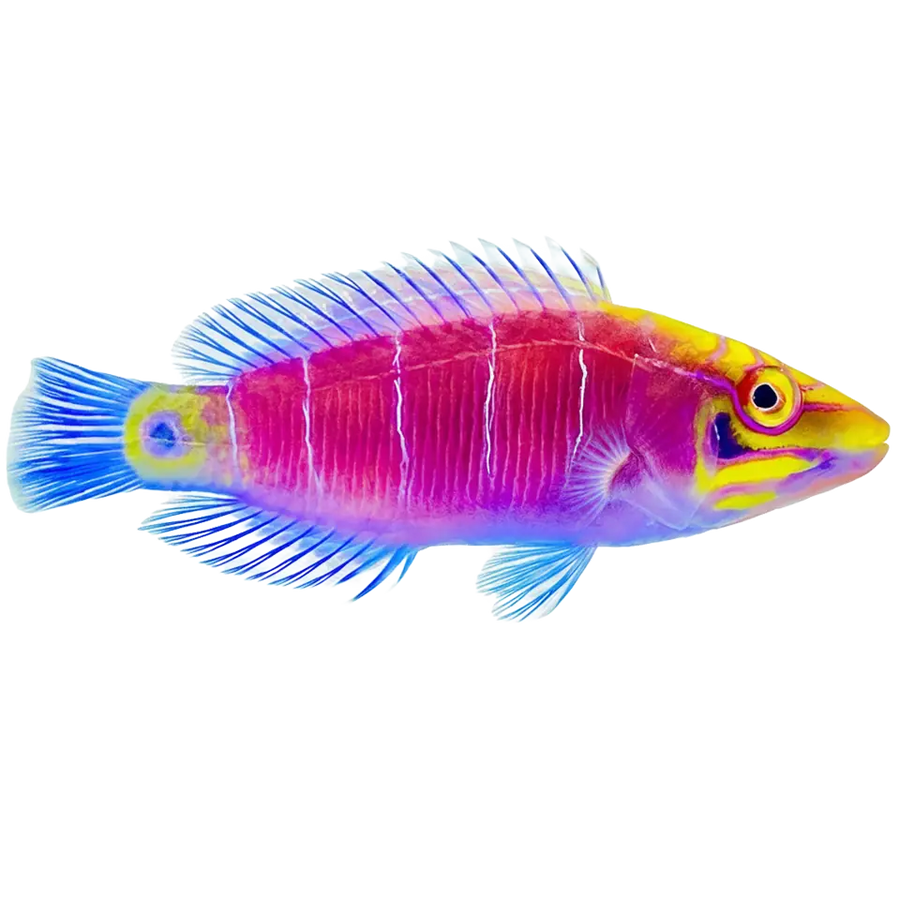
Fairy Lineatus Wrasse saltwater fish care guide

Overview:
The Fairy Lineatus Wrasse, known for its vibrant coloration and active swimming behavior, requires a well-maintained marine aquarium to thrive. Ideally, the tank should be at least 75 gallons to provide ample swimming space. The environment should mimic its natural habitat, featuring live rock formations for hiding and exploring. Water parameters should be stable, with a temperature range of 72-78°F, pH between 8.1-8.4, and specific gravity of 1.020-1.025. A moderate to strong water flow and efficient filtration are crucial to maintain water quality. Lighting should be moderate, as overly intense lighting can cause stress.

Compatibility:
Fairy Lineatus Wrasse are generally peaceful and can coexist with a variety of other marine species. They are best kept with other peaceful fish and are compatible with most reef environments, as they do not typically harm corals or invertebrates. However, they may become territorial towards other wrasses, so it is advisable to introduce them as the last wrasse in a community tank. Avoid housing them with aggressive or significantly larger fish to prevent stress and bullying.

Health and Quarantine:
To ensure the health of the Fairy Lineatus Wrasse, a quarantine period of 2-4 weeks is recommended before introducing them to the main tank. This helps in monitoring for diseases such as marine ich or flukes, which are common in wrasses. Regularly check for signs of stress or illness, such as loss of color, erratic swimming, or refusal to eat. Maintain optimal water quality and perform regular water changes to prevent disease. If any health issues arise, promptly address them with appropriate treatments, ensuring they are safe for wrasses and the overall tank environment.

Pellets Mysis Finely Chopped Seafood
The Fairy Lineatus Wrasse is a peaceful, reef-safe fish that thrives in a 70-gallon tank or larger. Originating from Melanesia, it reaches up to 5 inches and displays active swimming habits throughout the water column. This species is non-territorial and exhibits social behavior, often forming loose groups. It is compatible with other peaceful fish but should not be housed with aggressive species. As a carnivore, it requires a diet of mysis shrimp, brine shrimp, and enriched frozen foods to maintain its vibrant coloration and health.

FAQ

Frequently Asked Questions

About the Fairy Lineatus Wrasse

  • Can a Fairy Lineatus Wrasse be kept with more aggressive fairy wrasses like Scott’s or Lubbock’s, and how does its temperament affect stocking order?
    Fairy Lineatus Wrasses (Cirrhilabrus lineatus) are on the timid end of the fairy wrasse spectrum and can be easily bullied by more assertive species. If mixing with stronger personalities (Scott’s, Lubbock’s, solar, etc.), the Lineatus should be added first or at the same time, never last. Provide multiple rock structures and overhangs so it can retreat out of sight lines. Avoid highly aggressive wrasses (e.g., some Thalassoma, large Halichoeres, or domineering fairy wrasses) in tanks under 4 feet, as the Lineatus will often stay hidden, lose color, and may stop eating. When in doubt, pair it with other peaceful fairy and flasher wrasses, anthias, gobies, and small tangs instead of bold, territorial species.
  • Why does my male Fairy Lineatus Wrasse sometimes show intense burst colors and dart rapidly around certain fish, and is this normal or a sign of stress?
    That behavior is almost always display, not stress. Males will “flash” or perform courtship displays by rapidly changing hue (especially blues, yellows, and pinks), spreading fins, and doing short, fast dashes around females or even other wrasses and small planktivores. It’s most common around dusk or after a sudden change in light intensity. Stress, in contrast, shows as faded coloration, clamped fins, hiding in rockwork all day, and rapid breathing. If your fish returns to calm, normal swimming, keeps a good appetite, and only does the fast displays intermittently, it’s normal nuptial behavior. Strong, full-spectrum lighting and good nutrition actually encourage this display, whereas chronic aggression or poor water quality suppress it.
  • My Fairy Lineatus Wrasse sleeps on the rock and doesn’t bury in sand like my Halichoeres; do they ever need sand, and how should their sleeping spots be arranged?
    Unlike many “sand-sleeping” wrasses, Fairy Lineatus Wrasses do not bury; they wedge themselves into rock crevices and form a nighttime mucus cocoon. Sand is not required for their security, but complex, porous rockwork is. Arrange rock with plenty of finger-like branches and caves so the fish can slip into a tight gap with low flow at night. In bare-bottom systems, add at least a few substantial rock clusters or artificial caves so it can pick a stable sleeping spot. Strong, direct flow over all rock faces can disturb their sleep; aim for moderate flow zones with subtle shadowed areas. As long as it can vanish into the rock at lights out and reappear at lights on without signs of injury or stress, its needs are met.
  • How sensitive is the Fairy Lineatus Wrasse to changes in salinity or temperature during shipping and acclimation compared to other fairy wrasses?
    Fairy Lineatus Wrasses are among the more sensitive Cirrhilabrus species and often react poorly to rapid swings. They are particularly prone to shipping stress, which shows as heavy breathing, listlessness, and fading color. When acclimating, match temperature slowly over 20–30 minutes, then adjust salinity with a drip method over 45–60 minutes, keeping the bag water dark and calm. Avoid long, open-air transfers and keep aeration gentle but continuous. Sudden jumps above 1.026 sg or temperature spikes over 78–80°F right after shipping are more problematic for this species than for some hardier fairy wrasses. Stable parameters afterward (around 1.025–1.026 sg, 76–78°F) are critical to recovery; avoid major parameter changes for at least a week after introduction.
  • How can I maintain the intense coloration of a male Fairy Lineatus Wrasse in a reef tank over the long term, and what specific diet and lighting conditions help?
    Color in male Fairy Lineatus Wrasses is strongly tied to diet, lighting, social context, and stress level. For diet, provide frequent small feedings (2–4 times daily) of high-quality frozen foods rich in carotenoids and marine protein (mysis, enriched brine, finely chopped krill, calanus, roe) plus a quality marine pellet that includes astaxanthin and spirulina. Avoid relying solely on flake or un-enriched brine. For lighting, full-spectrum reef lighting with a strong blue component (typical LED reef profiles) brings out blues and violets; adding some white spectrum (not running purely deep blue) keeps yellows and pinks more vivid. Socially, the presence of at least one compatible fairy or flasher wrasse often keeps a male “in gear” and colored up, as he will display more. Minimize bullying, nitrate spikes, and large swings in alkalinity, as chronic stress will dull the fins and body, and the fish may regress toward female-like coloration over time.