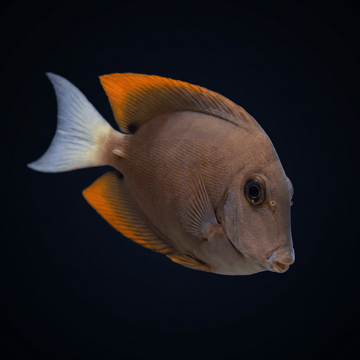
Achilles Tang saltwater fish care guide

Acanthurus achilles is among the most recognizable surgeonfish in the hobby, built on a jet-black to charcoal body broken by crisp white markings: a band across the gill cover, patches near the bases of the dorsal and anal fins, and a white-edged caudal fin framed by a vivid orange teardrop at the tail base. Electric blue highlights along the fins add further contrast, and the orange, scalpel-like peduncle spine typical of the genus sits just ahead of the tail. Coloration functions as a live readout of condition; it dulls quickly under stress or inadequate nutrition. Adults reach roughly 10 inches and grow more slowly than most other tangs. The species ranges across Pacific reefs from Hawaii, the Marshall Islands, and the Line Islands eastward toward the Mexican coast, where it occupies the shallow surge zone and reef crest in only one to ten feet of water, on volcanic rock scoured by breaking waves.

Replicating that habitat is the central challenge. Adult housing starts at 180 gallons, and wider-than-tall dimensions with generous open swimming lanes matter more than rock stacked to the waterline, though some grazing structure should remain. Water movement must be extreme by reef tank standards: chaotic, multidirectional turbulence in the range of 3,000 to 5,000 or more gallons per hour, produced by opposed gyre pumps, wave makers, or propeller powerheads set to alternating patterns. A fully mature, chemically stable system is not optional. This fish tolerates swings in water quality far less than most reef species, so nitrate is best held under 10 ppm with no detectable ammonia or nitrite. Quarantine is worthwhile, but it should be carried out in a spacious system rather than a small holding tank, since cramped quarters add significant stress to an already delicate import.

Reef compatibility deserves careful planning. The Achilles Tang itself will not harm corals or invertebrates, but the violent flow it needs is often at odds with large-polyped stony corals and other sessile animals that prefer gentler currents, so coral selection and placement should be chosen around the fish rather than the reverse.

On the reef crest, this is an almost continuous grazer, working short turf algae from wave-washed volcanic rock throughout the daylight hours. That pattern should drive the captive feeding plan. Frozen herbivore preparations, dried algae sheets and nori clipped in the current, and modest amounts of mysis or brine shrimp for variety cover its needs well. Soaking prepared foods in a vitamin supplement supports immune function, which matters for a species that arrives with little margin for error.

Offer smaller portions two to three times daily rather than one large feeding, so grazing opportunity is nearly constant. The most difficult phase is the beginning: convincing a freshly imported Achilles Tang to eat at all is the single greatest hurdle with this species. Present nori immediately upon arrival, dim the lighting, and provide shelter so the fish can settle without being pushed into open water. Once it is grazing reliably and holding color, it becomes a bold, confident feeder.

Frozen Herbivore Blends Dried Algae Sheets Nori Mysis Shrimp Brine Shrimp Vitamin-Soaked Prepared Foods
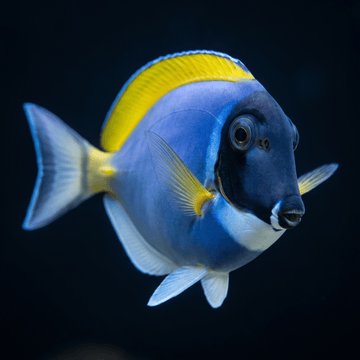
Expect nonstop motion. This is a fast, powerful swimmer that patrols open water and rockwork continuously, which is why swimming length and turbulent flow are as important as volume. It is territorial and semi-aggressive, and hostility is sharpest toward other surgeonfish with similar body shape, including Powder Blue, Powder Brown, and Goldrim tangs along with other Acanthurus and Naso species. Conflict with its own kind can turn lethal, so a single specimen per system is the safe approach.

Tankmates of unlike shape and temperament work far better. Wrasses, anthias, gobies, and blennies generally coexist without issue, while very aggressive triggerfish are a poor match and will make the already fragile acclimation period worse. Toward invertebrates the Achilles Tang is harmless, showing no interest in shrimp, crabs, snails, or clams, and it will not pick at corals. The limiting factor in a mixed reef is the flow regime rather than the fish, so build the coral list around the turbulence this species requires.

FAQ

Frequently Asked Questions

About the Achilles Tang

  • What size aquarium does an adult Achilles Tang need?
    Plan on a minimum of 180 gallons for an adult, with wider-than-tall dimensions. Open swimming length matters as much as total volume for this constantly moving surgeonfish.
  • Is the Achilles Tang reef safe?
    Yes, it grazes algae and will not harm corals or invertebrates. The practical caution is that its need for extremely turbulent flow can conflict with corals such as large-polyped stony species that prefer gentler current.
  • How much water flow does an Achilles Tang require?
    Aim for very strong, chaotic, multidirectional movement in the range of 3,000 to 5,000 or more gallons per hour, using opposed gyre pumps or propeller powerheads to imitate its natural surge-zone habitat.