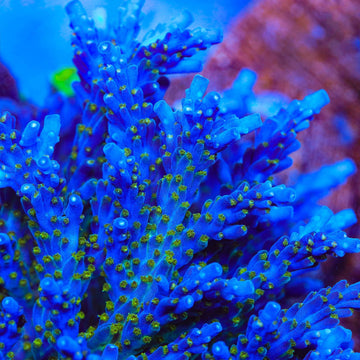
TSA Sunset Mirage Spathulata Acropora Coral
Overview
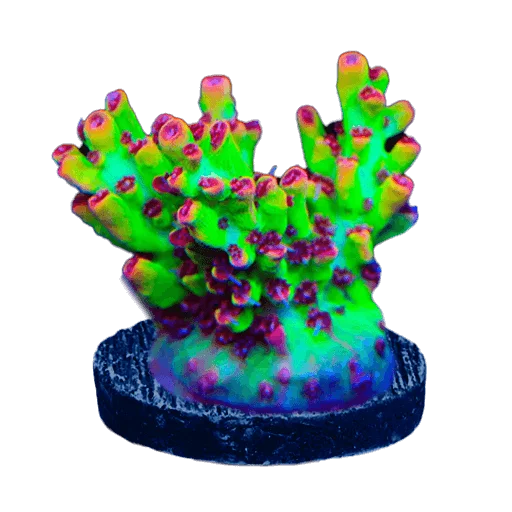
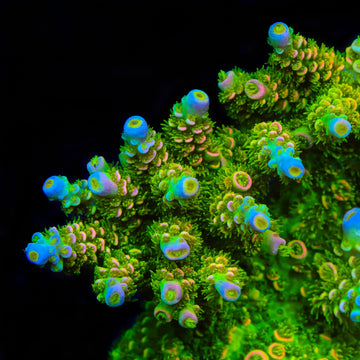
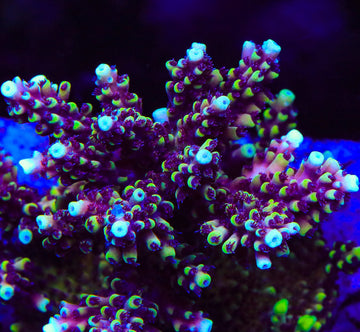
Sunset Mirage Spathulata Acropora Coral shows thick, flattened branch tips with contrasting polyp colors. Acropora spathulata is a branching stony coral that prefers strong light and high, turbulent water flow. It is mainly photosynthetic through symbiotic algae, but occasional small-particle foods can support growth and color. Place high on stable rockwork and leave space from stinging neighbors to prevent tissue damage.
Quick Facts
Care
Difficult
Lighting
High
Flow
High, turbulent
Placement
High
Temperament
Peaceful (2–3 inches spacing)
Recommended Parameters
Temp
76–80°F
pH
8.1–8.4
Salinity
1.025–1.026
Calcium
420–450 ppm
AlkAlkalinity
7.5–9 dKH
Magnesium
1280–1350 ppm
Feeding
photosynthetic, microplankton, rotifers, copepod nauplii, oyster eggs, coral-specific micro foods, amino acids
Care & Placement
FAQ
Frequently Asked Questions
About the TSA Sunset Mirage Spathulata Acropora Coral
-
How can I tell Acropora spathulata from similar species like A. millepora?
Look for thick, spatula-like branch tips with a smooth coenosteum and prominent axial corallites. Polyps are shorter and less “hairy” than millepora. Growth tends toward corymbose/table forms with wide, flattened branch ends. Under strong, turbulent flow, branches broaden rather than becoming fuzzy. A macro photo at night with polyps extended helps confirm the smooth tissue and paddle-like tips typical of spathulata. -
Why is my Sunset Mirage Spathulata fading from pink/red to beige?
Color shifts usually follow light spectrum and nutrient imbalance. Aim for PAR ~300–450 with strong blue/near-UV (400–470 nm), gradual acclimation, and chaotic flow. Keep nutrients non-zero (NO3 2–10 ppm, PO4 0.02–0.08) to avoid washed-out tones. Avoid rapid alkalinity changes and excessive white light. Trace elements (especially iron and iodine) at natural levels support pigment expression; test before dosing. -
What’s the most common trigger for RTN/STN in this species, and how do I prevent it?
Sudden parameter swings, especially alkalinity and temperature, are typical triggers. Keep alk stable (7.5–8.5 dKH, <0.3 dKH/day change), temperature 24–26°C, and maintain high dissolved oxygen via strong, cross-flow. Mount the base off the rock to limit detritus and bacterial hotspots. After handling or fragging, use iodine-based dips and increase flow to the healing edges to reduce tissue recession. -
Any placement tips to avoid self-shadowing as the colony plates out?
Position high with multi-directional, pulsed flow to keep the interior oxygenated. Provide clearance around the rim so it can expand without shading neighbors. A slight tilt or raised mount improves light to lower tiers. Multi-source or diffused lighting reduces harsh shadows. Periodically rotate the frag or use strategic pruning to reopen light lanes under the table.