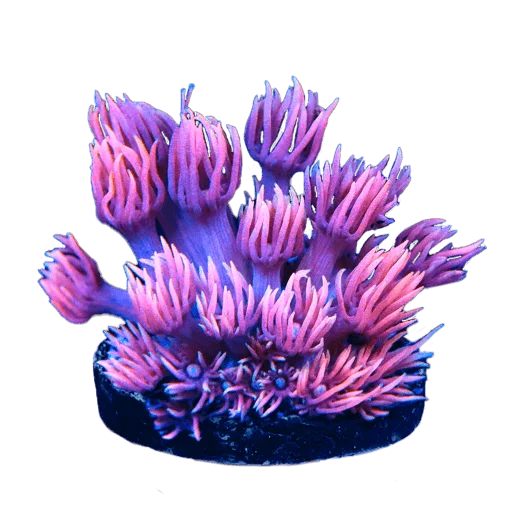
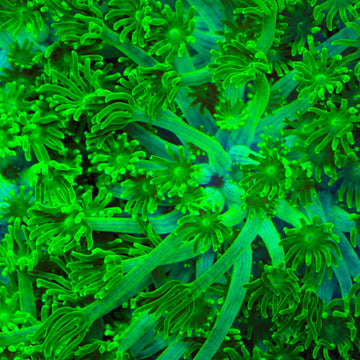
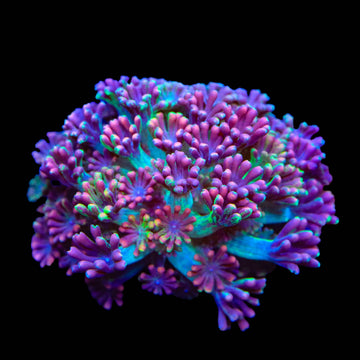
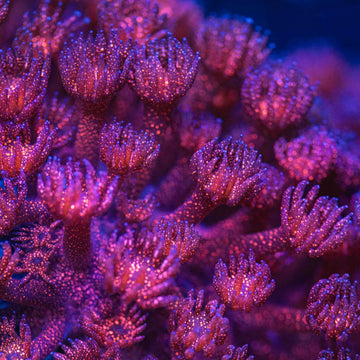
TSA Strawberries on Fire Goniopora Coral
Overview
Strawberries on Fire Goniopora Coral shows bright red to pink polyps with long, daisy-like tentacles. Goniopora sp. is a large-polyp stony coral with a porous skeleton, preferring moderate light and gentle to moderate, indirect water flow. It relies on symbiotic algae for energy but benefits from occasional small particulate or microplankton feedings to support growth and polyp extension. Place it on a stable surface with space from aggressive neighbors, and avoid strong direct flow or repeated handling.
Quick Facts
Care
Moderate
Lighting
Moderate
Flow
Moderate, indirect
Placement
Mid–Low
Temperament
Semi-aggressive (3–6 inches spacing)
Recommended Parameters
Temp
76–80°F
pH
8.1–8.4
Salinity
1.025–1.026
Calcium
400–450 ppm
AlkAlkalinity
8–9 dKH
Magnesium
1280–1350 ppm
Feeding
photosynthetic, phytoplankton, zooplankton, rotifers, copepod nauplii, microplankton, coral-specific powdered foods, enriched brine shrimp nauplii, finely minced mysis
Care & Placement
FAQ
Frequently Asked Questions
About the TSA Strawberries on Fire Goniopora Coral
-
Why does my Strawberries on Fire Goniopora retract for days after looking fine?
Extended retraction often points to micro-irritants or flow/light mismatch. Check for vermetid snails, bristleworms near the base, or shrimp stealing food. Adjust to gentle, alternating flow that moves polyps without bending them. Keep light in the moderate range, not peak-intensity hotspots. Stabilize nutrients (nitrate 5–15 ppm, phosphate 0.03–0.1) and consider an iodine dip if tissue looks pinched or frayed. -
How do I preserve the vivid strawberry-red colors and avoid fading or browning?
Color washout typically follows either ultra-low nutrients or heavy shading. Maintain moderate PAR and balanced nutrients instead of “stripped” water. Feed fine particulate foods 2–3 times weekly when polyps are fully extended. Regular trace element maintenance, especially iron and manganese, supports pigmentation and growth; dose only if you test or perform consistent water changes to avoid excess. -
My Goniopora shows “pinched polyp” tips and slow tissue recession—what advanced steps help?
Increase oxygenation and flow, perform a large, well-matched water change, and trim back any irritating neighbors. An iodine or povidone dip often helps; if rapid necrosis continues, experienced keepers sometimes use a short, isolated antibiotic bath (e.g., ciprofloxacin) in a separate container with strong aeration. Remove detritus traps at the base and stabilize temperature, pH, and alk tightly. -
Can it coexist near torches or acans, and how far should I place it?
While Goniopora lacks long sweepers, its long polyps can be chemically sensitive and physically chafed by aggressive LPS. Give 3–6 inches clearance from Euphyllia, acans, and favias, more if flow pushes tentacles into them. Avoid direct line-of-fire from torch sweepers. Watch for nocturnal contact patterns and shift rockwork so polyps sway freely without rubbing neighbors.