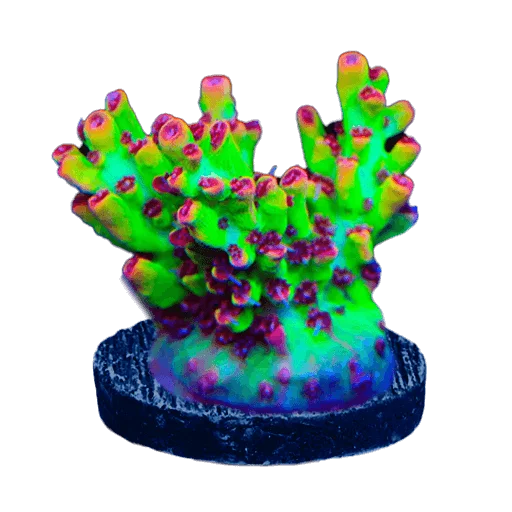
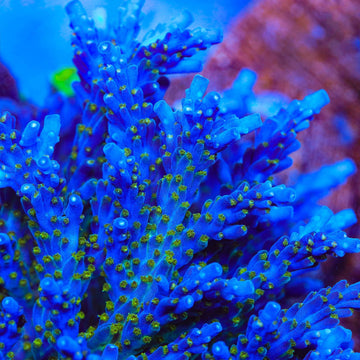
TSA Sour Tsunami Acropora Coral
Overview
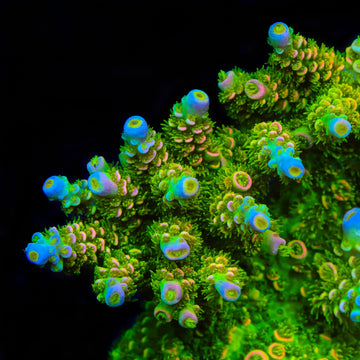
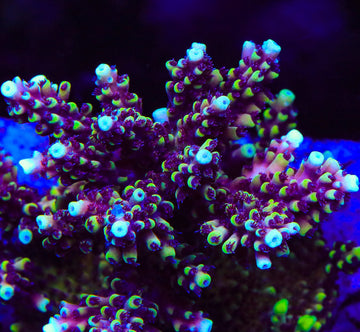
Sour Tsunami Acropora Coral shows branching, tightly spaced corallites with contrasting tips. Classified as Acropora sp. Coral, it is a small-polyp stony branching coral that thrives under strong light and high, turbulent water flow. It is primarily photosynthetic via symbiotic algae, but occasional small-particle foods can support growth and coloration. Place high and stable, with ample space from aggressive neighbors, as its delicate branches are prone to breakage and can shade lower corals.
Quick Facts
Care
Difficult
Lighting
High
Flow
High, turbulent
Placement
High
Temperament
Peaceful (3–6 inches spacing)
Recommended Parameters
Temp
76–80°F
pH
8.1–8.4
Salinity
1.025–1.026
Calcium
420–460 ppm
AlkAlkalinity
7–9 dKH
Magnesium
1280–1350 ppm
Feeding
photosynthetic (primary), microplankton, zooplankton, rotifers, copepod nauplii, oyster eggs, marine snow, coral-specific powdered foods, amino acid supplements
Care & Placement
FAQ
Frequently Asked Questions
About the TSA Sour Tsunami Acropora Coral
-
Why does my Sour Tsunami Acropora Coral encrust for months before growing upward?
Acropora sp. often lays a broad base first to anchor against strong currents, a trait from high-energy reef zones. Provide high, random flow and leave clear space around the plug/rock to encourage outward growth. Mounting on a slightly vertical face can prompt earlier branching. Avoid early fragging; let the base mature with stable alkalinity (8–9 dKH). Moderate nutrients (NO3 5–10 ppm, PO4 0.03–0.08 ppm) support steady tissue production. -
The blue tips are fading to green/brown—what’s the fix without shocking the coral?
Color loss is usually light spectrum or nutrient imbalance. Target 300–350 PAR with strong blue/UV (400–470 nm, some 380–405). Reduce excessive white/red channels. Keep NO3 5–10 ppm and PO4 0.03–0.08; ultra-low nutrients cause paling, high nutrients brown it. Maintain potassium 380–420 ppm; avoid heavy iron dosing that pushes green. Make changes gradually over 1–2 weeks. -
I’m seeing polyp retraction and slow tissue loss at the base—what should I check first?
Rule out pests and instability. Inspect for AEFW (bite marks, flatworm eggs) and red bugs; use targeted dips and quarantine if found. Verify flow is turbulent, not a direct jet on one face, which can cause recession. Confirm daily stability in alkalinity and temperature. If necrosis advances, cut well above the affected area and remount the healthy tip in strong flow. -
Any placement or compatibility tricks specific to Sour Tsunami beyond standard SPS advice?
Give 3–4 inches clearance for rapid plating/branching and self-shading management; trim inner branches to maintain light and flow through the core. Avoid contact with aggressive LPS (e.g., Galaxea, Euphyllia). Consider hosting Trapezia acro crabs for natural grooming and minor predation deterrence. Be cautious with angel and butterfly species that may nip. Maintain nighttime aeration and pH stability to prevent tip burn in fast growers.