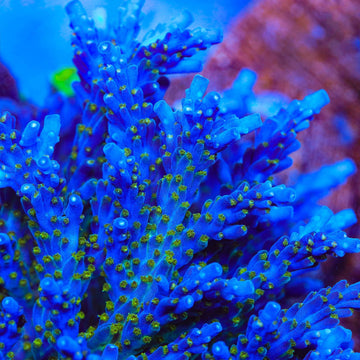
TSA Green Hornet Acropora Coral
Overview
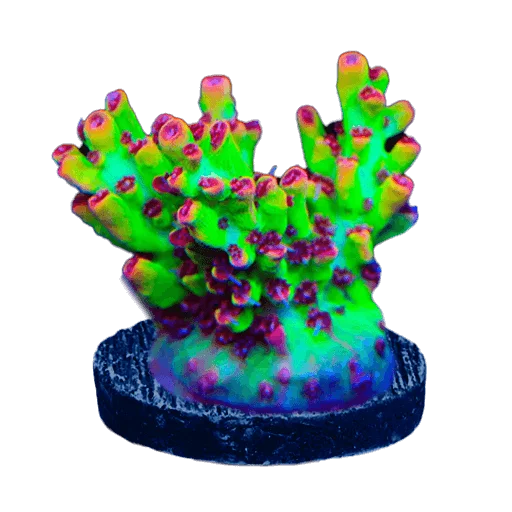
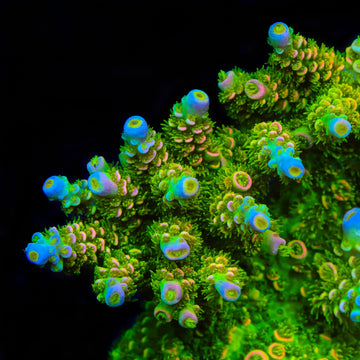
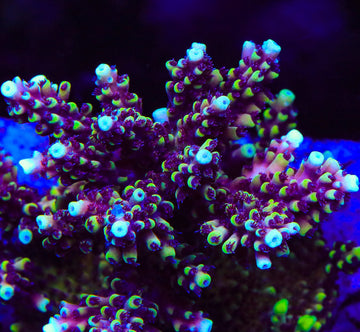
Green Hornet Acropora Coral shows bright green branching tips with small axial polyps and a tight staghorn form. Acropora sp., a small-polyp stony branching coral, prefers strong lighting and high, turbulent water flow in stable reef conditions. It is primarily photosynthetic via symbiotic algae but can take occasional micro-plankton foods to support growth and color. Place high on rockwork with ample spacing, and avoid contact with aggressive corals or sudden swings in alkalinity, temperature, or nutrients.
Quick Facts
Care
Difficult
Lighting
High–Very High
Flow
High
Placement
High
Temperament
Peaceful (2-3 inches spacing)
Recommended Parameters
Temp
76–80°F
pH
8.1–8.4
Salinity
1.025–1.026
Calcium
420–450 ppm
AlkAlkalinity
8–9 dKH
Magnesium
1280–1350 ppm
Feeding
photosynthetic, microplankton, phytoplankton, zooplankton, rotifers, copepod nauplii, coral-specific powdered foods, amino acid supplements
Care & Placement
FAQ
Frequently Asked Questions
About the TSA Green Hornet Acropora Coral
-
Why is my Green Hornet Acropora losing its neon green and looking dull or brown?
Color shifts often track light spectrum, nutrients, and potassium. Aim for 250–350 PAR with strong 420–460 nm blues and moderate whites; avoid abrupt changes. Keep nitrate 2–10 ppm, phosphate 0.03–0.08 ppm, alkalinity 7.5–8.5 dKH with minimal swing. Low potassium (<380 mg/L) or iodine depletion can mute fluorescence—confirm with ICP and correct slowly. Stability restores glow. -
How does this coral typically grow, and how should I place it to avoid dead zones or shading?
It encrusts first, then throws vertical branches. Give it room on a slightly raised rock to spread a plate-like base, with strong, random flow from at least two sources to keep detritus off the base. Anticipate self-shading; orient branches toward flow and light, and trim inner branches periodically so the base keeps receiving light and maintains tissue. -
What pests or diseases uniquely trouble Acropora sp., and how can I respond quickly?
Watch for AEFW (crescent bite marks, pale patches) and red bugs (tiny orange dots, reduced polyp extension). Quarantine, inspect at night, and use targeted dips (e.g., Bayer-type for AEFW; interceptor-style treatments for red bugs) per proven protocols. For sudden RTN, frag 5–10 mm into healthy tissue, stabilize alkalinity and temperature, increase aeration/flow, and consider an iodine dip. Remove dying tissue promptly. -
Are there trace element or feeding tweaks that reliably improve polyp extension and vigor?
Maintain potassium 380–420 mg/L and iodine at natural seawater levels; both support color and extension. Periodic amino acids or fine powdered foods at lights-out can help, but keep nutrients balanced to avoid film algae. Run fresh carbon to blunt allelopathy from nearby LPS, and perform regular ICP to correct minor deficits without heavy-handed dosing. Stability beats quantity.