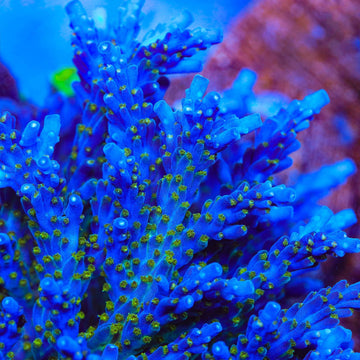
TSA Gorilla Glue Acropora Coral
Overview
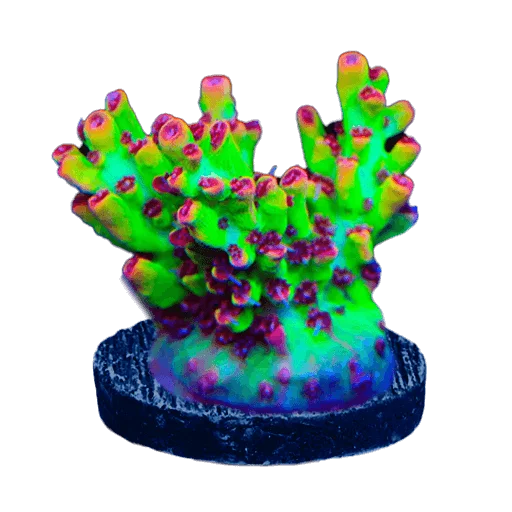
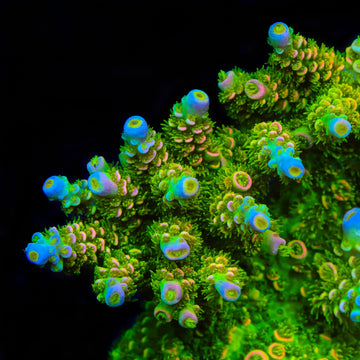
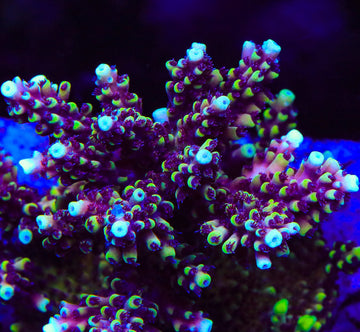
Gorilla Glue Acropora Coral shows thick, knobby branches with compact corallites and a dense growth form. Classified as Acropora sp., it is a small-polyp stony branching coral that prefers strong lighting and high, turbulent water flow. It relies on symbiotic algae for energy but can accept occasional fine particulate foods, which may support growth and coloration. Place high on stable rockwork with space from aggressive neighbors, and keep parameters stable to avoid stress and tissue loss.
Quick Facts
Care
Difficult
Lighting
High
Flow
High
Placement
High
Temperament
Peaceful (3–4 inches spacing)
Recommended Parameters
Temp
77–80°F
pH
8.1–8.4
Salinity
1.025–1.026
Calcium
400–450 ppm
AlkAlkalinity
7.5–9 dKH
Magnesium
1280–1350 ppm
Feeding
photosynthetic (primary), microplankton, rotifers, copepod nauplii, reef-specific powdered coral foods, cyclops, oyster eggs, amino acid supplements
Care & Placement
FAQ
Frequently Asked Questions
About the TSA Gorilla Glue Acropora Coral
-
Why does my Gorilla Glue Acropora encrust for months before shooting branches?
This strain often prioritizes a thick, “cemented” base in high-flow zones to stabilize itself, especially if first mounted on fresh rock. Encourage vertical growth by giving it strong, random flow and 300–400 PAR, plus a stable alkalinity of 8–9 dKH. Once the base has fully gripped and shaded edges are trimmed, you’ll usually see rapid nubbing and upward branching. -
My colony’s tips look burnt while the base stays fine—what’s the likely cause?
Tip burn commonly follows an alkalinity spike in a low-nutrient setup. Confirm alk stability (daily swing <0.2 dKH), keep nitrate 2–10 ppm and phosphate 0.03–0.08 ppm, and reduce PAR by 10–15% for a week. Resume normal light once polyp extension returns. Amino dosing at night and slightly increased flow around the tips can speed recovery. -
How can I preserve the signature color under LEDs without washing it out?
Target 14–18K overall spectrum with strong blue/violet (400–470 nm) and moderate white; avoid abrupt jumps in UV. Too white can mute fluorescence; too blue with ultra-low nutrients can pale tissue. Stabilize nutrients first, then fine-tune spectrum. A short evening “blue pop” period helps, but keep total photoperiod 8–10 hours and acclimate intensity over 2–3 weeks. -
Why is the shaded base slowly receding while the tips look healthy?
Dense branching can starve the base of light and flow. Prune a few inner branches to open pathways, increase cross-tank turbulence, and rotate the colony slightly to expose the base. Check for pests like AEFW or red bugs if polyps stay withdrawn. An iodine dip and mild bacterial management (good skimming, fresh carbon) can halt slow tissue loss.