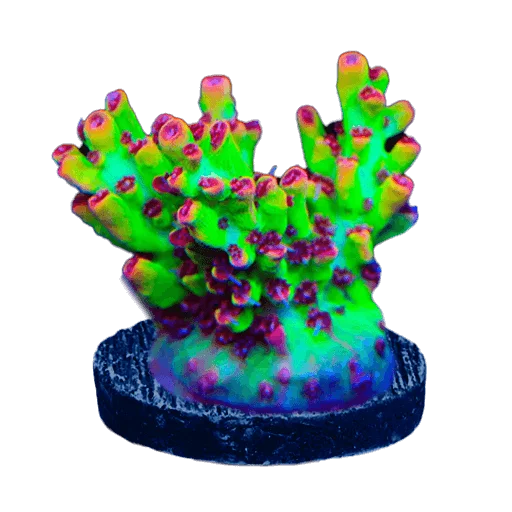
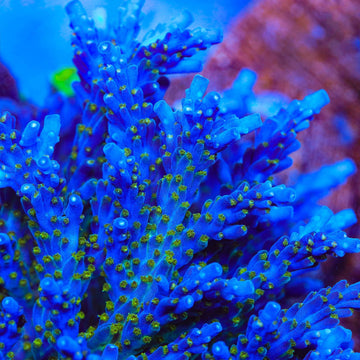
TSA Golden Waves Grafted Anacropora Coral
Overview
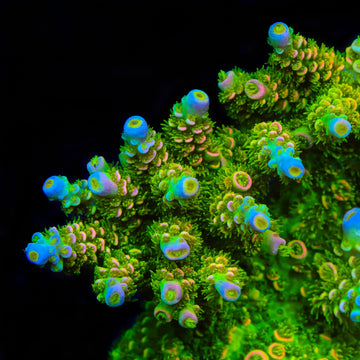
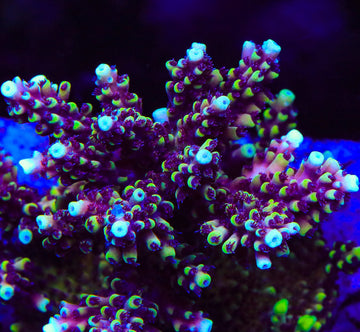
Golden Waves Grafted Anacropora Coral shows branching, wave-like spikes with contrasting grafted color patches. Anacropora sp. is a small-polyp stony branching coral that prefers moderate to strong lighting and brisk, turbulent water flow. It is photosynthetic via symbiotic algae but can accept fine particulate foods, which may support growth and deepen coloration. Place high on stable rockwork with space from aggressive neighbors, as its thin branches are fragile and can break or be overgrown.
Quick Facts
Care
Moderate
Lighting
Moderate–High
Flow
Moderate–High
Placement
Mid–High
Temperament
Peaceful (2–3 inches spacing)
Recommended Parameters
Temp
76–80°F
pH
8.1–8.4
Salinity
1.025–1.026
Calcium
400–450 ppm
AlkAlkalinity
7.5–9 dKH
Magnesium
1280–1350 ppm
Feeding
photosynthetic (primary), microplankton, rotifers, copepod nauplii, phytoplankton, zooplankton, coral-specific powdered foods, amino acid supplements
Care & Placement
FAQ
Frequently Asked Questions
About the TSA Golden Waves Grafted Anacropora Coral
-
How do I keep the grafted colors on Golden Waves Grafted Anacropora Coral from blending or fading over time?
Keep PAR consistent (250–350), with even coverage across the colony so one morph isn’t shaded. Maintain steady alkalinity (7.5–8.5 dKH) and moderate nutrients (NO3 2–10 ppm, PO4 0.03–0.10 ppm). If one color starts to dominate, trim back the faster morph and reposition frags to equalize light and flow. Avoid rapid spectrum shifts; blue-heavy light helps maintain fluorescence without washing out pastel tones. -
What growth quirks should I plan for when placing this Anacropora sp.?
It typically plates or encrusts first, then throws thin, fast branches that can sweep outward and shadow neighbors. Provide room for lateral spread and turbulent, not laminar, flow to keep polyps clean without tip burn. Mount on a stable, slightly vertical surface to reduce self-shading. Branches are brittle—keep it away from high-traffic rockwork or fish routes to prevent breakage and secondary infections at snapped tips. -
My tips are “burning” or receding while the base looks fine—what’s the likely cause?
Tip necrosis usually points to combined stress: sudden PAR increase, alkalinity swing, or laminar blast flow. Verify alk stability day-to-day, reduce hot spots with diffused, cross-current flow, and acclimate to higher light over 2–3 weeks. Ensure trace balance (notably iodine and iron) and avoid ultra-low nutrients; bottomed-out NO3/PO4 can starve tips even under “perfect” PAR. Frag a few millimeters above dead tips to halt recession if needed. -
Are there pests or chemical warfare issues I should watch for with Anacropora sp.?
While AEFW and red bugs target Acropora more commonly, they can incidentally affect Anacropora—dip new pieces and inspect branch junctions and underside plates. Keep distance from LPS with long sweepers (e.g., Euphyllia, Galaxea), as single stings can start RTN on thin tissue. Run carbon and ensure solid skimming if housing soft corals that shed terpenes. Vermetid snails and hydroids can irritate polyps—manual removal improves extension and growth.