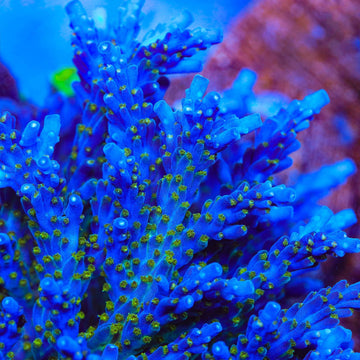
TSA Golden Temple Acropora Coral
Overview
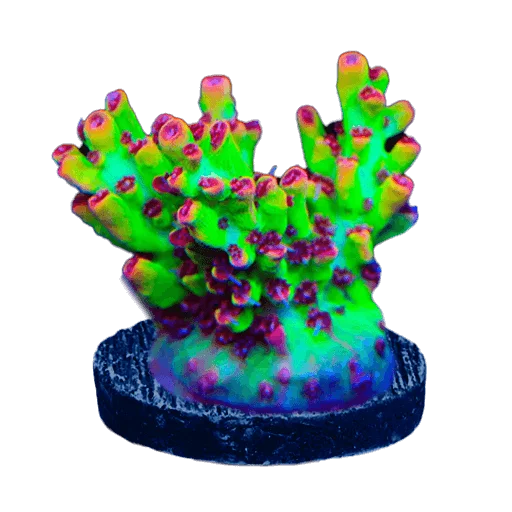
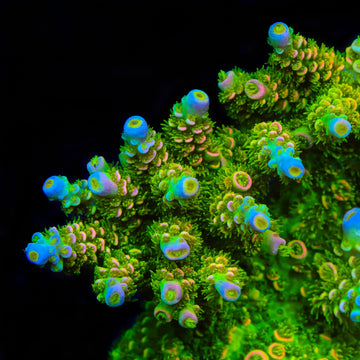
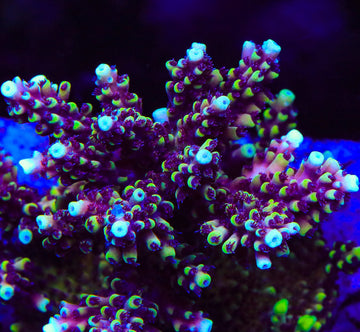
Golden Temple Acropora Coral shows branching, tabling clusters with golden to tan tips. Classified as Acropora sp., it is a small-polyp stony coral that prefers strong lighting and high, turbulent water flow. It relies mainly on symbiotic algae for energy but can take fine particulate foods; periodic feeding may support growth and coloration. Place high on stable rockwork with room for upward and outward growth, and keep distance from aggressive, stinging corals.
Quick Facts
Care
Difficult
Lighting
High
Flow
High
Placement
High
Temperament
Semi-aggressive (3–6 inches spacing)
Recommended Parameters
Temp
76–80°F
pH
8.1–8.4
Salinity
1.025–1.026
Calcium
420–450 ppm
AlkAlkalinity
7.5–9 dKH
Magnesium
1280–1350 ppm
Feeding
photosynthetic (primary), microplankton, zooplankton, rotifers, copepod nauplii, baby brine shrimp (nauplii), oyster eggs, coral-specific powdered foods, amino acid supplements
Care & Placement
FAQ
Frequently Asked Questions
About the TSA Golden Temple Acropora Coral
-
Why does my Golden Temple Acropora lose its gold and shift to green or brown?
Gold pigments are sensitive to spectrum, nutrients, and stability. Aim for PAR ~250–350 with strong blue/violet (400–460 nm), NO3 2–10 ppm, PO4 0.02–0.07 ppm, and steady alkalinity 7.5–8.5 dKH. Elevated nutrients with low PAR push it toward green/brown; sudden alkalinity swings or low iodine can wash out gold. Confirm trace balance with periodic ICP tests. -
What growth form should I expect, and how do I prevent the base from dying off?
This acro often forms corymbose to tabling colonies under high light. As the canopy expands, it can shade its base. Provide strong, cross‑current flow to the lower branches, prune or frag overhanging plates, and mount to allow light from the sides. Occasional repositioning or trimming maintains airflow and prevents slow tissue necrosis at shaded bases. -
I see burnt tips despite good color—what’s the likely cause?
Tip burn typically follows rapid alkalinity rises in high light/low nutrient systems. Verify dosing accuracy, avoid large buffer corrections, and target 0.2 dKH or less daily swing. If tips are burnt, lower light 10–20% temporarily, increase feeding slightly (or amino acids), and stabilize alk/cal/mag before ramping light back up over 1–2 weeks. -
What pests target this coral, and how do I detect them early?
Watch for Acropora‑eating flatworms (AEFW) and red bugs. Signs include crescent bite marks, pale patches, or reduced polyp extension. Inspect undersides with a flashlight, use turkey baster blasts to dislodge flatworms, and consider a white dip container to spot them. Quarantine new frags, perform sequential dips 5–7 days apart, and verify with nighttime inspections.