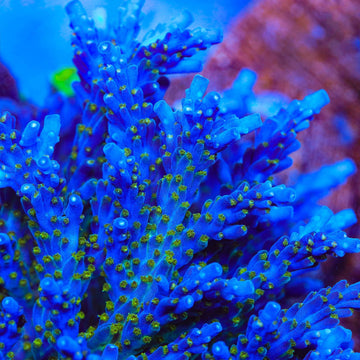
TSA Fruity Splice Acropora Coral
Overview
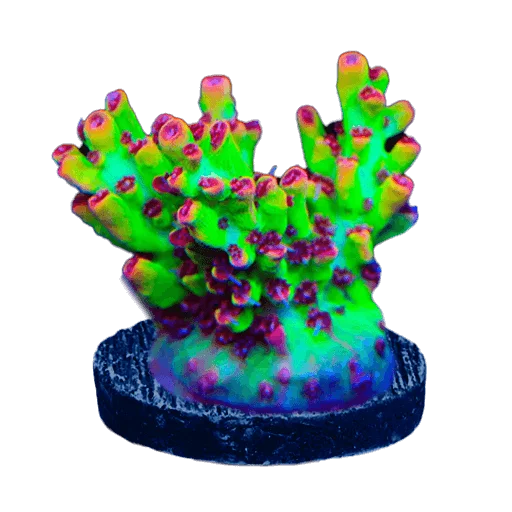
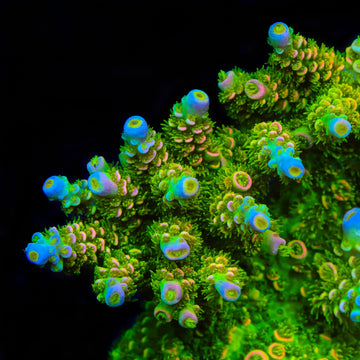
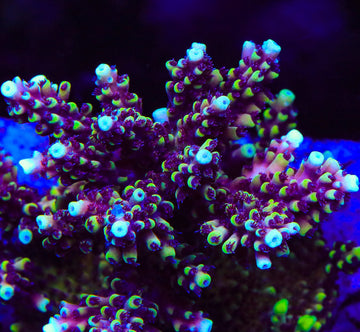
Fruity Splice Acropora Coral shows a branching, tightly spaced polyp structure with contrasting tip coloration. Known scientifically as Acropora tenuis, this is a branching stony coral that prefers strong light and brisk, random water flow. It is primarily photosynthetic via symbiotic algae, but occasional small meaty foods or planktonic feeds can support growth and color stability. Place high on stable rockwork with room for upward growth, ensure very stable alkalinity and nutrients, and keep clear of aggressive, stinging neighbors.
Quick Facts
Care
Difficult
Lighting
High
Flow
High
Placement
High
Temperament
Peaceful (2–3 inches spacing)
Recommended Parameters
Temp
76–80°F
pH
8.1–8.4
Salinity
1.025–1.026
Calcium
420–450 ppm
AlkAlkalinity
7.5–9 dKH
Magnesium
1280–1380 ppm
Feeding
photosynthetic (primary), very fine zooplankton, microplankton, rotifers, copepod nauplii, coral-specific powdered foods, amino acid supplements
Care & Placement
FAQ
Frequently Asked Questions
About the TSA Fruity Splice Acropora Coral
-
Why does my Fruity Splice Acropora Coral lose its vivid color tips after a few weeks in high light?
Acropora tenuis often adapts by thickening tissue and increasing zooxanthellae under excess PAR, muting tips. Aim for 250–350 PAR with strong blue spectrum (420–470 nm), avoid abrupt jumps, and keep nutrients detectable (NO3 5–15 ppm, PO4 0.03–0.08 ppm). Sudden alkalinity spikes or ultra-low nutrients cause paling; excess nutrients cause browning. Stabilize alkalinity 8–9 dKH and ramp lighting slowly. -
My colony shows base recession while branches look fine—what’s the likely cause?
Shading and stagnant microzones at the base are common for A. tenuis. As branches thicken, the base gets poor flow and low light, inviting STN. Increase crossflow to reach the skeleton base, prune dense areas, and consider raising the colony for underflow. Inspect for pests (AEFW, red bugs) and address parameter swings, especially alkalinity or temperature dips. -
What flow pattern brings out the best polyp extension and growth form for this species?
Short, alternating bursts that mimic surge work well. Use offset gyres or two pumps pulsing out of phase to create chaotic, high-oxygen flow without blasting the axial tips. Aim for strong movement that keeps polyps swaying with no tissue slapping. This promotes thicker radial corallites and cleaner bases, reducing detritus pockets where recession starts. -
How should I frag a Fruity Splice Acropora Coral to keep color and growth speed?
Cut just below the axial corallite at branch nodes where radial corallites are well-spaced. Avoid cutting through the axial tip itself; leave at least 1–2 cm of branch for each fragment. Mount horizontally or at a slight angle to expose multiple growth points. Maintain stable alkalinity and moderate nutrients post-frag; brief iodine dip helps reduce bacterial stress.