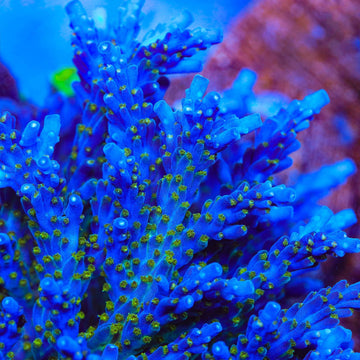
TSA Forbidden Fruit Speciosa Acropora Coral
Overview
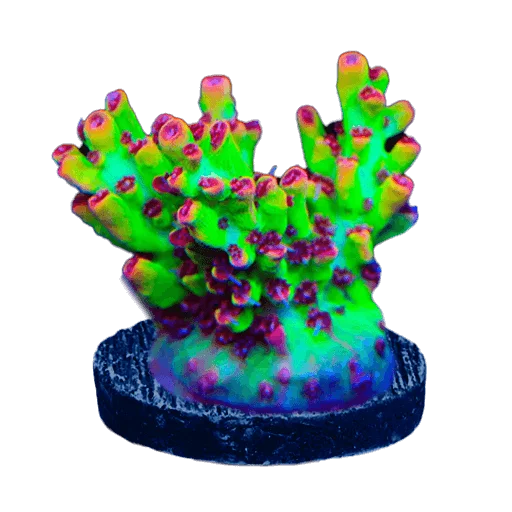
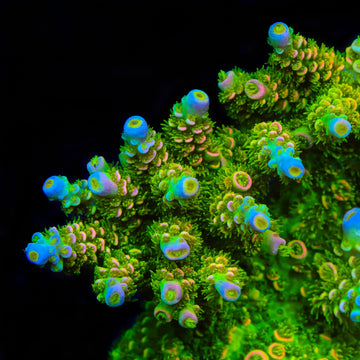
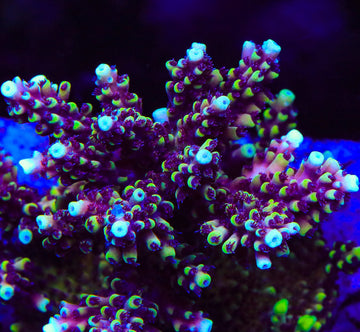
Forbidden Fruit Speciosa Acropora Coral displays table-like branching with short, evenly spaced corallites. Acropora speciosa is a small-polyp stony coral forming tabling colonies that prefers strong lighting and high, turbulent water flow. It is photosynthetic with symbiotic algae, and occasional feedings of fine plankton can support growth and maintain color. Place high on stable rock with room for outward growth, and keep distance from aggressive stinging corals.
Quick Facts
Care
Difficult
Lighting
High
Flow
High, turbulent
Placement
High
Temperament
Peaceful (3–4 inches spacing)
Recommended Parameters
Temp
76–80°F
pH
8.1–8.4
Salinity
1.025–1.026
Calcium
400–450 ppm
AlkAlkalinity
7.5–9 dKH
Magnesium
1280–1350 ppm
Feeding
photosynthetic, microplankton, rotifers, copepod nauplii, cyclops, oyster eggs, coral-specific powdered foods (e.g., Reef Roids), amino acid supplements
Care & Placement
FAQ
Frequently Asked Questions
About the TSA Forbidden Fruit Speciosa Acropora Coral
-
Why does my Forbidden Fruit Speciosa Acropora Coral lose tissue at the base even though parameters look fine?
This species shades its own base as it thickens. Give strong, turbulent flow from multiple angles to keep detritus off and oxygen high, and avoid crowding by placing it on a pedestal or isolated rock. Trim or reposition branches that cast heavy shade. Maintain moderate nutrients (NO3 2–10 ppm, PO4 0.03–0.08) to support tissue, and keep alk stable (7.5–9 dKH) to avoid burn in low-nutrient systems. -
How do I keep the intense “Forbidden Fruit” reds/greens from washing out or browning?
Acclimate to 300–450 PAR with a blue-heavy spectrum (peaks near 420–470 nm). Run moderate nutrients; ultra-low can pastel and thin tissue, high can brown it. Stable alkalinity and temperature are key. Potassium and iron support reds/greens; test before dosing. Increase random flow rather than light when color fades, and avoid big light jumps that shock pigments. -
Are there pest clues specific to Acropora speciosa I should watch for?
Look for tiny flat bite marks or sand-like eggs under shaded branch undersides (AEFW), and reduced polyp extension with yellow specks on smooth tissue (red bugs). Polyps may retract first on inner branches where flow is weakest. Inspect at night with a flashlight, turkey-baste to dislodge pests, and quarantine with targeted dips (e.g., Bayer/CoralRX, Interceptor for red bugs). Repeat dips to break egg cycles. -
Do any beneficial partners or tankmates help this coral thrive?
Hosting Acropora crabs (Trapezia spp.) can improve polyp extension and defend against small predators. Avoid angelfish and some wrasses that nip new growth. Keep aggressive LPS at distance; long sweepers can damage inner branches. Add flow rather than space alone to mitigate allelopathy, and run fresh carbon if neighboring soft corals are present. Clean, stable, high-energy conditions mirror its natural reef slope.