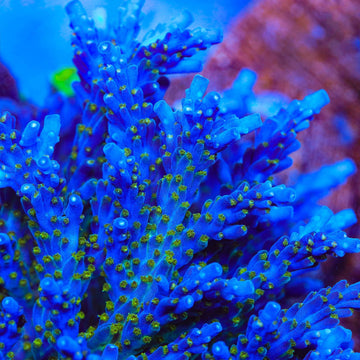
TSA Flame Tip Microclados Acropora Coral
Overview
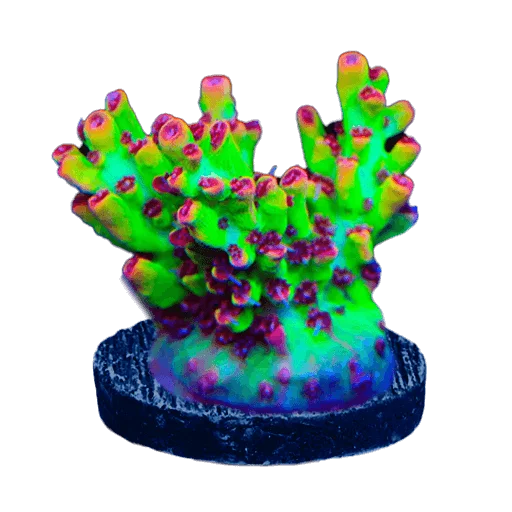
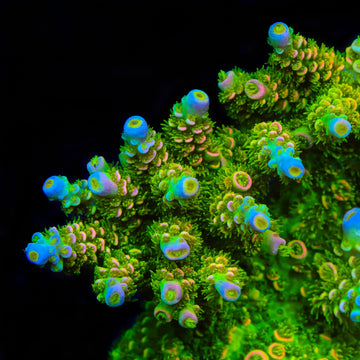
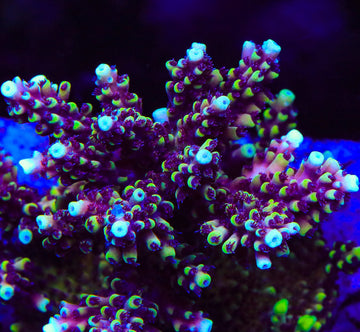
Flame Tip Microclados Acropora Coral forms tight branches with red‑orange tips and smooth, compact corallites. Acropora microclados is a small‑polyp stony branching coral that prefers strong light and high, turbulent flow. It is photosynthetic via symbiotic algae but benefits from occasional fine plankton foods, which can support faster growth and maintain color. Place high on stable rockwork with space from aggressive corals, avoiding shading and sudden parameter swings.
Quick Facts
Care
Difficult
Lighting
High
Flow
High
Placement
High
Temperament
Peaceful (3–4 inches spacing)
Recommended Parameters
Temp
77–80°F
pH
8.1–8.4
Salinity
1.025–1.026
Calcium
420–450 ppm
AlkAlkalinity
8–9 dKH
Magnesium
1280–1350 ppm
Feeding
photosynthetic, microzooplankton, rotifers, copepod nauplii, powdered coral foods (e.g., Reef-Roids), amino acid supplements, marine snow
Care & Placement
FAQ
Frequently Asked Questions
About the TSA Flame Tip Microclados Acropora Coral
-
Why do the “flame” tips fade or turn dull on my Flame Tip Microclados Acropora?
Tip color is highly sensitive to light–nutrient balance and certain traces. If PAR jumps while nitrate/phosphate are near zero, tips bleach; if nutrients climb, pigments brown. Aim for nitrate 2–10 ppm, phosphate 0.03–0.08 ppm, alk 7.8–8.4 dKH, potassium 400±20 ppm. Use blue‑heavy spectrum, ramp intensity slowly, and avoid rapid alk changes. Minor iodine/iron supplementation can help, but only with testing. -
What flow pattern keeps this coral growing without tip burn or base die‑off?
Provide strong, randomized, cross‑tank flow that surges from multiple angles. Direct jets at axial tips can cause tissue recession; too little flow at the base leads to detritus buildup and slow tissue loss. Alternate pumps to create intermittent turbulence. If the colony thickens, increase flow or reposition to maintain movement through inner branches and prevent shaded, stagnant zones. -
How can I frag A. microclados for best survival and shape?
Choose healthy, colored branches and cut 1–2 cm below the axial tip; avoid tiny micro‑frags. Dip and mount with fresh, clean cuts. For bushier growth, mount frags vertically; for tabling/plating forms, mount slightly horizontal to encourage lateral branchlets. Heal frags in moderate light/strong flow for 7–14 days, then slowly increase PAR. Keep alk stable during and after cutting to prevent tip necrosis. -
I’m seeing tiny bite marks and reduced polyp extension—what pests target this coral?
AEFW and red bugs are common offenders. AEFW leave crescent bite tracks and pale patches; inspect for eggs on the underside and use weekly dips plus a fallow period for frags. Red bugs cause muted color and poor extension; targeted treatments in a separate system are safer for inverts. Quarantine all new Acropora, dip on entry, and inspect under white light and magnification.